
Hard water shows up in ways you can feel: cloudy spots on clean glasses, stiff laundry, dull hair, and that chalky rim building around faucets and showerheads. Over time, those dissolved minerals shorten the life of water heaters, dishwashers, and washing machines. The right combination of surface cleaners and whole-house filtration tackles both the visible mess and the hidden scale, so you spend less time scrubbing and more time enjoying a home that simply feels cleaner.
The Leading Options At A Glance

Mrs. Meyer’s Rain Water Multi-Surface Spray 3-Pack

Swiffer WetJet Multi-Purpose Floor Solution, Lavender

PUREPLUS 2-Stage Whole House Filter, KDF & Coconut Carbon

PUREPLUS 2-Stage Iron and Manganese Filtration System

PUREPLUS 2-Stage Filter, Grooved Sediment & KDF

PUREPLUS 2-Stage Clear Housing Iron Filter
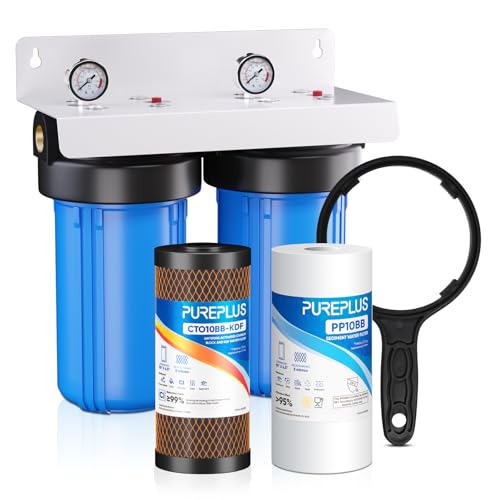
PUREPLUS 2-Stage PP Sediment & KDF Carbon Filter

PUREPLUS 2-Stage Chlorine, Iron, and Manganese Filter

PUREPLUS 2-Stage PP Sediment & KDF Carbon
The Details Behind The Selections
Hard water leaves chalky rings on countertops, faucets, and tile that no dry cloth fully removes, and that’s the everyday battle this spray is built for. Each bottle holds 16 fluid ounces of ready-to-use multi-surface solution, and the three-pack format keeps a backup ready under the sink or in the laundry room.
Compared to the Swiffer floor solution below, it stays in spray-and-wipe territory rather than mop territory. The Rain Water scent reads as a clean, lightly floral mix that lingers for an hour or so without dominating a small kitchen. It’s a no-fuss companion for daily wipe-downs in homes where mineral spots accumulate faster than you can keep up.
Everyday Wins
- Multi-surface formula handles sealed countertops, tile, walls, and finished hardwood without switching bottles
- Spray head lays down an even mist, so one pass usually lifts water-spot residue and light grime together
- Three-pack format stretches supply across the kitchen, laundry, and mudroom without restocking pressure
- Light Rain Water fragrance freshens the room mid-clean instead of smelling chemical-heavy
- Ready-to-use mix removes the guesswork of diluting concentrates in a hard-water home
Worth Noting
- Does not soften water or treat minerals at the source, so it’s a cosmetic fix for surfaces only
- Trigger sprayers can clog if stored with residue around the nozzle, so a quick rinse helps longevity
Whose Home It Belongs In
Apartments, rentals, and busy family kitchens where you wipe down counters nightly and want a pleasant scent while doing it.
Where Another Pick Suits Better
Homeowners fighting orange staining from a private well get more mileage from the PUREPLUS 2-Stage Iron and Manganese Filtration System reviewed below.
When hard water dries on sealed floors, it leaves a faint haze that mopping alone won’t lift, and a WetJet-style pre-mixed solution is the quick countermeasure. The twin-pack delivers 1.25 liters per bottle of pre-diluted formula designed for use with the WetJet mop system, with a lavender-and-freshness scent built into the mix.
Where Mrs. Meyer’s spray targets countertops and spots, this one is built for sweeping an entire kitchen or hallway floor in minutes. The fast-drying blend is meant for sealed hardwood, finished tile, and laminate, so most modern homes can use it room to room. It’s the kind of supply you keep beside the mop and reach for two or three times a week.
Strong Points
- Pre-mixed solution eliminates measuring mistakes and protects mop heads from over-saturation
- Safe across sealed hardwood, tile, and laminate in a single routine, simplifying your cleaning shelf
- Fast-drying formula cuts the window where kids or pets step onto a wet floor after mopping
- Lavender scent pairs with the Febreze-inspired freshness to mask mineral odors in older bathrooms
Practical Considerations
- Not suited for unfinished, oiled, or waxed wood floors and unsealed tile, so older homes need a different product
- Twin-pack bottles can leak if stored on their side in a utility closet, so upright storage is the safer habit
Feature Snapshot
Best Suited To
Homeowners with sealed hardwood or laminate floors who mop three or four times a week and want a quick-drying routine.
A Better Fit Elsewhere
Anyone needing actual mineral reduction should look at the PUREPLUS PP Sediment and KDF Carbon Filter below, which tackles the source.
Once you’re ready to stop scrubbing scale and start removing it at the tap, a whole-house filter changes the math. This PUREPLUS unit runs two stages: a first cartridge pairing KDF media with activated carbon to strip heavy metals and sediment, and a second coconut-shell carbon block certified against NSF/ANSI 42 for chlorine, taste, and odor.
Compared to the surface sprays above, this is plumbing-level intervention that feeds cleaner water to every shower, sink, and laundry hookup. KDF, for the unfamiliar, is a copper-zinc media that reacts with dissolved contaminants, while coconut carbon polishes flavor and smell. It mounts on the main incoming line, so installation needs a clear run of pipe and basic DIY comfort or a plumber’s visit.
Useful Strengths
- Targets heavy metals like lead and mercury alongside sediment, addressing two problems in one housing
- NSF/ANSI 42 certification on the carbon stage gives documented chlorine and odor reduction
- Whole-house placement means drinking, bathing, and laundry water all improve together
- Two-stage design is easier to maintain than multi-tank reverse osmosis rigs for most homeowners
Honest Caveats
- Cartridges require scheduled replacement every few months, so factor that into your running maintenance
- Does not soften water for true hardness reduction, so pairing with a softening plan may be needed in extreme cases
- Professional installation is wise if you’re unfamiliar with main-line plumbing shutoffs and pressure testing
Made For
Municipal water homeowners worried about heavy-metal reports and chlorine taste who want a single point-of-entry upgrade.
Skip It When
Private well owners with iron staining should consider the PUREPLUS Iron and Manganese Filtration System reviewed next instead.
Well water tells on itself quickly: rust-orange stains in toilet bowls, black specks on aerators, and a metallic tang in morning coffee. This PUREPLUS rig leads with an RFN cartridge engineered to capture iron and manganese, paired with a coconut-carbon block certified for chlorine, taste, and odor.
Set against the KDF-and-carbon model above, the front of this rig is tuned to metallic minerals rather than broader heavy-metal reduction. Manganese, in case you missed it, is the mineral behind dark-brown or black staining that chlorine alone can’t touch. The 10-inch by 4.5-inch blue housings fit standard filter mounts, and the 1-inch inlet and outlet keep flow comfortable for mid-size households.
The Case For It
- First-stage RFN media is specifically designed to address iron staining that defeats basic carbon filters
- Coconut-carbon polishing stage also handles chlorine and odor for a more rounded treatment
- Standard 10-inch housing keeps future cartridge shopping simple and broadly compatible
- 1-inch port sizing supports healthy flow rates for family-sized homes during peak morning use
Points To Note
- Pre-filter sediment loading can shorten cartridge life in very turbid well water
- Cartridge swaps need a housing wrench and a towel nearby, since some residual water always escapes
Quick Facts
Right Fit For
Households on private wells seeing orange or black staining in tubs, sinks, and laundry, plus a noticeable metallic taste.
Consider Something Else When
Municipal water users chasing chlorine and lead should reach for the PUREPLUS 2-Stage KDF and Coconut Carbon filter reviewed earlier.
Surface water and older municipal supplies can carry fine sediment that clouds a glass of water the moment it settles, and standard string-wound cartridges often let that grit pass through. PUREPLUS addresses it here with a grooved PP sediment filter layered at three densities, paired with a KDF carbon block for heavy-metal and chlorine reduction.
Where the iron-and-manganese unit above targets metallic staining, this one leans into physical filtration. The included pressure gauges let you monitor flow drop at a glance, signaling when a cartridge is reaching the end of its useful life. It’s a hands-on option for homeowners who like to see exactly what their filter is catching.
Notable Upsides
- Three-density grooved PP sediment captures particles outer-to-inner, extending cartridge life
- Pressure gauges provide a visual cue so you replace cartridges before flow suffers
- KDF carbon stage addresses heavy metals that pure sediment filters leave untouched
- 10-inch housing fits in basement utility racks with room to spare for future additions
Some Limits To Know
- Pressure gauges add small upfront complexity compared to gauge-less housings
- Sediment cartridges darken visibly over time, which can be alarming for first-time filter users
Who Should Grab It
Homeowners on lake-fed or older municipal water who want both sediment and metal coverage with visible performance feedback.
Another Choice May Suit
Well owners whose main issue is iron staining should look at the PUREPLUS Clear Housing Iron and Manganese Filter reviewed below for easier inspection.
For homeowners who prefer to see the filter doing its job, opaque blue housings hide too much. This PUREPLUS rig swaps them for clear housings on a sediment-and-carbon first stage certified by IAPMO R&T against NSF/ANSI 42, paired with the same RFN iron and manganese cartridge used in the dedicated well-water model.
Where the previous PUREPLUS picks target specific contaminants, the visible housing here is the practical standout for first-time installers. Watching a cartridge darken over weeks is genuinely useful for learning your water’s behavior, though direct sunlight exposure on clear housing can encourage algae inside if placed in a sunny utility room.
What Works In Its Favor
- Clear housings make cartridge condition visible without tools or disassembly
- First-stage carbon captures up to 99 percent of chlorine, taste, odor, and sediment per the manufacturer
- RFN second stage targets iron and manganese for broader well-water compatibility
- IAPMO R&T certification to NSF/ANSI 42 confirms material safety standards
Things To Consider
- Clear housings can grow algae in direct sunlight, so install them away from basement windows
Built With In Mind
DIY homeowners who want visual confirmation that their filter is catching sediment and learning their replacement cycle.
Reach For A Different Pick When
Anyone wanting chlorine-and-heavy-metal focus on municipal water gets stronger coverage from the PUREPLUS KDF and Coconut Carbon filter above.
City water often needs less help than well water, but chlorine taste and the odd particle of rust from old mains still show up at the tap. This PUREPLUS rig pairs a 5-micron PP sediment cartridge certified to NSF/ANSI 42 with a KDF and activated carbon block, hitting the two most common city-water complaints in one compact pair of housings.
Compared to the heavy-metal-focused KDF and coconut-carbon model above, the first stage here leans more on sediment capture and the second on chlorine reduction. For most municipal customers, that ordering actually matches the daily reality of cloudy glasses and faint chemical taste.
Useful Highlights
- 5-micron PP sediment handles rust flecks from older municipal mains effectively
- KDF and carbon block combination addresses chlorine and metallic taste in one housing
- Streamlined two-stage design keeps the maintenance schedule simple for first-time owners
- Replacement cartridges are widely available in standard 10-inch formats
Where It Is Less Suited
- Not designed for iron or manganese reduction, so well owners should look elsewhere
Feature Rundown
The Right Fit
City water households who want a simple pair of housings that knock down sediment and chlorine without extra complexity.
Look Elsewhere When
Anyone dealing with iron staining needs the PUREPLUS Iron and Manganese Filtration System reviewed earlier.
Homes that pull from a mix of sources, or households on wells where chlorine is added by a treatment system, need a rig that handles both at once. This PUREPLUS unit leads with a PP and carbon block certified for chlorine, taste, odor, and sediment reduction, and follows with a 5-micron iron-reduction cartridge.
Compared to the iron-and-manganese rig reviewed earlier, the order is reversed, putting general polishing up front and iron-specific media second. For homes with moderate iron plus a chlorine step, that sequencing keeps the iron cartridge from clogging as quickly and extends service intervals.
The Good Stuff
- First-stage carbon block claims up to 99 percent chlorine, taste, odor, and sediment reduction
- 5-micron iron-reduction second stage keeps moderate iron staining in check
- IAPMO R&T certification to NSF/ANSI 42 on the carbon cartridge confirms material safety
- Pairing the two stages broadens coverage for homes with multiple water complaints at once
A Few Limitations
- Iron cartridge life shortens in very high-iron wells, so cartridge checks should be monthly at first
- Two specialized stages mean slightly more planning around replacement schedules
Who Will Love This
Suburban homes on treated well water or mixed-source supplies who notice both tap chlorine and rust-orange staining.
Not Your Match When
Heavy-duty well owners should consider the dedicated PUREPLUS Iron and Manganese Filtration System reviewed earlier instead.
For a home that just needs the basics handled without specialized media, this PUREPLUS rig keeps things simple. It runs a 5-micron PP sediment cartridge certified to NSF/ANSI 42 followed by a KDF and activated carbon block for chlorine and metallic taste.
Side by side with the streamlined PP and KDF model reviewed earlier, the spec sheet looks close. The practical difference comes down to cartridge availability and your familiarity with the PUREPLUS naming, so choosing between the two often comes down to which replacement set is easier to find in your area.
Notable Gains
- 5-micron PP sediment captures rust and grit before they reach appliance valves
- KDF and carbon block target chlorine and metallic taste common in city water
- Two-stage design is approachable for first-time whole-house filter owners
- Standard 10-inch housings keep replacement shopping uncomplicated
Points To Keep In Mind
- Not built for iron or manganese reduction, so well owners with staining should look at specialized options
Technical Highlights
Perfect Match For
General households wanting a no-fuss whole-house setup that handles sediment and chlorine without specialized media.
Where A Sibling Pick Shines
Homes with iron and manganese issues should reach for the PUREPLUS 2-Stage Iron and Manganese Filtration System reviewed earlier in this list.
What Matters Most Before Choosing Solutions For Hard Water In Home
Know Your Water Source First
Municipal water, private well, and surface-fed systems each carry different mineral loads, so the right filter starts with a clear picture of what your home actually receives. A local water-quality report covers municipal supplies, while well owners benefit from a one-time lab test that reveals iron, manganese, and hardness levels. Surface clarity alone doesn’t tell you much, since dissolved minerals pass through invisibly.
Match The Filter Stage To The Problem
Sediment cartridges catch physical particles, carbon blocks address chlorine and odor, KDF media tackles metals, and RFN cartridges target iron and manganese specifically. Whole-house systems stack these stages in order of likely contamination, so a PP-first, carbon-second rig suits city water, while iron-heavy wells benefit from a dedicated iron-reduction stage up front.
Plan For Cartridge Replacement
Every whole-house filter on this list runs on a cartridge rotation, and missing a swap lets contaminants slip past exhausted media. Most homes do well setting a calendar reminder at six months, then adjusting based on visible cartridge condition and household water volume.
Key Considerations Across These Picks
Common Shopping Slip Ups
Treating hard water as a single problem is the most common miss, since scale, staining, and chlorine taste each respond to different media. Another slip is ignoring the main line before buying a single-tap filter, which leaves showers and laundry unprotected. Measure twice on inlet and outlet sizes too, since 1-inch and 3/4-inch plumbing don’t mix without an adapter.
Where The Extra Money Goes
Higher-tier whole-house filters earn their keep with stacked media that handles multiple contaminants in one housing run, plus certifications like NSF/ANSI 42 that confirm material safety. Pressure gauges, clear housings, and grooved sediment designs also add visible feedback, so you know the system is working without lab testing. For homes with multiple water complaints at once, that broader coverage often replaces the need for separate point-of-use filters at every tap.