

A burst pipe at 2 a.m. is the kind of home disaster you only get to learn from once. Smart water monitors exist for that exact reason: catching the slow drip behind a wall or the sudden surge from a failed supply line before drywall, flooring, and furniture pay the price. Whether you live in an older house with aging copper lines, manage a vacation rental remotely, or just want a daily read on how many gallons the family is actually using, there’s a sensor category built for you. The trick is matching the right tool to your plumbing, your connectivity setup, and your appetite for installation.
A Closer Look At The Lineup
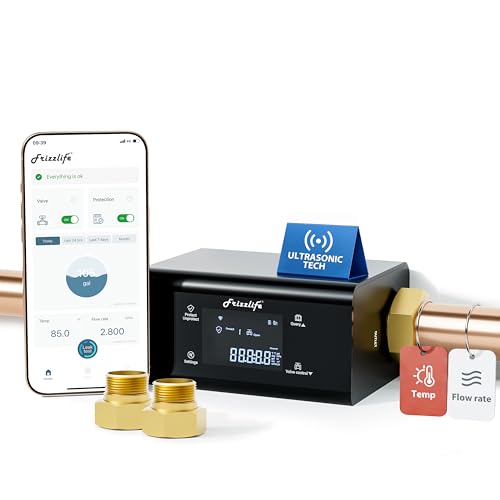
Frizzlife LP365 Smart Water Monitor with Auto Shutoff

YoLink Water Leak Sensor 3 with SpeakerHub

Bluebot Mini Smart Water Meter Bundle 3

METAK Water Leak Detector Sensor Alarm

Frizzlife LPG365-P Shutoff Valve with 3 Leak Sensors

Nestool Smart WiFi Water Tank Level Sensor

YoLink FlowSmart All-in-One Meter and Shutoff
Bluebot Mini Smart Water Meter Bundle 1
Bluebot Mini Smart Water Meter Bundle 2
Inside Each Recommended Option
The LP365 sits at the main supply line, watching every gallon that enters the house. Where most point sensors only know about water pooling under them, this one hears the flow itself, so a pinhole leak behind drywall still registers as an anomaly.
It’s the kind of install that pays for itself the first time you take a long trip and the app pushes a shut-off event to your phone. Owners in homes with 3/4″ or 1″ copper mains, the standard for most U.S. residences, will find the swap straightforward.
The Practical Payoff
- Ultrasonic sensing (sound-based, no moving parts in contact with water) reads down to 0.01 GPM, catching the slow drips that wreck subfloors over months.
- App-driven shutoff means a burst washing machine hose gets closed remotely, even from the grocery store.
- Daily and monthly usage reports turn a vague water bill into a per-fixture story.
- Certified to NSF/ANSI 61 and 372 standards for materials safety on potable water lines.
Worth Bearing In Mind
- Requires cutting into the main line, so plan on a brief plumbing visit if you’ve never sweated a fitting.
- Does not monitor pressure by default, and the variant that does costs more.
Made For
Homeowners with standard 3/4″ or 1″ copper mains who want whole-house shutoff and a meaningful daily usage log.
Look Elsewhere When
Renters without pipe access should consider the YoLink Water Leak Sensor 3 instead, since it skips plumbing work entirely.
Drop one under the sink, another behind the washing machine, a third near the water heater. That placement strategy is exactly how this kit is meant to be used, and the included SpeakerHub gives you a 105 dB siren that wakes the whole house when a probe trips.
For anyone who can’t touch the plumbing, like renters in older apartments, point sensors are the most realistic path. This bundle ships with the hub required to push notifications, so there’s no shopping list to finish before setup.
Features That Help
- Built-in 105 dB siren cuts through a finished basement without needing a separate alarm.
- Hub included means Wi-Fi bridging is handled out of the box.
- Alexa and IFTTT compatibility lets you chain leak events to lights or other routines.
Trade-Offs To Consider
- Only detects standing water, so a leak inside a wall won’t trigger anything until it surfaces.
- The SpeakerHub needs a wired Ethernet or 2.4 GHz Wi-Fi connection, which rules out dead spots.
- Battery replacement is the usual long-term upkeep with point sensors.
Best Suited To
Renters and multi-room homes where pipe access is off-limits and acoustic alarms matter more than flow analytics.
Where Another Pick Shines
Homeowners wanting whole-home shutoff and pressure readouts should look at the Frizzlife LP365 instead.
The clamp-on ultrasonic approach is the headline feature here, and it’s a real differentiator from the Frizzlife and YoLink options above. No pipe cutting, no soldering; the meter wraps around an existing 3/4″ or 1″ line and reads flow through the wall.
That makes this Bluebot bundle a natural fit for PEX, copper, PVC, or galvanized plumbing in homes where a plumber visit isn’t in the budget. The app and web dashboard track gallons used in real time, set usage budgets, and assign a dollar value to every drop.
Points In Its Favor
- Clamp-on install means no pipe modification, just a clean section of main line.
- Works across copper, PVC, PEX, and galvanized materials without reconfiguration.
- Indoor and outdoor rated, so exterior hose taps and pool feeds stay covered.
Possible Compromises
- You may find accuracy dips on heavily corroded or scaled pipe, since ultrasonic readings rely on a clean exterior.
- Limited to 3/4″ and 1″ diameters, which leaves homes with non-standard supply lines out of luck.
Built With In Mind
DIYers managing rentals, duplexes, or guesthouses who want meter-level analytics without disturbing the plumbing.
Skip It When
You need an actual shutoff valve rather than just monitoring, in which case the Frizzlife LPG365-P makes more sense.
Six probes cover more angles than most budget sensors, with four rear contacts for under-unit placement and two front drip probes for overhead or sink-edge mounting. There’s no Wi-Fi, no Bluetooth, and no app, just an audible alarm the moment any of the probes touch water.
For a basement floor, a utility closet, or a place where running a smartphone alert is overkill, that simplicity is the entire point. No gateway hub, no account, no firmware updates.
Notable Upsides
- Three separate probe zones catch slow drips, puddles, and condensation in one unit.
- Adjustable wetness threshold reduces false alarms from minor splashes.
- No network dependency means it works in concrete-walled basements where Wi-Fi is unreliable.
Areas To Watch
- Cannot connect to a phone, so you’ll only know about a leak if you’re home to hear it.
- It’s not designed for whole-home protection, more of a single-risk-area alarm.
Who Should Grab It
Anyone wanting a cheap, dedicated alarm for the sump pump corner, water heater pan, or under the kitchen sink.
Consider Something Else When
If smartphone alerts matter, the YoLink Water Leak Sensor 3 delivers the same probe-style detection plus hub connectivity.
Think of this as the LP365 plus three wireless leak sensors, with pressure monitoring layered on top. The valve handles whole-house flow anomalies, while the remotes cover the high-risk zones: laundry room, water heater closet, and kitchen sink base.
That dual-detection approach catches what each system misses alone. The shutoff sees anomalies the point sensors can’t reach, and the point sensors see pooling the shutoff can’t localize.
Strong Points
- Combines ultrasonic flow sensing with three remote point sensors for layered coverage.
- Pressure monitoring adds another data stream, useful for diagnosing municipal supply issues.
- App-driven shutoff means a tripped remote sensor can close the main automatically.
Where It May Fall Short
- The added cost only makes sense for homes with multiple risk zones, otherwise it’s overkill.
- Sensor placement strategy matters: the included three remotes won’t cover a sprawling layout.
The Right Fit
Multi-risk households with finished basements, second-floor laundry, and an aging water heater all in the same property.
Not Your Match When
Simpler setups should look at the Frizzlife LP365, which handles the main line without the bundled remotes.
This one solves a different problem than everything above. Instead of catching leaks, it tells you how much water is left in a cistern, rainwater tank, RV freshwater tank, or outdoor storage reservoir.
The non-contact ultrasonic design sits above the water line, so nothing corrodes or wears out in the tank. Through the Smart Life app, you get real-time depth readings and high or low alerts before the pump runs dry.
Where It Helps
- Non-contact measurement means no submerged probes to clean or replace.
- Smart Life app integration keeps it compatible with broad smart-home routines.
- High and low level alerts prevent overflow during storms and dry-running pumps during droughts.
Some Limits To Know
- Requires Wi-Fi coverage at the tank location, which rules out remote rural cisterns without a repeater.
- Tank shape affects accuracy; very narrow or irregular tanks may need calibration.
Whose Shelf It Belongs On
RV owners, homesteaders, and anyone managing rainwater collection or a well-fed cistern.
Reach For A Different Pick When
For indoor leak protection rather than tank levels, the Frizzlife LP365 or YoLink Water Leak Sensor 3 cover that ground more directly.
The FlowSmart pairs an ultrasonic water meter and a motorized shutoff valve into one integrated unit. It also ships with NSF certification for potable water applications, which matters for households worried about material leaching.
LoRa (Long Range, a low-power radio protocol that travels farther than Wi-Fi) gives this kit unusually broad signal range, which is useful when the shutoff lives at the curb and the rest of the system sits deep inside the house. The battery life claim of up to 10 years is the standout durability metric.
Good Reasons To Consider
- NSF certified for potable water lines, a real plus for drinking-water safety.
- LoRa long-range radio reaches outbuildings, basements, and detached garages more reliably than Wi-Fi alone.
- Control-D2D (device-to-device) rules keep critical shutoff actions working even when internet is down.
Details To Watch
- Requires the YoLink hub, which adds a separate piece to your network.
- Available in specific pipe diameters, so measure the main before ordering.
Perfect Match For
Large properties with detached workshops, long driveways, or outbuildings that need monitoring beyond Wi-Fi range.
Swap It Out When
Smaller homes without outbuildings will get more straightforward value from the Frizzlife LP365.
Bundle 1 is the entry-level version of the Bluebot Mini lineup reviewed earlier. Same clamp-on ultrasonic sensor, same app-driven flow tracking, same material compatibility across copper, PVC, PEX, and galvanized lines, but a smaller footprint in the box.
It’s the natural starting point for first-time monitor shoppers who want to see their usage data without committing to the heavier Bundle 3 setup. For a single-family home with one supply line, it’s plenty.
Key Advantages
- Lower entry cost than the larger Bluebot bundles while keeping the same core meter.
- App and web dashboard show real-time flow, historical usage, and budget thresholds.
- Quick DIY install without cutting into the existing pipe.
Less Ideal Details
- Smaller bundle may leave multi-unit properties under-monitored.
- Same ultrasonic accuracy caveats as the other Bluebot kits on heavily scaled pipe.
Right Fit For
First-time shoppers in a standard single-family home with one main supply line and no remote structures.
Where A Sibling Pick Shines
Households wanting broader coverage across multiple branches should step up to the Bluebot Bundle 2 instead.
Bundle 2 sits between Bundle 1 and Bundle 3 in the Bluebot lineup, adding a wider configuration that better fits mid-size homes. The same clamp-on ultrasonic principle applies, with the meter reading through the pipe wall rather than inside the flow.
For a household with growing water demands, think teenagers, irrigation, a guest bathroom, this tier tracks enough detail to spot which fixtures are pulling the most gallons. You may find it hits the sweet spot between starter and prosumer.
Reasons It Performs
- Mid-tier configuration covers more branches than Bundle 1 without the heavier setup of Bundle 3.
- Compatible with copper, PVC, PEX, and galvanized plumbing.
- App-driven budget tools let you set per-period targets and watch for overruns.
Factors To Consider
- Doesn’t include a shutoff valve, so detection without action is the trade-off.
- Wi-Fi range at the meter location still determines whether notifications arrive reliably.
Who Will Love This
Growing households with multiple high-use fixtures that want usage data without committing to a whole-home shutoff.
A Better Fit Elsewhere
Anyone who wants automatic shutoff when a leak trips should consider the Frizzlife LP365 instead.
Choosing The Right Smart Water Monitor For Your Home
The first decision is point sensor versus flow meter. Point sensors, like the YoLink and METAK models, sit where water pools and wait for it to arrive. Flow meters and shutoff valves, like the Frizzlife LP365, install on the main supply line and detect anomalies in real time through ultrasonic readings. Each approach misses different failure modes, which is why dual setups like the LPG365-P bundle both styles.
Pipe material and diameter matter more than most shoppers expect. Most U.S. homes run 3/4″ or 1″ copper, which fits nearly every kit on this list. Older galvanized or mixed-material plumbing narrows the field, since clamp-on ultrasonic meters handle varied materials better than in-line valves do.
Connectivity drives daily experience. Wi-Fi-based kits work fine in apartments and single-family homes with reliable routers. LoRa-equipped options like the YoLink FlowSmart reach detached structures and far corners of large properties where 2.4 GHz signals struggle. For tank owners, Smart Life app compatibility opens up broader smart-home routines.
Finally, think about whether you need active shutoff. Detection without shutoff is useful for catching slow leaks, but a burst supply line calls for a motorized valve that closes the main remotely. The price gap between these tiers is real, but so is the cost of one missed burst.
Things Worth Knowing Before You Click
Mistakes Worth Dodging
Buying a point sensor and placing it in the wrong room is the single most common regret. These devices only alert when water reaches them, so a kitchen sink leak won’t trigger a sensor tucked behind the washing machine. Lay out the high-risk zones first, then match sensor count to that map. Skipping a hub check is another quiet trap: kits like the YoLink Water Leak Sensor 3 require the included hub to push phone alerts, so confirm your router has a free Ethernet port or stable 2.4 GHz Wi-Fi before ordering.
Where The Extra Money Goes
The jump from a basic point sensor to a flow meter with shutoff covers new ground entirely. Premium picks add ultrasonic sensing capable of catching 0.01 GPM drips that no puddle detector will ever see. They also add motorized valves that close the main line automatically, which turns an alert into an action. Pressure monitoring, NSF-certified materials, and LoRa radio range each add another layer of robustness. For households with finished basements, second-floor laundry, or aging supply lines, that layering is what separates a nice-to-have from genuine protection.
Frequently Asked Questions
Do smart water monitors actually prevent damage?
They catch leaks early enough to matter. A slow drip behind a wall that’s detected today avoids the subfloor replacement that comes from discovering it six months later. Shutoff-equipped models also limit catastrophic bursts by closing the main automatically.
How are ultrasonic water monitors installed?
Clamp-on versions wrap around an existing pipe and read flow through the wall, requiring no cutting. In-line ultrasonic models and shutoff valves need to be installed directly into the supply line, which usually means a brief plumbing visit unless you’re comfortable sweating copper fittings.
Do these monitors need Wi-Fi to work?
Most do, yes. Wi-Fi drives the app notifications, usage logs, and remote shutoff commands. The METAK point sensor is the exception here, since it runs entirely offline with just an audible alarm, which makes it useful in basements and outbuildings where Wi-Fi is unreliable.
Can renters use smart water monitors?
Point sensors like the YoLink Water Leak Sensor 3 or the METAK alarm work without touching the plumbing, which makes them renter-friendly. Flow meters and shutoff valves typically require pipe access that renters don’t have, so check with your landlord before installing one.
What’s the difference between flow meters and leak detectors?
Leak detectors wait for water to arrive at a probe. Flow meters read the actual flow through the supply line and flag anomalies in real time. The second category catches problems earlier but costs more and usually requires pipe installation.
Bottom Line
A smart water monitor earns its place the moment it catches something you wouldn’t have seen for weeks. For whole-home shutoff with real-time flow analytics, the Frizzlife LP365 is the most complete pick on this list. For renters or anyone avoiding pipe work, the YoLink Water Leak Sensor 3 with SpeakerHub covers the essentials without tools. Match the tool to your plumbing access, your connectivity, and your appetite for installation, and the rest takes care of itself.
