
A dripping spigot in January is the kind of problem that sneaks up on you. By the time you notice the soggy patch near the foundation, you’ve already spent months overwatering the patio slab and quietly draining your utility budget. The fix is rarely glamorous, and the options feel interchangeable until you start matching thread types, wall thicknesses, and mounting scenarios to your actual setup.
This list pulls together nine spigots, valves, barrel taps, and extender kits that cover the most common outdoor water scenarios: replacing a tired hose bib, retrofitting a rain barrel, extending a faucet through a wall, or capping off an unused line. Each pick below pairs a real-world use case with the construction details that make it a sensible match, plus honest trade-offs so the wrong kit doesn’t end up in your cart.
How The Shortlist Stacks Up

Enoch’s Land PVC Rain Barrel Spigot Kit 3/4″

RAINPAL RBS022 Brass Rain Barrel Spigot
SIGURANTA Brass Hose Bibb Valve 3/4″

SIGURANTA 3/4″ Brass Male Hose Faucet Butterfly Handle

SIGURANTA 3/4″ Brass Hose Faucet 2-Pack Long Handle

LUOFANT Brass Rain Barrel Spigot Kit 3/4″

LEIFIDE Hose Bib Faucet Extender Kit (Black)

Hooshing 3/4″ GHT Brass End Cap Plug 4-Pack

LEIFIDE Hose Bib Faucet Extender Kit (White)
Taking A Closer Look At The Options
If you’ve never tapped a rain barrel before and want the lowest-friction entry point, this PVC kit from Enoch’s Land is the kind of thing you’d grab first. The whole package centers on a 3/4-inch GHT (Garden Hose Thread, the standard spiral thread on outdoor hoses) ball valve paired with a bulkhead fitting and a thread adapter, which means it covers the two jobs most beginners stall on: actually sealing the barrel and getting a hose to thread on cleanly.
The PVC body keeps weight and cost down, so for a single-barrel setup sitting under a downspout, it does the work without overbuilding. Where you’ll feel the trade-off is in colder climates. PVC becomes brittle below freezing, and unlike the brass-bodied options below, this one isn’t really designed to live through harsh winters exposed on a wall.
What Stands Out
- Full 3/4-inch bore keeps water flow closer to what you’d get from an open hose, useful for filling buckets fast.
- Crack- and corrosion-resistant PVC construction handles typical outdoor moisture without the rust concerns of cheap metal.
- Lead-free, non-toxic build means it’s safe for potable water use on garden produce or animal troughs.
- Comes with thread sealing tape and a straight connector, so most people won’t need a second trip to the hardware store.
Things To Consider
- PVC is more vulnerable to UV degradation than brass, so direct sun exposure may shorten its working life compared to metal-bodied options.
- Not as forgiving if you overtighten the bulkhead during install, since plastic threads can strip more easily than metal ones.
Quick Facts
Best Suited To
First-timers adding a single barrel to a downspout in a mild climate who want a low-friction kit that covers the basics.
Look Elsewhere When
You’re installing in a four-season region with freezing winters, where the RAINPAL RBS022 brass spigot will outlast PVC by years.
The RAINPAL RBS022 is the brass counterweight to the PVC kit above. The body is a chunky 4.0 oz solid brass piece, which is the spec that actually separates a spigot you’ll replace in three years from one you forget about for a decade. Where the Enoch’s Land option is friendly to first-timers, this one leans into people who want to install it once and stop thinking about it.
One thing worth knowing before you thread it on: the bulkhead nut is reverse-threaded, meaning it tightens counterclockwise, opposite from what most DIYers assume. That’s a quirk that catches people the first time, and it’s the kind of detail that shows up in owner reports when a kit is installed backwards and leaks. Take a beat, read the directions, and the rest is straightforward.
What Earns Its Place
- Solid brass construction handles freeze-thaw cycles far better than PVC, important in northern yards.
- Lead-free compliant brass keeps the water safe for gardens, pets, and animal troughs.
- Quarter-turn ball valve design lets you shut off flow quickly without a multi-handle twist.
- Manufacturer offers a free replacement gasket if the original ever fails, which extends the working life of the install.
Honest Caveats
- The reverse-threaded bulkhead nut is genuinely easy to misread on first install, so budget a few extra minutes to verify direction.
- Heavier brass body means it’s overkill for a lightweight barrel that doesn’t need that much mass on the spout.
Made For
Homeowners setting up a long-term rain barrel in a region with real winters who would rather overbuild once than replace parts every few seasons.
Skip It When
You’re putting together a quick, inexpensive rain barrel for a mild climate and don’t need the brass weight, where the Enoch’s Land kit costs less and does the job.
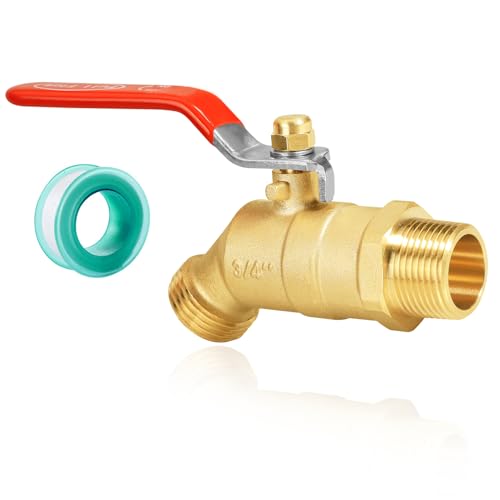
When the existing outdoor faucet is rusted frozen or the handle snapped off mid-summer, the SIGURANTA Brass Hose Bibb Valve is the kind of straightforward replacement that gets the water running again without drama. The body uses 85-3 brass (a copper-zinc alloy known for corrosion resistance) with a stainless steel handle, and the 1/4-turn operation means no more cranking a knob ten times to fill a watering can.
It’s threaded 3/4-inch NPT (National Pipe Thread, the tapered thread common on threaded metal pipe) on the inlet side and 3/4-inch GHT on the outlet, which covers most residential hose bib replacements. The trade-off is the kind that’s easy to dodge if you check first: the source notes that mismatched threads cause most returns, so confirming your pipe size before ordering is the cheapest insurance policy you’ll get.
Where It Delivers
- Quarter-turn operation speeds up everyday tasks like washing the car or rinsing muddy boots.
- Anti-rust brass alloy paired with a stainless handle holds up well to weather without seizing up after one winter.
- Includes leak-proof sealing tape in the box, so the install finishes in one stop.
- Compact 3.8-inch body length fits standard exterior wall stub-outs without forcing awkward pipe bends.
Things To Consider
- Long handle sticks out a few inches farther than a recessed bibb, so it can catch on people walking close to the wall in tight side yards.
- Not a frost-free design, meaning it won’t protect against freezing on its own; you’ll still want to winterize the line each year.
Feature Snapshot
Who It Suits Best
Homeowners replacing a worn-out exterior hose bib on a standard 3/4-inch supply line who want a brass upgrade without overthinking the install.
Consider Something Else When
You need a higher-volume valve for a long hose run or sprinkler system, where the SIGURANTA butterfly handle model offers more full-flow capacity.
The butterfly handle version of the SIGURANTA brass faucet is built around flow. The internal bore is sized for full-flow performance, which is the spec to look at when you’re running a soaker hose, filling a stock tank, or powering a sprinkler manifold that complains about pressure drops. A standard quarter-turn lever does the same job, but the butterfly handle gives you a wider grip, which matters when your hands are wet or gloved.
Like the long-handle model above, it pairs a brass body with a stainless steel handle to fight corrosion at the moving parts. Where you’ll want to think twice is clearance: the wings of the handle add a couple of inches in each direction, so on a tight side yard where someone might brush past the wall, a recessed lever can be the safer daily choice.
A Favorable Mix
- Full-flow valve design keeps pressure loss minimal across long hose runs or multi-zone manifolds.
- Brass body with stainless handle components resists the rust-and-seize cycle that wrecks cheaper outdoor faucets.
- Butterfly handle is easier to operate with gloved or wet hands during garden chores.
- Comes with sealing tape so the install wraps up without a second supply run.
Worth Noting
- Butterfly handle sticks out wider than a standard lever, so it can snag clothing or gear passing close to the wall.
- Single-pack means buying two for a matched front-and-back install costs more than the 2-pack option below.
At A Glance
Right Fit For
Yards with long hose runs, sprinkler manifolds, or stock tanks where maintaining strong flow at the spigot matters more than a low-profile handle.
A Better Fit Elsewhere
You’re working in a narrow side yard where the protruding wings could catch on passers-by; the SIGURANTA long-handle model sits flatter against the wall.
Same SIGURANTA brass body, different handle, and it ships as a pair. The long-handle lever keeps the profile flat against the wall compared to the butterfly model, which is why the 2-pack tends to land on jobs where multiple exterior walls need a matching upgrade: front yard hose bib plus a back patio line, garage spigot plus a garden shed tap.
The packaging lists two faucets plus two rolls of leak-proof tape, so the value angle is real once you’re doing more than one install. Owners commonly report that the long handle makes the faucet easier to locate and operate without looking, which is a small but real ergonomic win when the spigot is hidden behind a planter.
The Good Stuff
- Two-pack format cuts down on per-unit cost when multiple faucets need replacing at once.
- Long handle offers better leverage for stiff hands and stays closer to the wall than butterfly handles.
- Brass body and stainless components hold up to multi-season exposure without rust seizing.
- Each faucet includes its own sealing tape, simplifying two simultaneous installs.
Small Caveats
- Long handle requires a bit more clearance to swing fully open, so tight wall corners may limit handle travel.
- Buying two when you only need one slightly reduces the per-faucet value if you have a single repair job.
Perfect Match For
Homeowners tackling two outdoor spigot upgrades in one project, such as a front and back yard refresh, who want matching hardware without ordering twice.
Not Your Match When
You only need a single replacement valve today, where buying just the SIGURANTA single-pack brass bibb keeps the order simpler.
The LUOFANT brass rain barrel kit slots in alongside the RAINPAL brass spigot above as the more DIY-focused option, with a lead-free brass body that handles drinking-water and garden-water setups without second thoughts. It includes a bulkhead fitting and the standard 3/4-inch GHT male outlet, which lets you tap a barrel, a 5-gallon bucket, or any open-top container with a flat sidewall up to 1/4-inch thick.
The honest read is that this kit rewards people who measure before drilling. The spec sheet calls for a 22 mm or 7/8-inch mounting hole, and a barrel wall thicker than 1/4-inch will need a different bulkhead. Take a minute to confirm your container, and the install is a five-minute job rather than a redo.
Positive Points
- Lead-free brass construction makes it safe for potable water use on garden produce or livestock.
- Bulkhead fitting handles flat-wall containers up to 1/4-inch thick, including standard rain barrels and 55-gallon drums.
- Quarter-turn ball valve speeds up on/off control compared to older multi-turn spigots.
- Standard 3/4″ GHT outlet threads directly onto any common garden hose without an adapter.
Points To Note
- Requires a 22 mm or 7/8-inch mounting hole, so you’ll need to drill your own rather than use a pre-cut opening.
- Bulkhead fitting is limited to 1/4-inch wall thickness, which excludes thicker custom tanks.
Who Should Grab It
DIYers who want to retrofit a standard rain barrel or food-grade drum and have a drill ready to make the proper 7/8-inch mounting hole.
Swap It Out When
You’re working with a container wall thicker than 1/4-inch or you prefer a reverse-thread bulkhead design like the RAINPAL RBS022 for a different install approach.
Most spigots on this list replace or attach to existing plumbing, but the LEIFIDE extender kit solves a different problem: getting a water line through a wall where none exists. The kit includes a brass bib that mounts to a plate, plus carbon steel screws for anchoring, so it works as a through-wall irrigation adapter running from an indoor supply out to a patio, planter bed, or detached garden nook.
It ships as a 2-pack, which covers both sides of a typical wall penetration or two separate locations. Worth considering if you’re drilling through brick or stone: the included screws are designed for straightforward wood and drywall mounting, and harder substrates may need different anchors.
The Practical Payoff
- Through-wall design adds an outdoor water source in locations where running a hose from an existing spigot isn’t practical.
- Brass bib handles outdoor conditions without the rust concerns of a steel alternative.
- Mounting plate and carbon steel screws are included, simplifying the anchoring process.
- Two-pack covers both sides of the wall or two separate install sites in one purchase.
Less Ideal Details
- Included screws are best suited to wood or drywall; masonry or brick walls may need separate anchors.
- Black finish shows water spots and mineral deposits more visibly than the white version below.
Whose Shelf It Belongs On
Homeowners adding an outdoor water tap to a workshop, she-shed, or planter wall where running a hose from the main bib would be awkward or unsafe.
Reach For A Different Pick When
You need a cap or plug for an unused hose line rather than an active spigot, where the Hooshing brass end cap 4-pack is the right tool.
Not every outdoor water job needs a valve. The Hooshing 4-pack is a set of brass end caps designed to seal off a 3/4-inch GHT male thread, which is the workhorse role for winterizing spare hose runs, capping off a sprinkler branch, or replacing a lost hose end cap. The hex head shape gives you wrench grip, so you can tighten them properly without chewing up the threads.
The brass build handles temperature swings better than plastic caps and won’t strip the way cheap zinc alloy plugs sometimes do. If you’ve got one hose to cap, this is overkill; if you’re managing three or four lines or want spares in the garage drawer, the 4-pack format keeps things tidy.
Notable Gains
- Standard 3/4-inch GHT male thread fits any common garden hose fitting without an adapter.
- Brass construction resists corrosion and high temperatures better than plastic or zinc caps.
- Hex head design lets you wrench-tighten without slipping or rounding the edges.
- Four caps per pack covers multiple lines or leaves spares for future replacements.
Where It Is Less Suited
- Not a substitute for an actual valve, since you can’t control flow once a cap is in place.
- Buying four caps at once is more than necessary if you only have a single hose to seal.
Built With In Mind
Anyone winterizing a yard with multiple hose runs or sprinkler branches who wants a brass seal that won’t degrade in storage.
Consider Something Else When
You need active flow control on a hose bib, where the SIGURANTA Brass Hose Bibb Valve gives you on/off capability rather than a permanent seal.
The white-finish sibling to the LEIFIDE black extender kit above uses the same brass bib, mounting plate, and carbon steel hardware. The white finish is the practical choice when the wall color leans light: vinyl siding, painted fiber cement, stucco, or a white-painted shed. Where the black version shows water spots and minerals, the white keeps a cleaner visual line against similar-tone walls.
The 2-pack format is genuinely useful here, since through-wall installs usually involve both the indoor and outdoor sides of the penetration. Owners commonly report that the included screws handle wood framing cleanly, and the brass bib keeps its color under sun exposure better than painted or plated finishes.
The Value In It
- White finish blends with light-colored siding and trim better than the black alternative.
- Two-pack covers an indoor-outdoor pair of bibs or two separate install sites in one order.
- Brass bib withstands outdoor weather without the rust concerns of steel-bodied alternatives.
- Includes mounting plate and carbon steel screws for a complete install without extra parts.
Honest Caveats
- White finish can show dirt and pollen more readily than darker colors on a low-maintenance property.
- Carbon steel screws may need separate masonry anchors for brick or concrete wall installations.
Who Will Love This
Homeowners adding an outdoor spigot through a light-colored wall who want the hardware to disappear visually rather than contrast with the siding.
Where A Sibling Pick Shines
Your exterior is darker or you prefer a high-contrast finish, where the LEIFIDE black extender kit pairs better visually with deep-toned siding.
What To Weigh Before Choosing Outdoor Water Spigots
Start with the job, not the brand. A rain barrel tap, a hose bib replacement, a wall-penetration extender, and a hose end cap solve four different problems, and the wrong category choice costs more in rework than any price difference between models.
Thread matching is the single biggest source of returns in this category. NPT (the tapered thread on metal supply pipe) and GHT (the straight thread on garden hoses) are not interchangeable, and a 3/4-inch measurement means different things in each. Confirming your pipe size, your barrel wall thickness, and your hole diameter before ordering saves the most time and money.
Material choice tracks the climate. PVC keeps weight and cost low for mild regions but becomes brittle below freezing. Brass costs more and weighs more, but it survives freeze-thaw cycles and stays serviceable for years on an exposed exterior wall. If your winters drop well below 32°F, brass is the practical default.
Smart Shopping Notes Across These Picks
Pitfalls Shoppers Hit
The most common stumble is buying a 3/4-inch spigot without checking whether the pipe is 3/4-inch. A 1/2-inch supply line with a 3/4-inch faucet creates an awkward reducer adapter situation, and a 1-inch pipe with a 3/4-inch valve restricts flow more than necessary. Measure the existing pipe thread before clicking.
Another trap is choosing a barrel spigot without confirming the container wall thickness and the required mounting hole. Most rain barrel kits call for a 7/8-inch hole and a wall no thicker than 1/4-inch. Skip that check and you’ll be drilling twice or returning the kit.
Why Top Tier Costs More
Higher-tier brass spigots and valves carry extra cost through material weight, tighter machining tolerances, and corrosion-resistant handle hardware. The payoff shows up in service life: a brass body that handles ten freeze-thaw cycles without cracking versus a PVC body that splits after two.
For full-flow valves like the SIGURANTA butterfly handle model, the upgrade also buys you a wider internal bore that maintains pressure across long hose runs. If you’re running a sprinkler manifold or filling a stock tank, that flow preservation saves real time every time you use the spigot.
Frequently Asked Questions
What is the difference between NPT and GHT threads?
NPT (National Pipe Thread) is a tapered thread used on metal supply pipes and fittings, while GHT (Garden Hose Thread) is a straight thread standard for outdoor hoses. They are not interchangeable, and using the wrong one is the most common cause of leaks at the connection point.
Can outdoor water spigots stay installed through freezing winters?
Brass spigots tolerate freeze-thaw cycles better than PVC, but most exterior faucets are not frost-free. Winterizing by shutting off the interior supply valve and draining the line is the standard practice regardless of body material.
How do I know what size spigot to buy?
Measure the existing pipe thread diameter at the supply side, and confirm the hose-side outlet matches a standard 3/4-inch GHT garden hose if you’ll be attaching a hose. For rain barrel installs, measure the container wall thickness and the planned mounting hole diameter before ordering.
Are brass spigots worth the higher cost over PVC?
In mild climates with no freezing, PVC kits do the job at lower cost. In regions with real winters, brass avoids the brittleness and cracking that ends PVC’s working life after a season or two, making it the more economical long-term choice.
Do I need plumber’s tape for outdoor spigot installations?
Yes. Thread sealing tape (often included with the kits above) is the simplest way to prevent small leaks at threaded connections. Wrap the male threads two to three times clockwise before threading the joint together for a clean seal.
Final Take
The right outdoor spigot comes down to matching the install scenario, not chasing the heaviest or priciest valve on the shelf. Rain barrel taps, hose bib replacements, wall extenders, and end caps each have a clear best-fit pick above, and choosing by job keeps the project tight and the parts list short. Pick the scenario that matches yours, confirm the thread and wall measurements, and the rest of the decision tends to take care of itself.