

A sump pump quietly stands between your basement and a very bad day. Heavy rain, melting snow, or a rising water table can push groundwater into a sump basin faster than you’d expect, and once that basin fills, you need a motor that wakes up and gets to work. Outdoor and utility sump pumps earn their keep on jobs like draining window wells, pulling water out of a flooded garden trench, emptying a hot tub, or protecting a finished basement from a storm surge. This roundup looks at ten submersible options built for those very tasks, comparing motor size, flow rate, build materials, switch type, and the small design details that decide whether a pump is a set-and-forget tool or a recurring headache.
The Main Contenders

Wayne CDU800 1/2 HP Submersible Sump Pump (Cast Iron)

Tsurumi LB-480 Submersible Dewatering Pump 2/3 HP

Little Giant VCMA-20ULST Condensate Removal Pump

Liberty Pumps 237 1/3 HP Submersible Sump Pump

Aquastrong 1 HP Sump Pump 4500 GPH

Aquastrong 1/2 HP Submersible Utility Pump 3159 GPH
Aquastrong 1/2 HP Utility Pump with Float Switch

Aquastrong 1/2 HP Automatic Sump Pump 3159 GPH
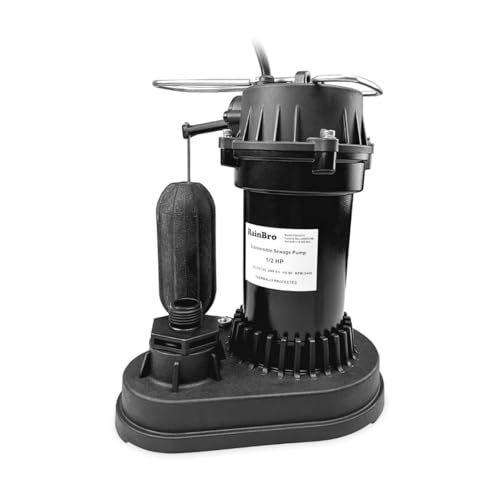
Rainbro 1/2 HP Submersible Sump Pump PSU051V

Green Expert 1/2 HP Submersible Utility Pump 2500 GPH
Wayne has built a reputation in residential sump pumps, and the CDU800 sits near the top of that line. The cast iron and stainless steel body is what you reach for when a basement sump pit cycles hard through storm season, and a 5,100 GPH rating means this motor can keep pace with serious groundwater intrusion. It is the kind of pump you install and then forget about until the next big rain.
The vertical float switch is a small detail that matters more than it looks. Vertical floats take up less room than tethered designs, which makes the CDU800 a friendlier fit in narrow basins. Top-suction flow also pulls water in from above the impeller, which tends to resist the air-lock problems that plague cheaper pumps. For most homeowners dealing with steady groundwater, this is the safe, sturdy choice.
Positive Points
- Cast iron and stainless steel construction that holds up to constant submersion and resists corrosion over years of service.
- 5,100 GPH output, which is enough headroom to handle the kind of inflow that hits during multi-day rain events.
- Vertical float switch rated for a million cycles, so automatic operation stays dependable season after season.
- Top-suction design that lowers the risk of clogging and skips the weep-hole requirement of older pumps.
- 3-year warranty that signals the brand stands behind the build quality.
Things To Consider
- Cast iron adds real weight, so pulling the pump for annual cleaning takes some effort.
- Flow is measured at zero lift, so expect noticeably less throughput once you push water up and out through a long discharge line.
At A Glance
Built With In Mind
Homeowners with a finished basement and a sump pit that runs hard during storms who want a set-it-and-forget-it cast iron workhorse.
Swap It Out When
The Liberty Pumps 237 1/3 HP Submersible Sump Pump is a quieter, lighter alternative if your basin is shallow and your inflow is modest.
Tsurumi is the brand contractors reach for when a job site is muddy and unforgiving. The LB-480 is a slimline dewatering pump built to slide into an 8-inch caisson, which is a real advantage on construction sites or older homes with tight, deep pits. With a 2/3 HP motor and a 3,780 GPH ceiling, it pushes a serious amount of water for its size.
The urethane impeller and wear plates are the parts that take the abuse. Urethane tolerates grit better than brittle plastics, which is exactly what you want when the water carries sand, mud, or small aggregate. A 32-foot cord gives installers more reach than most residential options, so you can position the pump where the work is rather than where the outlet happens to be.
What Stands Out
- Slimline body fits an 8-inch caisson, which opens up uses in deep wells and tight construction pits.
- 2/3 HP motor with 3,780 GPH output that competes with bigger pumps in real-world flow.
- Urethane impeller and wear plates that shrug off grit and last longer than plastic alternatives.
- 32-foot power cord that adds flexibility on job sites and outdoor setups.
- 2-inch discharge that moves high volume without forcing you into specialty fittings.
Worth Noting
- It is a dewatering pump rather than a residential sump unit, so it lacks an automatic float switch and must be manually controlled.
- Higher capacity and tougher materials typically mean a heavier upfront investment than entry-level options.
Whose Shelf It Belongs On
Contractors, tradespeople, and homeowners managing foundation work or deep outdoor drainage who want a pump built for grit and long runs.
Reach For A Different Pick When
The Wayne CDU800 1/2 HP Submersible Sump Pump is the smarter choice if you need automatic float-switch operation in a residential basement.
The Little Giant VCMA-20ULST plays a very different game than the rest of this list. It is a condensate pump, not a basement sump pump, designed to carry away the small but steady drip produced by high-efficiency furnaces, air conditioners, and dehumidifiers. With an 80 GPH rating, you will not be draining a pool with it, but you will never again worry about a condensation line overflowing onto a ceiling.
What makes the VCMA-20ULST clever is the safety overflow switch. If the pump fails or a line clogs, the switch trips before water spills where it does not belong. The 20-foot discharge tubing is also longer than what most condensate units ship with, which simplifies routing to a floor drain or utility sink in tight mechanical rooms.
Bright Spots
- Compact vertical footprint that slides into the small space beside a furnace or above a ceiling-mounted air handler.
- Overflow detection switch that cuts power if the reservoir overfills, protecting ceilings and floors from water damage.
- 20-foot included tubing that gives installers flexibility for routing discharge to the nearest drain.
- ABS tank and thermally protected motor designed for the slow, steady workload of condensate duty.
Honest Caveats
- An 80 GPH rating is the wrong tool for any sort of flood, sump pit, or pool-draining job.
- The plastic tank is fine for condensate but will not stand up to the grit and abuse a dewatering pump sees.
Made For
Homeowners with high-efficiency HVAC systems, whole-home dehumidifiers, or refrigeration units that need automatic condensate removal in tight mechanical spaces.
Look Elsewhere When
The Aquastrong 1/2 HP Automatic Sump Pump 3159 GPH is a far better match if you need to move large volumes of water from a basement or window well.
The Liberty Pumps 237 is the quiet workhorse option for a residential sump pit. With a 1/3 HP motor, it pulls less current than the bigger units on this list, which matters if your sump circuit is shared or older. The deep-finned aluminum motor housing sheds heat well during long cycles, and the vortex-style impeller resists clogging from the small debris that sneaks past basin covers.
Vertical magnetic float switches are a step up from mechanical contacts in many ways. The 1-1/2 inch discharge fits standard residential plumbing, and the unit handles 3/8 inch solids without choking. For a basement that occasionally sees damp but rarely faces a true flood, the 237 is the practical pick.
Useful Highlights
- Vortex impeller that resists clogging, so small debris and sediment pass through without jamming the motor.
- Vertical magnetic float switch that responds reliably without taking up much room in the basin.
- Powder-coated aluminum motor housing with deep cooling fins that extend runtime without overheating.
- 1-1/2 inch discharge that drops into standard sump plumbing with no special adapters.
- Thermally protected motor that reduces the risk of burnout during unusually long pumping cycles.
Points To Keep In Mind
- 1/3 HP is enough for typical groundwater but will struggle during a basement-level flood event.
- Aluminum is lighter than cast iron but does not dissipate heat into the water as effectively as iron.
Best Suited To
Homeowners with a small to mid-size sump pit, modest groundwater issues, and a preference for quieter, lower-amperage pumps.
A Better Fit Elsewhere
The Wayne CDU800 1/2 HP Submersible Sump Pump earns its place if your basin fills fast and you want cast iron durability.
The Aquastrong 1 HP sits at the high-output end of this list. A full horsepower motor and a 4,500 GPH rating mean this pump tackles flooded basements, full swimming pools, and other big-volume jobs that would bog down a 1/2 HP unit. The 30-foot vertical lift ceiling also gives you more freedom in choosing where to route the discharge line.
The bottom-suction design is what makes this pump useful in shallow water. It pulls water down to roughly 1/5 inch from the surface, which means you can drain a pool almost flat or clear the last puddle out of a basement corner without grabbing a mop. Owners commonly appreciate that level of thoroughness when the goal is truly dry.
Practical Advantages
- 1 HP motor with 4,500 GPH output, which clears a flooded basement or drained pool in a fraction of the time a smaller pump needs.
- 30-foot maximum lift that supports long vertical runs or uphill discharge paths.
- Bottom-suction intake that pulls water down to about 1/5 inch from the floor, leaving surfaces almost dry.
- Handles solids up to 1/5 inch without choking the impeller.
Trade Offs
- 1 HP draws more current than 1/2 HP pumps, so older 15-amp circuits may need a dedicated line.
- Higher flow comes with a louder operating note, which you may notice in attached living spaces.
Who It Suits Best
Homeowners with frequent basement flooding, deep pools, or heavy inflow who want to clear large volumes of water quickly.
Where A Sibling Pick Shines
The Aquastrong 1/2 HP Utility Pump 3159 GPH is easier on smaller circuits and lighter to move for one-off outdoor jobs.
The thermoplastic Aquastrong 1/2 HP trades the heavier cast iron of full residential sump pumps for portability, and that trade pays off for outdoor and one-off jobs. At 3,159 GPH with a 26-foot lift ceiling, it has enough muscle to drain a hot tub, garden pond, or flooded window well in minutes rather than hours. The 10-foot cord keeps it friendly to standard outdoor outlets.
Plug-in control is the defining feature. There is no float switch to tinker with, so you decide when the pump runs and when it stops. That makes this unit well suited to jobs where you are standing right there, watching the water level, and pulling the plug the moment the work is done. Thermoplastic also means the body shrugs off rust, which matters when the pump lives outside between uses.
Notable Gains
- Lightweight thermoplastic body that is easy to carry to a window well, pond, or pool deck.
- 3,159 GPH flow at 5 feet of lift, which empties a typical hot tub in a reasonable window.
- 26-foot vertical lift that handles most yard drainage runs without an intermediate booster pump.
- 10-foot power cord that reaches standard outdoor outlets without an extension.
Room For Improvement
- No automatic switch, so you must plug and unplug manually, which is awkward for unattended drainage.
- Thermoplastic tolerates abuse less gracefully than cast iron if the pump is dropped or struck.
Who Should Grab It
Homeowners who need a grab-and-go pump for spas, garden ponds, window wells, and seasonal water removal.
Skip It When
The Aquastrong 1/2 HP Utility Pump with Float Switch handles the same flow but adds automatic operation for unattended jobs.
This Aquastrong 1/2 HP adds a tethered float switch to the same 3,159 GPH motor, and that switch makes a real difference. Drop the pump into a flooded window well, set the float tether where you want it, and the pump turns itself on when water rises and off when the level drops. No babysitting required.
The tether is adjustable, which is a small detail that saves real headaches. A short tether setting means the pump shuts off earlier, leaving more water behind. A longer setting lets the pump drain a basin almost dry before shutting down. Either way, the pump is rated for outdoor use across pools, hot tubs, ponds, and garden irrigation work.
What Pays Off
- Adjustable tether float switch that gives you direct control over the on and off water levels.
- 3,159 GPH output at 5 feet of lift, which keeps drain times short for typical residential flooding.
- 26-foot vertical lift ceiling that supports longer discharge runs to a yard drain or street curb.
- 10-foot cord that reaches outdoor outlets without an extension cord, reducing trip and GFCI nuisance risks.
Smaller Caveats
- Tethered floats need vertical clearance, so this pump fits less comfortably in shallow basins than vertical-float models.
- Continuous unattended use calls for occasional cleaning to keep the float hinge free of debris.
The Right Fit
Homeowners who want automatic water removal in a low spot, garden trench, or pool cover sump without running out to plug and unplug.
Not Your Match When
The Aquastrong 1/2 HP Automatic Sump Pump 3150 GPH uses an electronic sensor instead of a tethered float for tight or debris-heavy basins.
The Aquastrong 1/2 HP Automatic replaces the familiar floating ball with an electronic water-level sensor. That sensor triggers the pump at one of six preset levels, from about 1 inch up to 5 inches, and shuts the motor off near 0.4 inch. Because there is no moving float arm, debris in the basin is less likely to jam the switch and leave the pump stuck in one position.
For tight sump basins where a tethered float would tangle or hit the side walls, the slim sensor head is a practical upgrade. The 3,159 GPH rating and 26-foot lift ceiling are identical to the tethered-float sibling, so you do not give up flow to gain the cleaner switch design. Owners with narrow basins commonly report fewer nuisance cycles and fewer stuck-float headaches after switching to a sensor-style switch.
A Few Strong Suits
- Electronic water-level sensor with six activation points that lets you dial in the on and off behavior to your basin.
- Shuts off near 0.4 inch, leaving a basin almost dry after each cycle.
- No moving float arm, so debris and small debris strands are less likely to jam operation.
- Same 3,159 GPH motor and 26-foot lift as the tethered-float model.
Worth Bearing In Mind
- Electronic sensors can be more sensitive to extreme power events, so a surge protector on the sump circuit is a smart add-on.
- Sensor probes benefit from a quick wipe-down during annual cleaning to keep readings accurate.
Best Suited To
Homeowners with narrow or debris-prone basins who want automatic operation without the bulk or snag risk of a tethered float.
Where Another Pick Suits Better
The Aquastrong 1/2 HP Utility Pump with Float Switch is the friendlier choice when you want a simple, easy-to-adjust mechanical switch.
The Rainbro PSU051V is built for depth. With a maximum immersion depth of 22 feet and a maximum head of 31 feet, this pump can push water from a deep well pit or basement sump all the way up to a yard line or storm drain. The 3,600 GPH rating keeps flow respectable even when the lift is significant.
The thermoplastic body and vertical float switch keep the pump light and compact. The 10-foot cord is shorter than some larger units, so plan your outlet placement accordingly. Rainbro positions this as a clean-water and lightly dirty-water pump, which lines up well with most residential sump pit conditions.
A Few Highlights
- 31-foot maximum head, which is high enough for basements with deep pits or uphill discharge paths.
- 22-foot maximum immersion depth for unusually deep sump or well applications.
- 3,600 GPH output that holds up better than many competitors at higher lift.
- Vertical float switch that conserves basin space.
Points To Note
- A 10-foot cord is on the shorter side, so you may need a properly rated outdoor extension for distant outlets.
- Thermoplastic tolerates abrasion less well than cast iron in rocky or gritty water.
Right Fit For
Homeowners with deep sump pits, well casings, or basement layouts that demand high vertical lift.
Where A Sibling Pick Shines
The Tsurumi LB-480 Submersible Dewatering Pump is a tougher contractor-grade alternative when grit and long runtimes dominate the workload.
The Green Expert 1/2 HP is a straightforward manual utility pump. No float, no sensor, no programming, just a plug-in switch and an oil-free PSC motor (a permanent split capacitor motor that runs cooler and more efficiently than standard shaded-pole designs). With a 2,500 GPH ceiling and thermal overload protection, it focuses on doing one job well: moving water out of a flooded spot on demand.
The included check valve and hose adapters are practical touches that save a trip to the hardware store. The “manual” framing is the point here, and it works for one-off jobs like emptying a water heater pan, draining a stock tank, or pulling the last inch of water out of a basement corner. You stay in control of when it runs and when it stops.
What Earns Its Place
- Manual plug-in control with no float switch to set, which makes startup and teardown fast.
- 2,500 GPH at zero lift and 25 GPM at a 10-foot lift, which handles most small flooding jobs in a reasonable window.
- Thermal overload protection that reduces the risk of motor damage during long unattended sessions.
- Included check valve and hose adapters that simplify hookup to standard garden or utility hoses.
Some Limits To Know
- Manual operation means you must monitor the pump and pull the plug, which is inconvenient for overnight drainage.
- 2,500 GPH is on the lower end of this list, so very large volumes take noticeably longer to clear.
Perfect Match For
Homeowners who want a simple, low-cost pump for occasional water removal in basements, pools, hot tubs, or window wells.
A Better Fit Elsewhere
The Aquastrong 1/2 HP Utility Pump 3159 GPH delivers more flow and automatic float-switch operation for a similar footprint.
## What To Weigh Before Choosing a Sump Pump ### Match the Pump to the Pit A sump pump that is too big cycles on and off constantly, which shortens motor life. A pump that is too small runs forever during a storm and may still lose the race against rising water. Measure your basin’s diameter and depth, then check the pump’s shut-off depth and flow rating at a realistic lift height. A 1/3 HP motor handles modest groundwater, while a 1/2 HP or 1 HP unit earns its keep in regions with heavy rainfall or high water tables. ### Decide Between Float, Tethered, and Sensor Switches Vertical floats save space but offer less adjustment. Tethered floats let you tune the on and off points by changing the tether length, which is great in wider basins. Electronic sensors remove moving parts from the equation, which reduces jam risk in debris-heavy water. Each style works, but the basin dimensions and water clarity usually pick the winner for you. ### Think About Build Materials Cast iron is heavy, durable, and sheds heat into the water around it. Thermoplastic is lighter, easier to carry, and will not rust, though it scuffs more easily. Stainless steel components add corrosion resistance at the wettest seals. For an outdoor or job-site pump that gets moved often, thermoplastic often wins. For a basement sump that sits in the same pit for a decade, cast iron earns the higher upfront cost. ### Plan for Installation and Maintenance A sump pump should be easy to lift out for cleaning. Look for a comfortable handle, a quick-discharge coupling, and a cord long enough to reach your outlet without strain. Annual cleaning of the intake screen and float switch is widely recommended, and a check valve on the discharge line prevents backflow that can re-trigger the pump. ## Key Considerations Across These Picks ### Where Shoppers Go Wrong The most common slip is buying on flow alone and ignoring lift. A pump rated at 5,000 GPH at zero lift may move only half that volume once you push water 10 feet up and out to a yard line. Always check the GPH at your realistic discharge height, and size your discharge pipe so it does not strangle the pump. Skipping a check valve is another frequent mistake, and it leads to short cycling that wears out switches and motors alike. ### When Paying More Pays Off Spending more usually buys better materials, longer warranties, and switches that survive a million cycles instead of a few thousand. For a basement sump that runs weekly, that upgrade pays for itself in fewer service calls. For an outdoor utility pump that runs a few times a year, a mid-priced thermoplastic unit often makes more sense than a premium cast iron model. The honest read is that the upgrade is worth it where the pump is your primary line of defense, and less critical where it is a backup or seasonal tool. ## Frequently Asked Questions ### How often should a sump pump run? In a dry season, an occasional cycle during rain is normal. Constant cycling every few minutes suggests the pump is undersized, the check valve is failing, or the float switch is stuck. Inspect the float and discharge line before replacing the unit. ### Can a sump pump run continuously? Most residential sump pumps are designed for intermittent duty. Continuous running for many hours, especially at low water levels, can overheat the motor. A thermally protected motor adds a safety margin, but a pump that never shuts off is usually telling you something is wrong with the basin or the switch. ### What size sump pump do most homes need? For typical groundwater infiltration, a 1/3 HP or 1/2 HP unit is enough. Homes with frequent heavy rain, high water tables, or finished basements often benefit from 1/2 HP to 1 HP. Measure inflow during the worst storm you remember and use that as your baseline. ### How long do submersible sump pumps last? With annual cleaning and a reasonable workload, a quality submersible sump pump lasts somewhere between 5 and 15 years. Cast iron models tend to sit at the longer end of that range, while lighter utility pumps may need replacement sooner in heavy-use settings. ### Do sump pumps need a dedicated outlet? A dedicated circuit is strongly recommended for anything 1/2 HP and above, and a GFCI outlet is required in many jurisdictions for outdoor and basement installations. Sharing a circuit with other appliances risks nuisance tripping at the worst possible moment. ## Wrap Up A sump pump is one of those products you forget about until the day you really need it. Cast iron models like the Wayne CDU800 and Liberty Pumps 237 are the long-haul choices for residential basements, while the Aquastrong and Tsurumi picks cover the outdoor and utility side of the workload. Match the motor, switch type, and build to your basin and your climate, and you will spend more time enjoying a dry basement than worrying about the next storm.



