
The right outdoor faucet quietly does its job for years, surviving winter freezes, summer sprinklers, and the occasional yank on a forgotten hose. The wrong one splits, drips, or worse, leaks contaminated water back toward your home. This roundup covers 10 outdoor faucets and accessories that solve those problems head-on, from full frost-free sillcocks that anchor a plumbing run to small backflow preventers that bring an older hose bib up to modern safety standards. Pick based on your climate, your pipe material, and how much protection you already have at the wall.
The Essentials At A Glance

GBQA Frost Free Sillcock 10 Inch with Vacuum Breaker

Enoch’s Land PVC Rain Barrel Spigot Kit 3/4″

IVIGA 4 Inch Wall Mount Faucet with Gooseneck Spout

GBQA Self-Draining Vacuum Breaker Lead-Free Brass
SIGURANTA Brass Hose Bibb Valve 3/4″ NPT x GHT

GBQA 3/4″ Brass Vacuum Breaker for Hoses, Faucets, RVs

GBQA Atmospheric Vacuum Breaker 1/2″ Female NPT Chrome

GBQA 3/4″ Brass Vacuum Breaker (2 Pack) for Hoses, RVs

GBQA Self-Draining Vacuum Breaker Chrome Plated 3/4″ GHT
GBQA Atmospheric Vacuum Breaker 3/4″ Female NPT Chrome
A Breakdown Of The Leading Choices
Anyone replacing an old hose bib that cracks every February owes themselves a frost-free sillcock, and this GBQA model is the cleanest full-install pick in the roundup. The stem extends 10 inches into the heated wall cavity, so the actual shutoff sits indoors where the pipe can’t freeze. For homeowners tired of wrapping outdoor faucets in towels each November, that single detail is the entire reason to upgrade.
The vacuum breaker is built right into the body, which removes the chore of screwing on a separate hose-bib vacuum breaker every spring. The lead-free brass body shrugs off the corrosion that eats cheap zinc alloy taps within a season. It ships in the Crimp PEX configuration shown, with three other connection variants (PEX-A expansion, MIP thread, and push-fit) available for older copper or PVC plumbing.
What Stands Out
- The 10-inch stem pushes the shutoff valve inside the warm wall cavity, so winter freeze cycles never reach the water column.
- Anti-siphon vacuum breaker is integrated, which simplifies installation and removes one common leak point.
- Lead-free brass construction resists corrosion in coastal or high-humidity environments where zinc parts pit fast.
- Four connection variants cover new builds, retrofits, and DIY repipes without forcing a soldering lesson.
Things To Consider
- Full replacement requires cutting into the wall, which is heavier work than a screw-on retrofit.
- The 10-inch stem length only fits standard 2×4 exterior walls; deeper walls need the 12-inch variant.
Key Specs
Who It Suits Best
Homeowners in climates with sub-freezing winters who want one permanent replacement that handles both freeze protection and backflow safety.
Where Another Pick Suits Better
For renters or anyone unwilling to open a wall, the GBQA Self-Draining Vacuum Breaker adds freeze resistance to an existing hose bib without surgery.
Rain barrels, stock tanks, and even repurposed trash cans all share the same problem: drilling a clean hole at the right height for a hose hookup. This Enoch’s Land kit solves that with a 3/4-inch bulkhead fitting, a matching PVC ball valve, a hose thread adapter, and a roll of sealing tape. For a first rain-harvesting setup, it’s a complete starter package rather than a pieced-together parts list.
The ball valve uses full-bore construction, meaning the opening inside matches the pipe diameter so flow stays strong. PVC is lighter and cheaper than brass, which matters when you’re hauling fifty gallons of water and don’t want metal fittings leaching into it. The kit also covers non-garden uses like aquariums and small pools, since the bulkhead threads into any flat surface.
What Works In Its Favor
- Full kit (bulkhead, valve, adapter, tape) removes the need to source matching parts separately.
- 3/4-inch GHT outlet connects to a standard garden hose without an extra reducer.
- Full-bore ball valve keeps flow strong for filling cans or running a soaker line off the barrel.
- Lead-free PVC avoids any metal taste or contact concerns for edible garden irrigation.
Minor Gripes
- PVC is fine for rain barrels but not rated for high-pressure household plumbing.
- The bulkhead requires a precise 1-1/4 inch hole, and cracking a barrel with a sloppy cut is a common mistake.
Feature Snapshot
Made For
DIYers assembling a rain catchment system who want one box of parts instead of three separate orders.
Look Elsewhere When
Anyone needing freeze protection at the wall should skip this and pick the GBQA Frost Free Sillcock, which is built for that job.
Utility rooms, RVs, and converted laundry sinks share a need that kitchen faucets fill badly: a tall, swingable spout that clears buckets. The IVIGA wall-mount design hits that target with a 3.8-inch gooseneck that swivels a full 360 degrees and dual lever handles for precise hot and cold control. Compared with the rain barrel kit reviewed earlier, this is plumbing for a finished wall, not a plastic drum.
The chrome-polished brass body feels substantial, and the 4-inch center mount fits standard two-hole rough-in valves found in most utility sinks. Anyone building out a garage workshop or mudroom sink will appreciate that the spout reaches well over a bucket rim without splashing back. The dual-handle layout, rather than a single mixing lever, lets you dial temperature without touching the flow, a small detail that matters when hands are greasy.
Useful Strengths
- 3.8-inch gooseneck spout clears tall buckets and dog-washing tubs without awkward angling.
- 360-degree swivel keeps the spout out of the way when not in use.
- Dual lever handles allow independent temperature and flow adjustment, helpful with messy hands.
- Brass construction with chrome plating holds up to hard water spotting better than all-plastic utility faucets.
Trade Offs
- Not freeze-rated, so outdoor mounting in cold climates requires winter drain-down.
- Wall-mount rough-in needs standard 4-inch center holes; retrofitting older sinks may require drilling.
At A Glance
Best Suited To
Anyone outfitting a garage, laundry room, or RV utility sink where a tall, swinging spout is more useful than a fixed kitchen faucet.
A Better Fit Elsewhere
Homeowners who need freeze protection on an actual exterior wall should grab the GBQA Frost Free Sillcock instead, which is built for outdoor exposure.
Most hose bibs already mounted to a house don’t need full replacement; they need a smarter cap. The GBQA self-draining vacuum breaker screws onto an existing 3/4-inch GHT outlet and automatically drains residual water when the faucet shuts off. That auto-drain is the whole feature, since the water that sits in a hose bib between uses is what freezes and splits the body in January.
The lead-free brass core handles the same pressure and temperature ranges as a full sillcock, and the nickel plating shrugs off road salt and sprinkler splash. For anyone with an older house whose hose bibs were installed before backflow codes tightened, this is the smallest legal upgrade. Compared to the IVIGA wall-mount faucet, this is a retrofit add-on rather than a fixture.
Features That Help
- Auto-drain design empties standing water without any manual valve to remember.
- Anti-siphon backflow prevention protects potable water from hose-borne contamination.
- Lead-free, nickel-plated brass resists corrosion from chlorinated municipal water.
- 3/4-inch GHT outlet threads directly onto standard hose bibs with no adapter.
Worth Noting
- Must be installed pointing upward for the self-drain to work; sideways mounting defeats the freeze protection.
- Adds a few inches of height to the tap, which can crowd low overhangs or window wells.
Quick Facts
Whose Shelf It Belongs On
Owners of older homes with functional but vulnerable hose bibs who want a freeze and backflow upgrade without opening the wall.
Consider Something Else When
A house under full renovation with the wall open should jump to the GBQA Frost Free Sillcock for a true freeze-proof replacement from the inside out.
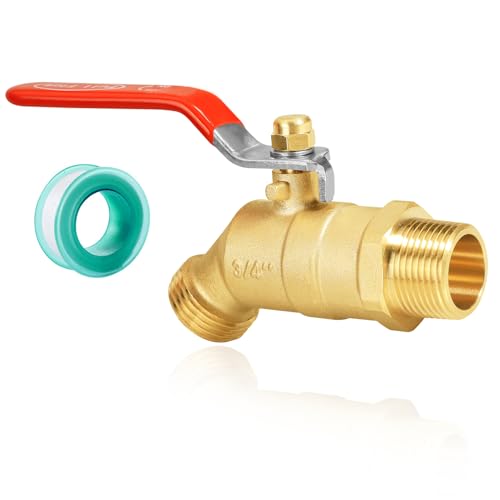
Sometimes the right answer is just a solid brass valve on the end of a stub-out pipe. The SIGURANTA hose bibb fits that role: 3/4-inch NPT male inlet on one side, 3/4-inch GHT male outlet on the other, and a quarter-turn handle in between. For a basement utility sink, a garden shed, or a small workshop wall, it’s the most straightforward outdoor tap available.
The body uses 85-3 brass, an alloy chosen for corrosion resistance, and the stainless steel handle holds up to years of wet hands. Quarter-turn operation beats the old multi-turn design when you’re rushing with a full watering can. The included leak-proof sealing tape removes the “I forgot to buy tape” trip to the hardware store that derails most weekend plumbing jobs.
What It Does Well
- Quarter-turn handle delivers full flow instantly, useful for fast bucket fills.
- 85-3 brass alloy resists dezincification, the corrosion that pits cheap brass valves over time.
- Stainless steel handle won’t rust or seize up after wet seasons outdoors.
- Sealing tape included, so the install only needs basic wrenches.
Room For Improvement
- No built-in vacuum breaker, so adding a backflow preventer requires a separate purchase.
- Not freeze-rated; exterior mounting in cold zones means winter shutoff and drain-down.
Perfect Match For
Plumbers and handy homeowners replacing a corroded outdoor tap where the existing stub-out already has the right 3/4-inch NPT thread.
Skip It When
Cold-climate installations where freeze protection matters should look at the GBQA Self-Draining Vacuum Breaker instead, which adds automatic drain-down.
Hose-end backflow preventers are a small upgrade that satisfies most plumbing codes without wall surgery. This GBQA vacuum breaker screws between any standard hose bib and garden hose, blocking the reverse flow that can siphon fertilizer, soap, or animal residue back into household pipes. For RV owners in particular, the brass body handles the vibration and temperature swings of mobile use better than plastic alternatives.
The break-off screw for permanent installation is the smart detail: once the breaker is mounted where you want it, tightening that screw severs the release tab and discourages casual removal. The brass body handles up to 180°F and 125 psi, comfortably above the working pressure of any home plumbing system.
Points In Its Favor
- Solid brass body survives drops and rough handling that cracks plastic breakers.
- 180°F and 125 psi ratings cover residential hot-water hose tasks like car washing in summer sun.
- Break-off screw option lets you commit the install so it can’t be casually removed.
- Compact size doesn’t crowd the tap when a hose is also attached.
Small Caveats
- Single pack; households with multiple hose bibs may need the two-pack variant reviewed next.
Who Should Grab It
RVers and homeowners with one outdoor tap who need a code-friendly backflow preventer that installs in seconds.
Reach For A Different Pick When
Properties with several hose bibs save money by ordering the GBQA 3/4″ Brass Vacuum Breaker two-pack, which serves the same role at multiple locations.
Lawn irrigation systems have specific code requirements that hose-end breakers don’t always meet. Atmospheric vacuum breakers (AVBs) mount directly into the irrigation supply line and break any siphon effect the moment pressure drops. This GBQA model uses a 1/2-inch female NPT thread that drops into most residential sprinkler manifolds without extra fittings.
The chrome-plated brass body resists the mineral deposits that fog up plain brass fittings after one irrigation season. It supports up to 125 psi working pressure, comfortably above the 60-80 psi most home regulators deliver. Unlike hose-end breakers, an AVB must be installed at least six inches above the highest sprinkler head, so plan placement carefully before mounting.
Useful Touches
- Chrome plating reduces mineral spotting in hard-water regions.
- 1/2-inch female NPT fits standard residential irrigation manifolds.
- 125 psi rating covers typical home water pressure with margin to spare.
- Atmospheric design is the simplest code-compliant backflow preventer for irrigation lines.
Points To Note
- Must be mounted at least six inches above the highest sprinkler head to function correctly.
- Not designed for continuous pressure, so it must sit downstream of an irrigation valve, not on a constant-pressure line.
Feature Rundown
Right Fit For
Homeowners installing or upgrading a lawn sprinkler system who need an atmospheric vacuum breaker that meets local plumbing code.
Swap It Out When
Properties with 3/4-inch supply lines should grab the larger 3/4-inch variant of the same GBQA atmospheric breaker for a cleaner fit.
Most homes have more than one outdoor tap, and buying breakers individually adds up. This two-pack of the GBQA 3/4-inch brass vacuum breaker delivers the same pressure and temperature ratings as the single version reviewed earlier, but at a per-unit cost that makes outfitting a four-tap property painless. The break-off screw for permanent mounting carries over too.
For households mixing RV hookups, garden hose stations, and a workshop spigot, the second breaker often ends up on a hose timer or hose reel where backflow prevention matters just as much. Brass over plastic is the practical call here, since plastic breakers in direct sun become brittle within two seasons.
The Helpful Details
- Two-pack pricing undercuts single-unit cost when outfitting multiple taps.
- Brass construction handles 180°F and 125 psi, matching the single-pack specs.
- Break-off permanent-mount screw included on each unit.
- Useful for hose timers and reel manifolds where contamination risk is highest.
Honest Caveats
- No variety in thread size; both units are 3/4-inch GHT, which doesn’t help taps with 1/2-inch outlets.
Who Will Love This
Homeowners with several outdoor water outlets who want to upgrade them all to code in one order.
Another Choice May Suit
Single-tap households save money by choosing the single-pack version rather than carrying the cost of an unused second breaker.
This is the chrome-finished sibling of the standard GBQA self-draining vacuum breaker, designed for visible front-of-house taps where appearance matters as much as function. The auto-drain feature still empties residual water when the tap shuts off, so freeze protection is identical to the nickel-plated version reviewed earlier. The difference is purely cosmetic, with chrome that matches modern kitchen and bath fixtures.
Lead-free brass underneath the plating keeps potable water safe, and the 3/4-inch GHT outlet threads onto any standard hose bib. For households upgrading curb appeal along with plumbing safety, mixing the chrome breaker with matching outdoor light fixtures and house numbers ties the front of the property together.
Reasons It Performs
- Chrome plating matches modern fixtures for a coordinated exterior look.
- Auto-drain mechanism prevents freezing without manual winter prep.
- Lead-free brass core keeps water safe for garden and pet use.
- Anti-siphon protection satisfies most residential plumbing codes.
Things To Weigh
- Chrome finish shows water spots more than brushed nickel in hard-water regions.
Made For
Homeowners who want the freeze and backflow protection of the standard self-draining breaker, but prefer a chrome finish for visible front-yard installations.
Consider Something Else When
Taps hidden behind bushes or on side yards where nobody sees them are better served by the more economical nickel-plated GBQA self-draining breaker.
The 3/4-inch version of the GBQA atmospheric vacuum breaker rounds out the irrigation options in this roundup. Where the 1/2-inch model suits small residential manifolds, this larger thread handles higher-flow sprinkler zones and properties feeding from 3/4-inch supply lines. The chrome-plated brass body and 125 psi rating match the smaller sibling exactly.
For homeowners with mixed plumbing, the chrome finish on both AVBs lets you keep a consistent look across the irrigation manifold even when line sizes differ. Like any AVB, the breaker must be mounted above the highest sprinkler head and downstream of an irrigation valve to function within code.
A Favorable Mix
- 3/4-inch female NPT fits larger residential irrigation supply lines.
- Chrome plating resists mineral spotting and matches the 1/2-inch variant.
- 125 psi working pressure handles elevated municipal supply without strain.
- Atmospheric design is the simplest code-compliant irrigation backflow option.
Practical Considerations
- Cannot be installed on constant-pressure lines; must sit downstream of a valve.
- Requires the same six-inch clearance above the highest sprinkler head as the smaller AVB.
Built With In Mind
Properties with 3/4-inch irrigation supply lines that need atmospheric backflow protection at the correct line size.
Where Another Pick Suits Better
Manifolds already fitted with 1/2-inch threads should pick the smaller GBQA Atmospheric Vacuum Breaker for a direct fit without adapters.
Matching Outdoor Faucets To Your Plumbing Reality
Cold-climate living changes everything about outdoor faucet choice. A standard hose bib is a winter casualty waiting to happen, and once the body splits, the repair involves opening a wall at the worst possible time. Frost-free sillcocks solve the problem at the source by relocating the shutoff inside the heated envelope. For households that can’t or won’t open the wall, self-draining vacuum breakers add automatic protection to an existing tap with a single screw-on install.
Backflow prevention is a quieter concern but no less important. Municipal codes increasingly require anti-siphon protection on any outdoor tap, and the small brass vacuum breakers in this roundup satisfy that requirement for a few dollars. Irrigation systems have stricter rules, which is why atmospheric vacuum breakers exist as a separate product category with specific mounting requirements.
Pipe material drives connection choice more than any other factor. Crimp PEX has become the new standard in residential plumbing, but homes built before 2000 may have copper, CPVC, or threaded galvanized stubs. The frost-free sillcock covered first comes in four connection variants for exactly this reason, and the SIGURANTA hose bibb uses standard NPT threads for older stub-outs.
Material matters for longevity more than for looks. Lead-free brass is the modern default, and zinc-alloy faucets save money upfront but corrode within a few seasons in coastal or hard-water regions. PVC makes sense only for rain barrels and cold storage, never for pressurized household lines.
Spotting The Gaps Before You Order
Mistakes Worth Dodging
The single most common error is buying the wrong connection type. A frost-free sillcock ordered in PEX when the house has copper ends with a useless part on the doorstep, and returns eat time for everyone. Measure the existing supply line at the wall and confirm the fitting type before placing an order, since NPT, MIP, PEX crimp, and PEX-A expansion are all different beasts.
Ignoring mounting height rules is the second trap, especially with atmospheric vacuum breakers on irrigation lines. Code requires these breakers to sit at least six inches above the highest sprinkler head, and mounting them lower renders the protection useless. Walk the irrigation layout with a tape measure before drilling.
Why Top Tier Costs More
Premium outdoor faucets justify their higher cost through material and engineering choices. Lead-free brass with thicker walls resists dezincification, the slow corrosion that turns cheap brass into porous pink powder. Frost-free designs add a long stem and precision-machined internal valve seat, both of which cost more to manufacture than a simple through-wall pipe.
Spending up makes the most sense for cold-climate full replacements where opening a wall costs real money. A premium frost-free sillcock that lasts twenty years is cheaper than a budget model that splits every five winters, once you add drywall patching. For hose-end breakers and irrigation accessories, the price gap between budget and premium is small enough that the upgrade almost always pays for itself.
Frequently Asked Questions
What is a frost-free outdoor faucet?
A frost-free outdoor faucet, also called a sillcock, has a long stem that extends inside the heated wall so the actual shutoff valve sits in the warm interior. The outside spout drains when the valve closes, preventing the trapped water from freezing.
Do I need a vacuum breaker on my outdoor faucet?
Most local plumbing codes now require anti-siphon protection on any outdoor tap connected to a hose. A vacuum breaker prevents hose water from siphoning back into household pipes, which can carry fertilizer, soap, or animal residue into your drinking supply.
Can outdoor faucets freeze in winter?
Standard hose bibs freeze whenever temperatures drop below freezing for extended periods, since water sits in the pipe up to the indoor valve. Frost-free sillcocks and self-draining vacuum breakers solve this by emptying the pipe between uses.
What is the difference between PEX and NPT connections?
PEX (cross-linked polyethylene) is a flexible plastic tubing used in modern plumbing, joined with crimp rings or expansion sleeves. NPT (national pipe thread) is a tapered metal thread used on copper, brass, and galvanized steel pipes. The two are not interchangeable without adapters.
How long do outdoor faucets last?
Lead-free brass outdoor faucets typically last fifteen to twenty-five years with normal use, longer when winterized properly. Plastic and zinc-alloy models often fail within five to ten years, especially in coastal or hard-water environments.
Closing Thoughts
Outdoor faucets sit at the intersection of plumbing code, climate, and convenience, and the right pick depends heavily on where you live and what already sits in the wall. Cold-climate homeowners get the most value from a full frost-free sillcock replacement, while everyone else can usually solve their problems with a quality vacuum breaker screwed onto an existing tap. Match the connection type, respect the mounting requirements, and your outdoor water setup will quietly do its job through every season.