

Crawl-space plumbing, attic lines, and exterior hose bibs all face the same quiet enemy: temperature swings that turn a perfectly good PEX run into a burst pipe at 3 a.m. The right insulation stops that, and it does more than you’d think, softening water-line noise, trimming standby heat loss, and keeping cold lines from sweating through drywall. This list rounds up ten solid pipe-insulation options ranging from heavy-duty rubber to budget foam tubes, with notes on fit, R-value (a measure of how well a material resists heat flow, where higher numbers mean better insulation), and real-world installation behavior.
The Leading Options At A Glance

BriskHeat Insul-Lock DS Closed Cell Pipe Insulation 2-7/8 in

M-D Building Products 50220 Foam Tube Pipe Insulation 6 ft

Amylove 12-Piece Pipe Insulation Foam Tube 1 ft
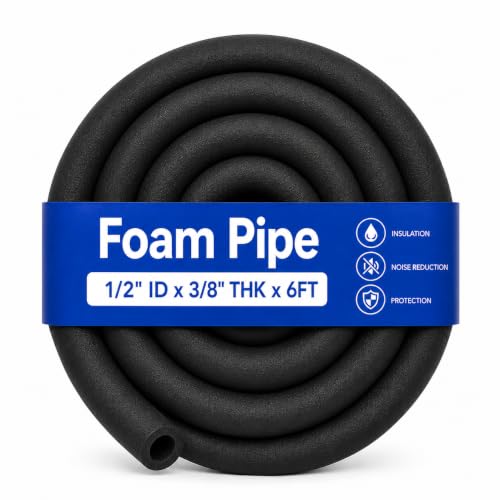
CARGEN 1/2″ ID Foam Pipe Insulation for PEX

Rebower Foam Pipe Insulation Tubing 28mm ID 3.3 ft

Frost King Fiberglass Pipe Wrap Kit 25 ft

Duda Solar Nitrile Rubber Pipe Insulation R1.95 6 ft
Rebower 5/8″ ID Foam Pipe Insulation 6 ft

Worldity 4-Pack 2 Inch Pipe Insulation 20mm Thick

Tsurpcao 5/8″ Foam Pipe Insulation Tube 6 ft
Inside Each Recommended Option
BriskHeat’s Insul-Lock DS targets the headache every installer knows: insulation that pops open halfway through the job. The flexible elastomeric (a rubber-like foam that stretches and seals cleanly) body is pre-slit and finished with a locking adhesive flap that closes along the seam, while a second inner seal adds redundancy along the pipe face.
At 2-7/8 inches nominal ID, this sleeve fits larger supply lines, so homes with 1-1/2-inch or 2-inch PEX runs benefit most. The closed-cell structure resists moisture absorption, which matters in damp crawl spaces where open-cell foam soaks up condensation. Installation is straightforward: wrap, peel, press, done.
Real Benefits
- Double-seal adhesive closure stays shut through seasonal expansion and contraction
- CFC-free elastomeric foam is gentler on indoor air quality during installation
- Closed-cell build blocks moisture migration, helping prevent mold at pipe penetrations
- Generous ID covers 1-1/2 to 2-inch PEX without forcing compression
Things To Consider
- Oversized for 1/2 or 3/4-inch residential lines, so you may end up trimming or reordering
- Premium elastomeric carries a noticeably higher cost than basic polyethylene sleeves
Key Specs
Built With In Mind
Plumbers and serious DIYers insulating larger PEX mains in basements or mechanical rooms.
Look Elsewhere When
Your run is standard 1/2-inch PEX, where the M-D Building Products foam tube covers the job at a friendlier cost.
For most homeowners, M-D’s 50220 foam tube is the workhorse of the category. The pre-slit polyethylene shell (a closed-cell foam that resists water absorption) opens along its length, wraps around 3/4-inch copper or 1/2-inch PVC and iron pipe, and seals with a self-adhesive strip running the full seam.
The 1/2-inch wall delivers a solid R-value of roughly 3.0, enough to slow condensation on cold-water lines and trim standby heat loss from hot runs. Scissors cut it cleanly, so trimming around fittings takes seconds rather than minutes.
Practical Pluses
- Self-adhesive seam holds through normal seasonal pipe movement
- Scissors-friendly cuts speed up fitting work
- Black color blends into crawl spaces and utility chases
- R-value near 3.0 handles most residential condensation and heat-retention needs
Trade Offs
- Not UV-stable for direct sun exposure without additional jacketing
- Wall thickness of 1/2-inch adds noticeable bulk in tight joist bays
Whose Shelf It Belongs On
First-time DIYers wrapping accessible PEX in basements, garages, or utility rooms.
Swap It Out When
You’re insulating exterior lines exposed to sunlight, where Duda Solar’s nitrile rubber handles UV and moisture better.
Amylove’s twelve-pack shows up aimed at small, scattered jobs. Each 1-foot foam tube is pre-slit for snap-on installation, so you can knock out a single troublesome elbow or short exposed run without unrolling a six-foot sleeve and wasting material.
The foam is described as waterproof, shock-absorbing, and useful for everything from PEX protection to crafts. For homeowners, that flexibility is the selling point. You can insulate the line under the kitchen sink and keep leftover tubes for the next repair.
What It Does Well
- Short individual pieces reduce waste on patch repairs
- Pre-slit design means no scoring or cutting tools required
- Waterproof shell limits wicking along the seam
- Twelve-pack covers multiple small gaps without a second order
Points To Note
- No listed R-value or temperature rating, so cold-climate runs should use a thicker sleeve
- Lightweight foam may compress under tight strapping
Right Fit For
Apartment dwellers and renters patching exposed PEX under sinks and behind washing machines.
A Better Fit Elsewhere
Whole-home retrofits are better served by the longer M-D Building Products foam tube.
CARGEN’s tube is purpose-built for 1/2-inch PEX and copper, so there’s no trimming or forcing a sleeve that wants to be somewhere else. The body is nitrile rubber (a dense, petroleum-based foam that holds its shape and tolerates heat better than polyethylene) with a Class B flame rating (a building-material classification meaning the foam resists flame spread within defined limits).
That combination matters in mechanical rooms where heat from a boiler or water heater runs near the PEX. The dense foam grips the pipe and stays put, and the same density gives the tube a useful life in damp spaces where lighter foam eventually breaks down.
What Earns Its Place
- 1/2-inch ID fits common residential PEX without compression
- Class B flame rating suits near-boiler installations
- High-elasticity nitrile handles expansion without cracking
- Dense foam body grips pipe and resists slipping
Honest Caveats
- Tighter fit on the pipe means less forgiveness around valves and fittings
- Specialty sizing means it won’t double as insulation for larger supply lines
Key Specs
Best Suited To
Mechanical-room installs where PEX runs past heat sources and needs stable thermal protection.
Skip It When
You need flexibility across mixed pipe sizes, where Rebower’s foam tube offers more forgiving geometry.
Rebower’s green foam tube pulls double duty: pipe insulation by day, handle grip by night. The 28mm ID with a 5mm wall wraps standard copper or PEX runs, and the soft foam stays comfortable in the hand for tool and fitness-equipment grips.
The foam is soft, pliable, and easy to cut, which helps in tight retrofit spaces where rigid tubes won’t bend around framing. For DIYers who like a single material solving multiple shop problems, that versatility is the honest appeal.
Bright Spots
- Soft foam bends around tight elbows without cracking
- Dual-purpose build covers plumbing and handle-grip projects
- Lightweight material ships and stores easily
- 5mm wall adds insulation without major bulk
Things To Weigh
- No published R-value, so deep-winter runs need verification
- Soft foam may compress under heavy clamping
Who Should Grab It
Hobbyists who want one foam tube to cover workshop handles and a few short plumbing repairs.
Reach For A Different Pick When
Cold-climate installs demand the higher R-value of Frost King’s fiberglass wrap kit.
Frost King’s fiberglass wrap kit takes a different approach. Instead of pre-formed tubes, you get a 25-foot roll of 3-inch-wide fiberglass insulation and a separate plastic vapor barrier that wraps over the top.
This matters in cold-climate homes where PEX runs through unheated attics or exterior walls. The R-1.6 value per wrap layer adds up when you double-wrap, and the included vapor barrier stops moisture from reaching cold pipes and condensing into droplets that wet the insulation and framing.
The Practical Payoff
- Roll format fits any pipe diameter from small PEX to larger supply lines
- Fiberglass delivers higher sustained R-value than foam in extreme cold
- Included vapor barrier prevents condensation wicking into surrounding framing
- Works as an overwrap for electric heat cables on problem runs
Less-Strong Areas
- Fiberglass requires gloves and long sleeves during installation
- Multi-step wrap is slower than snap-on foam tubes
Key Specs
Made For
Cold-climate homeowners wrapping exposed PEX in attics, garages, or exterior walls.
Consider Something Else When
You want a clean, snap-on look inside finished spaces, where CARGEN’s foam tube installs in minutes.
Duda Solar’s nitrile rubber tube targets the harshest pipe runs: solar thermal loops and high-temperature domestic water lines. The closed-cell nitrile resists moisture penetration, and the 13mm wall thickness delivers a usable R-1.95 rating.
The material handles temperatures that would degrade polyethylene foam, so it stays stable next to solar collectors and recirculation pumps. One honest caveat: the manufacturer recommends pairing it with aluminum jacketing if the line sees direct sunlight, since UV breaks down nitrile over time.
What Works In Its Favor
- High-temp nitrile handles solar and recirculation loops
- Water-resistant build suits outdoor and damp locations
- R-1.95 rating offers meaningful thermal resistance
- Stable closed-cell structure resists compression over time
Where It Is Less Suited
- Requires aluminum wrap for direct UV exposure
- Heavier material can sag on long horizontal runs without strapping
Key Specs
Who Will Love This
Solar homeowners and pros insulating high-temperature water or glycol loops.
Where A Sibling Pick Shines
Standard indoor residential PEX is faster to wrap with the M-D Building Products foam tube.

The thinner Rebower tube fits where bulkier sleeves can’t. A 5/8-inch ID with only 3/16-inch of foam wall keeps the wrapped pipe close to its original diameter, useful behind baseboards, inside vanity cabinets, or through drilled studs where space is already tight.
The foam behaves much like the green Rebower sibling reviewed earlier, soft, pliable, and easy to cut. For aesthetic-sensitive spots where you don’t want the insulation to telegraph through trim, the slim profile pays off.
Noteworthy Benefits
- Thin 3/16-inch wall preserves clearance in tight framing
- Soft foam conforms to slight pipe bends
- 5/8-inch ID fits 1/2-inch PEX with light compression
- Black color hides inside cabinet interiors
Practical Considerations
- Thinner wall means lower thermal performance per inch
- No published R-value to verify against extreme cold
Perfect Match For
Finish-conscious retrofits where insulation has to disappear into cabinet backs or baseboard gaps.
Another Choice May Suit
Exterior walls in cold climates benefit from the heavier R-value of Frost King’s fiberglass wrap kit.
Worldity’s four-pack steps up to 2-inch pipe with a heavy 20mm wall, putting it in the conversation for AC refrigerant lines and large-diameter copper or PEX risers. Each segment is roughly 40 cm, so a single pack handles several short repairs or one solid run.
The thick wall is the headline. It noticeably reduces surface temperature on hot lines, slows condensation drip on cold lines, and damps pipe-borne noise, a quiet bonus behind bedroom walls.
Practical Advantages
- 20mm wall delivers strong thermal and acoustic performance
- Four short segments simplify transport and trim cuts
- Designed for 2-inch copper, AC line, and large PEX
- Dense foam holds shape around elbows without kinking
Small Caveats
- Heavy wall adds visible bulk to exposed pipe runs
- Short segments require multiple pieces for longer installations
Key Specs
Who It Suits Best
HVAC techs and homeowners insulating mini-split line sets and 2-inch copper risers.
Not Your Match When
Standard 1/2-inch PEX won’t fill this sleeve; Amylove’s smaller foam tubes fit those lines better.
Tsurpcao rounds out the list with a soft, reusable rubber-sponge tube that bends without complaint around tight PEX geometry. The 5/8-inch ID hugs standard residential lines, and the foam stretches enough to slip on and stay put without adhesive.
One understated detail: this tube works on guitar stands and appliance handles too, so leftover scraps don’t end up in the trash. For mixed-use shops, that flexibility alone justifies keeping a length on hand.
Key Advantages
- Reusable rubber-sponge foam installs without adhesive
- High elasticity stretches around fittings without tearing
- Suitable for both indoor and outdoor plumbing
- Aging-resistant material holds up across multiple seasons
Potential Drawbacks
- No published R-value for confident cold-climate claims
- Soft foam may compress under heavy clamp pressure
Made For
DIYers and repair-minded homeowners who want a flexible, reusable sleeve for scattered PEX repairs.
Where Another Pick Suits Better
Whole-home installations are faster with the self-adhesive M-D Building Products foam tube.
What To Weigh Before Choosing Pipe Insulation
Start with pipe diameter. PEX comes in 1/2, 3/4, 1, and larger sizes, and insulation ID should match the outer diameter of the pipe, not the nominal name. A sleeve that’s too tight compresses the foam and drops R-value; a sleeve that’s too loose sags and exposes gaps.
Next, think about environment. Indoor conditioned spaces need basic polyethylene foam, while attics, exterior walls, and unheated crawl spaces benefit from closed-cell nitrile rubber or fiberglass with a vapor barrier. Cold-climate runs should target higher R-values, ideally above 2.0, and pair the insulation with a continuous vapor barrier to stop condensation from wicking into surrounding framing.
Matching Material To Climate And Use
Closed-cell foam resists moisture penetration and stays stable through temperature swings, making it the right choice for most residential PEX runs. Open-cell foam soaks up condensation and loses performance when wet. Fiberglass delivers the highest sustained R-value but requires gloves, careful wrapping, and a separate vapor barrier to perform correctly.
Installation Realities Worth Knowing
Pre-slit tubes with adhesive flaps install in minutes and look tidy inside finished spaces. Roll-format wraps take longer but adapt to any pipe diameter and odd routing. UV-exposed lines need either a protective jacket or an inherently UV-stable material, since most foam breaks down under direct sunlight.
Choosing Between Specialty And General Picks
Specialty items like Worldity’s 2-inch insulation or Rebower’s handle-grip foam solve narrow problems well, but most homeowners only need a general-purpose foam tube from a recognizable brand. Pay extra for the specialty build when the pipe configuration actually demands it.
Key Considerations Across These Picks
Pitfalls Shoppers Hit
The most common mistake is buying insulation sized to the pipe’s nominal name rather than its actual outer diameter. A “1/2-inch” PEX line measures roughly 5/8 inch across, so a too-snug fit compresses the foam and reduces thermal performance. The second slip is skipping the vapor barrier on cold-climate runs, which lets moisture condense inside the insulation and quietly soak the surrounding framing over several winters.
Where The Extra Money Goes
Premium picks like the BriskHeat Insul-Lock DS and Duda Solar nitrile tube charge more for material density and seal integrity. The denser foam holds R-value longer under compression, and the better adhesive closure survives seasonal pipe movement without peeling open. That upgrade makes sense on long exposed runs and high-temperature lines where cheap foam would degrade within a few seasons. For sheltered, easy-access PEX, the budget polyethylene picks do the same job at a fraction of the cost.
Frequently Asked Questions
What R-value do I need for PEX pipe insulation?
For most residential PEX runs in conditioned spaces, an R-value between 1.5 and 3.0 is enough to control condensation and reduce standby heat loss. Cold-climate homes with PEX in unheated areas should aim higher, ideally above 3.0, or layer fiberglass over a foam base.
Can I use the same insulation for hot and cold water lines?
Yes, closed-cell foam and nitrile rubber work for both directions. Hot lines benefit from the same insulation that protects cold lines from condensation, so a single material covers mixed plumbing runs.
Should pipe insulation be slit or solid?
Pre-slit tubes with adhesive flaps install faster and seal cleaner on retrofit work, where you can’t slide insulation over a pipe end. Solid tubes perform slightly better thermally but require access to a pipe end, which is rarely an option in finished homes.
How do I handle PEX insulation around fittings?
Most foam tubes can be cut and notched with a utility knife to wrap around elbows and tees. Larger fittings may need short additional segments sealed with foil tape. Fiberglass wrap kits include the vapor barrier needed to maintain a continuous seal.
Does pipe insulation need a vapor barrier?
In cold climates or on cold-water lines, yes. A vapor barrier stops humid indoor air from reaching cold pipe surfaces, condensing, and wetting the insulation from inside. Without it, even high R-value insulation eventually loses performance as moisture accumulates.
Wrap Up
The right insulation depends on where your PEX runs, what climate you live in, and how tidy you want the finished install to look. Foam tubes handle the majority of residential jobs well, and a step up to nitrile rubber or fiberglass pays off when temperatures drop or pipes sit exposed to the sun. Match the ID to your pipe, choose a material that fits the environment, and don’t skip the vapor barrier on cold lines. That combination will carry most homes through the next few winters without drama.




