

You shouldn’t have to wonder what’s flowing from your tap or well. Home water testing kits turn suspicion into a number you can act on, whether you run a private well, manage a small lab, keep a pool balanced, or simply want to know if your plumbing is leaching metals. The right kit depends on what you actually need to detect. Some target bacteria in well water, others measure chlorine in a pool, and a few handle hard-water minerals that leave scale on your kettle. The list below mixes commercial-grade tools with consumer-friendly options so you can pick one that matches your situation, not just your budget.
The Picks In Brief

Zurn RK14-860XL Wilkins 0.25″ Test Cocks, 4-Pack

LUVCOSY 4-Bottle Coliform Bacteria Water Test Kit

Taylor R0870-I DPD Powder Refill, 10g (2-Pack)

Hach Total Hardness Test Kit Model 5-B

Hach DR300 Pocket Colorimeter, Chlorine LR/HR
Hach Total Hardness Test Kit Model 5-EP

empowerDX Pro Drinking Water Lab Test Kit

Taylor R-0005-C Acid Demand Reagent, 2 oz

LaMotte 3002 Chlorine Dioxide Test Strips, 0-500 ppm
Meet The Standout Selections
This four-pack of quarter-inch test cocks sits in a different lane than every other pick on this list. Where the LUVCOSY and empowerDX kits let you screen water at home, these brass fittings connect directly to a backflow preventer so a plumber or certified inspector can verify that the device still holds rated pressure. A backflow preventer is a one-way valve assembly that stops contaminated water from siphoning back into your clean supply, and annual testing is mandated in many U.S. jurisdictions.
Compatibility matters more than brand recognition here. Each cock fits preventers sized 1.25 to 2 inches, which covers most commercial service lines and larger residential irrigation feeds. Field and lab water hardness testing made simple is not the goal. The honest read is that this is a replacement-parts play for pros who already own a gauge kit and need fresh cocks before an inspection appointment.
Positive Takeaways
- Four cocks in a single pack cover a full preventer plus a spare for the truck.
- Quarter-inch thread matches standard Wilkins test cock layouts.
- Brass body tolerates repeated annual cycling without thread damage.
- Law-compliant design keeps inspections straightforward in regulated areas.
- Works on the common 1.25 to 2-inch preventer range most properties use.
Things To Consider
- You still need a differential pressure gauge kit to actually run a test.
- Not a drinking-water screening tool, so it does nothing for well owners worried about bacteria.
- Thread sealant and a wrench are required for installation, adding setup time.
At A Glance
Who It Suits Best
Licensed backflow inspectors and facility maintenance teams who run annual certifications on mid-size preventers and need fresh, compliant cocks.
Look Elsewhere When
Homeowners chasing bacteria or lead data should reach for the LUVCOSY coliform kit instead, which is built for tap and well screening without gauges.
If you draw water from a private well, swim in a backyard pond, or simply want a sanity check on your tap, this four-bottle kit removes the usual barrier to bacteria screening: an incubator. Coliform bacteria are a broad family of microorganisms used as a marker for fecal contamination, and E. coli is the specific strain that signals real risk. Instead of culturing samples in a warm closet, you pour water into the provided tubes and watch for a color shift within roughly 48 hours.
The trade-off shows up in precision. A presence-absence color change tells you whether contamination exists, not how much. For most homeowners that binary answer is plenty, but anyone documenting levels for a real-estate closing or state report should still send a sample to a certified lab. Compared with the empowerDX lab kit further down, this one trades analytical breadth for speed and price.
Why It Works Well
- Four sample bottles let you retest after shocking a well or changing a filter.
- Works on tap, well, pool, pond, and lake water without special equipment.
- Color-based read needs no technical training.
Worth Noting
- Result is presence or absence, not a colony count.
- Awaiting the color change takes up to 48 hours of patience.
- Refrigeration between sampling and reading extends shelf life and may matter in hot garages.
Made For
Rural homeowners with private wells who want a low-fuss annual screen before deciding whether to call in a certified lab.
Skip It When
You need a detailed metals breakdown as well. In that case, the empowerDX Pro kit covers 60-plus parameters through a partnered lab instead.
Refills are easy to overlook, yet they matter. DPD powder (N,N-diethyl-p-phenylenediamine) is the reagent that reacts with chlorine to produce a pink color you compare against a standard block. Without fresh powder, your Taylor comparator turns into a guessing game. This two-pack of 10-gram bottles is the consumable restock for Taylor’s pool and spa kits.
Taylor recommends replacing reagents yearly because the powder absorbs moisture from the air, clumps, and loses potency. You may find that an opened bottle sitting through a humid summer gives fuzzy readings long before it runs out. Unlike the LaMotte strip-based entry later on, this refill assumes you already own the comparator and only need the chemistry.
The Value In It
- Two bottles mean a backup sits on the shelf when the first runs low mid-season.
- 10-gram size matches the standard Taylor K-2000 series demand.
- Fresh reagent restores accuracy in any DPD-based chlorine or bromine kit.
Trade Offs
- Only useful if you already own a Taylor comparator.
- Powder clumps if stored in a humid garage or shed.
Right Fit For
Pool and spa owners who already run a Taylor K-2000 or similar series and need a reliable mid-season top-up.
Another Choice May Suit
Someone wanting a one-shot chlorine dioxide check without owning any kit should consider the LaMotte 3002 strips instead.
Hard water leaves scale inside water heaters and dishwashers, and the culprit is calcium and magnesium measured as CaCO3 (calcium carbonate). The Hach Model 5-B uses drop-count titration, a method where you add reagent drops one at a time until a color change signals the endpoint. The reading tells you how many grains per gallon (gpg) of hardness sit in your supply, with 1 gpg equal to about 17.1 mg/L of CaCO3.
Range is the headline number here. The kit measures 1 to 30 gpg, which covers everything from soft municipal supplies to very hard well water in the Midwest. You get about 100 tests per kit before refilling reagents, which works out well for homeowners tracking seasonal shifts or service techs running multiple properties each month.
Practical Advantages
- Drop-count method removes guesswork once you learn the endpoint color.
- 1 to 30 gpg range swallows both soft city water and aggressive well supplies.
- Roughly 100 tests per kit suit homeowners and small-scale service work.
Small Caveats
- No carry case is included, so you will want a small tray for field use.
- Reagent refills are a separate purchase once the bottles run dry.
Feature Snapshot
Best Suited To
Homeowners with hard well water who want a numeric scale reading before buying a softener or swapping appliance parts.
Reach For A Different Pick When
You want a self-contained case to carry into the field. The Hach Model 5-EP kit further down ships in a sturdy carry case for portable jobs.
Where the Taylor refill above relies on your eye to match a color block, the Hach DR300 does the matching for you with a photometer, an electronic sensor that reads the actual color intensity in the sample. The result is a numeric chlorine value in mg/L (milligrams per liter) on a backlit screen, which matters for anyone documenting residuals for a health department or a commercial pool record.
The build leans toward field work. An IP67 rating means the housing survives temporary submersion, so a rainy inspection or a dropped-in-the-sink moment does not kill it. Two ranges cover both drinking-water residuals (low range, 0.02 to 2.00 mg/L free chlorine) and shock-dose verification (high range, 0.1 to 8.0 mg/L total chlorine). The catch is that reagents are sold separately, so budget for those alongside the meter.
A Favorable Mix
- Dual chlorine ranges suit both routine and shock-level checks.
- IP67 waterproof housing handles drops, rain, and pool-deck splashes.
- Backlit display keeps readings accurate in dim mechanical rooms.
- Designed for use with EPA-approved Hach reagents for traceable results.
Points To Keep In Mind
- Reagents cost extra and add to the total ownership number.
- Calibration expectations are higher than a strip or comparator.
Feature Card
Who Should Grab It
Commercial pool operators, water-system technicians, and serious homeowners who want documentation-grade chlorine numbers rather than rough visual estimates.
A Better Fit Elsewhere
Casual backyard users can save money with the LaMotte Insta-Test 3002 strip vial, which gives a quick ppm range without a meter.
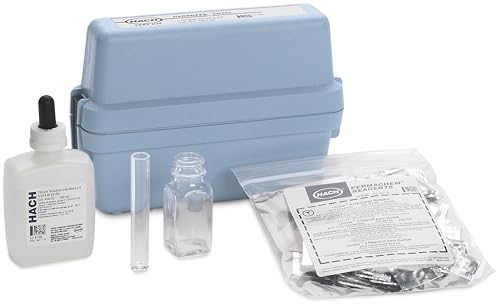
Think of the Model 5-EP as the traveling sibling of the Model 5-B covered earlier. Same drop-count titration method, but everything rides in a sturdy carry case that holds the reagents, measuring tube, square bottle, scoop, and instructions in one organized tray. If you run multiple properties or simply want a kit you can grab and bring to a job site without hunting for parts, the case is the whole point.
The compact design also keeps the consumables upright in the back of a service van. Compare that to the loose-bottle setup of the Model 5-B, where reagents can loosen and leak in a toolbox. Same story on accuracy: drop titration is consistent once you learn the endpoint, and results land in the same gpg scale you would get from a lab.
Noteworthy Benefits
- Carry case protects reagents and tube from toolbox damage.
- Drop-count titration gives a real numeric reading without electricity.
- Pre-organized layout speeds setup at each job.
Some Limits To Know
- Range details are not published in the source list, so verify before relying on extreme hardness readings.
- Reagent refills are a separate purchase once the original bottles are spent.
Perfect Match For
Service technicians, real-estate inspectors, and pool-route pros who test multiple sites each week and need a single durable case to take along.
Where A Sibling Pick Shines
For stationary home use on a kitchen counter, the Model 5-B reviewed earlier gives the same method without paying for the case hardware.
If you want one kit that covers the questions most homeowners eventually ask, this lab-based option casts a wide net. You collect a sample at the tap, mail it to a partner lab, and receive a report covering 60-plus analytes, including lead, copper, arsenic, bacteria, minerals, and general water-quality indicators. Useful for tap, city, well, filtered, and rain sources alike, it functions as an annual audit rather than a single-parameter check.
The catch is turnaround. Results arrive in roughly five days after the lab receives your shipment, so this is not a tool for emergency decisions. Compared with the LUVCOSY presence-absence test reviewed earlier, you trade instant gratification for a real numerical breakdown across heavy metals and bacteria on a single report.
Points In Its Favor
- 60-plus analytes cover lead, other heavy metals, bacteria, and minerals in one shipment.
- Works on tap, city, well, filtered, and rain sources without extra equipment.
- Lab analysis provides numeric readings rather than color guesses.
- Useful as a baseline before and after installing a filtration system.
Practical Considerations
- Five-day lab turnaround means no instant answers during a contamination scare.
- Single-use sample, so retesting requires a fresh kit purchase.
Quick Facts
Whose Shelf It Belongs On
Homeowners moving into a new property, families with infants, and anyone settling an ongoing worry about lead service lines or aging plumbing.
Swap It Out When
You need an immediate bacteria read on a private well. The LUVCOSY 4-bottle kit covered earlier gives a 48-hour color answer without shipping.
Acid demand testing tells you how much acid (typically muriatic acid or sodium bisulfate) you need to add to pool or spa water to bring the pH and total alkalinity into balance. Get the dose wrong and you bounce between cloudy water, scale, and equipment corrosion. Taylor’s R-0005-C refill keeps the 2000-series professional kits honest when the original reagent runs dry.
The 2-ounce dropper bottle is sized for repeated use across a season. Owners commonly report that the dropper tip clogs if the bottle is stored on its side, so an upright spot on a shelf is wise. Instructions use pictograms rather than dense text, which makes the procedure approachable for newer pool keepers.
Everyday Advantages
- Dedicated refill for the Taylor K-2000 series keeps the kit usable.
- Dropper bottle controls the dose for repeat tests.
- Pictogram-based instructions lower the learning curve.
Where It May Fall Short
- Only fits Taylor 2000-series kits starting with K-2.
- Not a standalone test, just one reagent in a multi-step procedure.
Built With In Mind
Pool and spa owners who already own a Taylor 2000-series kit and want to extend its working life without buying a whole new comparator.
Consider Something Else When
You want a chlorine dioxide strip read instead, in which case the LaMotte 3002 covered next operates without any reagent setup.
Chlorine dioxide is a sanitizer distinct from regular chlorine, used in produce wash water, hospital sanitation, and some industrial rinse loops. Dip-and-read strips simplify the verification step: dip the pad, wait for development, and read the color against the bottle’s printed scale. The 0 to 500 ppm (parts per million) range covers everything from trace residuals up to sanitizing concentrations, with sensitivity steps at 0, 10, 25, 50, 100, 250, and 500 ppm.
The 50-strip vial is the practical size for weekly checks at a commercial kitchen or greenhouse, and the strips do not require any dropper reagents. Compare that to the Hach DR300 earlier, which demands a separate reagent pack and a meter. For routine spot checks, the strip route is faster; for documentation-grade numbers, the meter wins.
Key Advantages
- Wide 0 to 500 ppm range suits both residual and sanitizing-dose checks.
- 50 strips per vial keep weekly spot checks covered for over a year.
- Dip-and-read design skips the dropper bottle entirely.
Less-Strong Areas
- Color reading is subjective and depends on lighting and eyesight.
- Vial should be capped tightly between uses to keep moisture out.
Right Fit For
Commercial kitchens, greenhouse operators, and industrial hygiene staff who need a quick chlorine dioxide residual check without hauling a meter.
Not Your Match When
You need trace chlorine readings in drinking water. The Hach DR300 low-range channel handles the 0.02 mg/L residuals municipal systems target.
Choosing The Right Match For Your Water Worries
Start with the question, not the kit. Private well owners usually care first about coliform bacteria, then about hardness and a handful of metals. Pool keepers prioritize chlorine and acid demand. Commercial operators and inspectors chase chlorine residuals and backflow certification. Once you know which question matters most, the kit choice narrows fast.
Match The Kit To The Parameter
A bacteria screen, a hardness titration, and a chlorine colorimeter are different instruments for different jobs. Buying a hardness kit to check for E. coli leaves you without an answer. The LUVCOSY kit covers bacteria, the Hach hardness kits cover scale-forming minerals, and the Hach DR300 covers chlorine. Match the parameter first, the brand second.
Mind The Source
Tap water, well water, pool water, and process water all behave differently. Well water tends to swing seasonally on hardness and is more prone to bacterial contamination after heavy rain. Pool water demands frequent chlorine and pH checks because bather load, sunlight, and rain all push chemistry around. A single kit rarely covers both worlds well.
Consider Turnaround And Frequency
Lab-mailer kits like the empowerDX option take about five days after the lab receives the sample. Strip and titration kits give immediate readings at the cost of narrower parameter coverage. Daily pool checks favor strip or comparator speed; annual whole-house audits favor the mail-in lab.
Check Replacement Costs Up Front
A kit is only as good as its fresh reagents. Taylor and Hach sell refills separately, and skipping that step leaves you with a comparator and no chemistry. Build the recurring cost into your decision alongside the upfront purchase, especially for pool-side and field kits that cycle through reagents each season.
Smart Angles Before You Commit
Pitfalls Shoppers Hit
A common mistake is treating color strips, drop-count titration kits, and lab mailers as interchangeable. They are not. Another is skipping the local context. A hardness kit does no good if your real concern is lead service lines, and a coliform screen misses mineral contamination. Finally, buying a refill like the Taylor R-0005-C without confirming it fits your specific kit series wastes the purchase.
Where The Extra Money Goes
Higher-tier tools like the Hach DR300 cost more because they replace eyeball color matching with an electronic sensor and a documented reading. Premium mail-in kits cost more because the price bundles the lab analysis and the certified methodology behind it. For occasional checks on a single property, the spend is hard to justify. For commercial documentation or recurring multi-site work, the upgrade pays back in time saved and traceable records.
Frequently Asked Questions
What Is The Most Reliable Home Water Test?
Reliability depends on what you are testing for. EPA-recognized mail-in labs cover the widest parameter list, while color-based titration kits from established brands like Hach or Taylor are reliable for the specific parameters they measure. Match the method to the parameter rather than chasing a single “most reliable” label.
How Often Should You Test Private Well Water?
Most health authorities suggest an annual bacteria screen and a periodic check of nitrates, lead, and other regional contaminants. Test more often after flooding, plumbing changes, or any noticeable change in taste, odor, or color.
Are Mail-In Lab Kits Better Than Strips?
Mail-in kits cover more parameters and return numeric results, while strips and titration kits give immediate answers at lower cost for a narrower set of measurements. The best choice depends on whether you need breadth or speed.
Do Pool Test Kits Expire?
Reagents lose potency over time, especially when exposed to heat or moisture. Most manufacturers recommend replacing reagents at least once per season for accuracy, even if the bottle still contains liquid.
Can One Kit Cover Both Drinking Water And Pool Water?
Most kits target a single application. Drinking-water kits focus on bacteria, lead, and minerals. Pool kits focus on chlorine, pH, and alkalinity. A small household can get away with two specialized kits rather than one compromise option.
Bottom Line
Your water source, your concern, and your documentation needs will narrow this list faster than any feature comparison. Start with the question you actually need answered, pick a kit built for that parameter, and budget for reagent refresh if you go the titration or colorimeter route.




