The tap in your kitchen tells a story. Sometimes it’s a faint chlorine tang, sometimes it’s orange staining on fixtures, sometimes it’s just a vague metallic note that makes you reach for bottled water more often than you’d like. Home water filtration systems solve different versions of that story, and the right one depends on whether you’re pulling from a municipal supply or a well, how many bathrooms you run at once, and how much room you have near the main shutoff.
This roundup walks through ten options that cover the most common household scenarios, from well-water iron and manganese removal to salt-free city-water softening and small-pitcher replacements. Each pick is mapped to a specific situation so you can match the system to the problem you actually have, not a generic “cleaner water” promise.
A Side-By-Side Look

Waterdrop WHF3T-FG 3-Stage Whole House Water Filter for Well Water
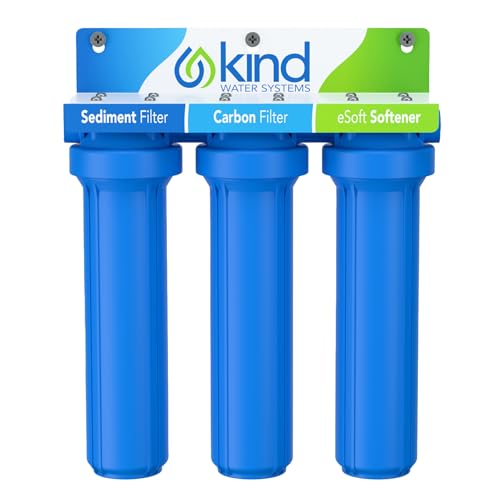
Kind Water Systems E-3000 Whole House Salt-Free Water Softener & Filter

Kind Water Systems E-3000UV Whole House Salt-Free Softener & Filter with UV

Whole House Salt-Free Water Softener Alternative with UV Light

Waterdrop WHF3T-PG 3-Stage Whole House Water Filter System (5 Micron)

GE FXHTC Whole House Replacement Water Filter (10 in. x 4.5 in.)

Waterdrop WHF3E-SKH 3-Stage Whole House Water Filter System for Well Water

Elkay Strainer for Elkay/Halsey Taylor 55996C Water Coolers

Rainbow Genuine 2 1/2 Quart Water Pan (Basin)

Soma by Full Circle Water Pitcher Filters (Pack of 2)
Inside Each Recommended Option
If your water comes from a well and you’ve noticed reddish-brown staining in sinks or a metallic aftertaste, this Waterdrop setup is built around that exact problem. The three-stage configuration runs incoming well water through paired cartridges engineered to pull out iron and manganese, the two minerals that do most of the visible damage to fixtures and laundry.
Installation happens at the main supply line, so every tap in the house benefits rather than just one kitchen faucet. Compared to whole-home softeners covered later in this list, this model focuses on sediment and metal reduction rather than scale, which makes it a better fit for well owners who don’t need softening but do need cleaner, clearer water.
The Helpful Details
- Targets iron and manganese, two of the most common well-water headaches
- Three-stage design treats every fixture in the home at once
- Reduces staining on sinks, tubs, and laundry, a daily-life payoff
- Lead-free materials throughout the housing and cartridges
Things To Consider
- Sediment cartridges typically need swapping more often in iron-heavy wells
- Doesn’t soften water, so pairing may be needed where hardness is also a concern
At A Glance
Right Fit For
Homeowners on private wells who see orange staining and want whole-house coverage without committing to a softener.
Swap It Out When
Your water is hard as well as iron-rich, in which case the Kind Water Systems E-3000 handles scale and sediment together.
City water brings its own quirks, mostly chlorine smell, occasional sediment from older mains, and the white scale that builds up on shower doors. The Kind E-3000 stacks three jobs into one compact cabinet: sediment filtration, carbon block filtration (carbon block is a dense form of activated charcoal that traps finer particles and chemical tastes), and salt-free conditioning.
Unlike traditional salt softeners, this one doesn’t actually remove hardness minerals. It conditions them so they’re less likely to stick to surfaces, which means no brine discharge and no salt bags to haul. For renters or homeowners in salt-restricted regions, that’s a meaningful difference from the Waterdrop WHF3T-FG above, which only addresses metals.
Where It Helps
- Three-stage treatment in a single, compact footprint
- Targets chlorine and chloramine for better-tasting water
- Salt-free design avoids brine discharge
- Suits homes up to several bathrooms on municipal supply
Worth Noting
- Salt-free conditioning reduces scale adhesion rather than removing hardness entirely
- Sediment cartridges need periodic rinsing or swapping
Spec Overview
Made For
City-water households that want softer-feeling water and chlorine reduction without the upkeep of a brine tank.
Look Elsewhere When
Your supply is well water with iron problems, where the Waterdrop WHF3T-FG is purpose-built for that situation.
The E-3000UV is the E-3000 with one important addition, a UV chamber. UV treatment (ultraviolet light exposure) doesn’t filter anything physically; it disrupts the DNA of microorganisms so they can’t reproduce. Where the base E-3000 handles sediment, carbon, and scale conditioning, this model adds a microbial defense layer that matters in certain edge cases.
The catch is that UV only works on water that’s already clear, since turbidity (cloudiness from suspended particles) shields microbes from the light. That’s why the upstream sediment and carbon stages remain essential. For a household on city water with old plumbing, occasional boil notices, or a private line that may pick up surface contamination, this stacked approach covers more bases than either the E-3000 or the Waterdrop WHF3T-FG on its own.
Standout Benefits
- UV stage reduces microbial load without chemicals
- Includes carbon and sediment stages for clear-water prep
- Targets chlorine, chloramine, and VOCs (volatile organic compounds such as solvents and pesticide traces)
- Salt-free conditioning keeps operation simple
Room For Improvement
- UV lamp replacement is an added maintenance step on top of cartridge swaps
- Requires a dedicated power outlet near the install point
Who Should Grab It
City-water homes with older plumbing or anyone wanting a microbial layer added to their whole-house treatment.
A Better Fit Elsewhere
Budget-focused shoppers who don’t need UV are better served by the base Kind E-3000 above.
If your main complaint is the chalky scale that gums up showerheads and shortens water-heater life, this whole-house unit addresses it without salt and without discharging brine down the drain. It pairs a reusable sediment cartridge (you rinse it instead of throwing it away) with scale-conditioning media and a UV stage for microbial coverage.
The reusable cartridge is the practical ownership story. Owners of standard disposable cartridges tend to forget the swap until pressure drops, but a rinse-and-reuse design rewards a quick monthly habit. For larger homes up to five bathrooms, this model scales where smaller units would struggle.
A Strong Showing
- Reusable sediment filter cuts long-term cartridge cost
- Zero brine waste compared to salt softeners
- Scales up to 5-bathroom homes without flow issues
- UV layer adds defense in one integrated cabinet
- Low-maintenance routine, mostly periodic rinses
Points To Note
- Larger footprint than compact city-only units
- Scale conditioning, not removal, so very hard water may still show some spotting
Perfect Match For
Larger homes on hard municipal water that want scale protection without the salt-bag routine.
Not Your Match When
Well-water households dealing with iron staining should pick the Waterdrop WHF3T-FG instead.
Most city dwellers notice chlorine first: the swimming-pool smell in a morning glass of water, the dry skin after a long shower. The WHF3T-PG leans hard into that problem with a KDF composite filter paired with a GAC (granular activated carbon) stage wrapped in carbon fiber. The micron rating (5 microns, roughly the size of a red blood cell) tells you how fine the sediment catch is, fine enough for most municipal grit.
Compared to the well-targeted Waterdrop WHF3T-FG, this unit is purpose-built for municipal water and skips the iron/manganese focus. The trade-off is a noticeably cleaner taste and reduced chemical odor in everyday use, which matters more in a city-supplied home than pulling metals out of well water.
Useful Strengths
- Strong chlorine and chloramine reduction through dual-stage carbon
- 5-micron sediment catch for cloudy-water days
- Lead-free certified materials throughout
- Whole-house coverage from a single install point
Honest Caveats
- Cartridges need replacing on schedule to maintain flow and taste
- Doesn’t address hardness, so a softener may still be needed where scale is heavy
Whose Shelf It Belongs On
City-water households whose main complaint is chlorine taste and shower odor rather than hardness or staining.
Reach For A Different Pick When
Hardness is your bigger issue, where the Kind Water Systems E-3000 handles scale conditioning in the same whole-house format.
This is a different kind of pick. The GE FXHTC isn’t a complete system, it’s the replacement cartridge that drops into several existing GE whole-house setups, including the GXWH40L, GXWH30C, GXWH35F, GXWH38F, and GNQH38S, plus most generic housings using the 10-inch by 4.5-inch standard.
Sediment, rust, and chlorine are the main targets, which puts it in the same conversation as the Waterdrop WHF3T-PG above, just for a different housing. The honest read: if your existing whole-house system is one of those GE units, this is the cartridge you’ll be searching for every three months anyway.
Noteworthy Benefits
- Standard 10 in. x 4.5 in. sizing fits several GE and compatible housings
- Reduces chlorine, sediment, and rust in one cartridge
- Simple twist-out replacement, no special tools needed
- Long-standing replacement part widely available
Things To Weigh
- Only useful if you already own a compatible whole-house housing
- Recommended swap interval is short, roughly every three months or 24,000 gallons
Who Will Love This
Existing owners of GE GXWH40L, GXWH30C, GXWH35F, GXWH38F, or GNQH38S whole-house systems due for a cartridge change.
Where A Sibling Pick Shines
Shoppers without an existing housing should pick the Waterdrop WHF3T-PG for a complete chlorine-and-sediment solution.
Hard water from a well is the worst of both worlds: you get iron staining and scale buildup at the same time. The WHF3E-SKH is Waterdrop’s answer, a three-stage system with anti-scale filtration layers that reduce scale adhesion across the whole house. The 9-layer filtration design runs incoming water through progressively finer media to catch sediment before finer filters do the chemical work.
Where the WHF3T-FG above targets iron and manganese primarily, this model leans into scale. If your well water leaves crusty deposits on faucets and shortens the life of water heaters, the anti-scale media should help. It’s a different angle on a well-water problem, and a complementary alternative to the Kind salt-free systems covered earlier.
Positive Takeaways
- Anti-scale media reduces hard-water buildup on fixtures and appliances
- Multi-layer filtration tackles sediment and chemical taste together
- Whole-house coverage from a single supply-line install
- Targets scale without the salt and brine of a traditional softener
Small Caveats
- Multi-layer media means a more complex cartridge replacement schedule
- Iron reduction isn’t the primary focus, so high-iron wells may still see some staining
Best Suited To
Well-water homes where scale buildup on faucets and water heaters is the dominant complaint.
Consider Something Else When
Your well water shows visible iron staining, where the Waterdrop WHF3T-FG does a more focused job.
This one is niche on purpose. The Elkay strainer is a small replacement part designed to fit Elkay and Halsey Taylor water coolers (excluding EZ and HTV models). It’s a simple mesh screen that sits in the cooler basin to catch larger debris before it reaches the bubbler or drain.
For offices, schools, or home gyms with one of those specific cooler units, a clean strainer keeps water flowing and reduces the gunk that builds up at the basin. It’s not a whole-house filter, and it shouldn’t be confused with one. Think of it as a small accessory that keeps a single point-of-use cooler working the way it should.
Everyday Advantages
- Direct-fit replacement for Elkay and Halsey Taylor coolers
- Catches debris before it reaches the cooler drain
- Simple, inexpensive spare part to keep on hand
Factors To Consider
- Only fits specific cooler models, not a universal part
- Doesn’t filter water, only catches larger particles
Right Fit For
Anyone running an Elkay or Halsey Taylor 55996C water cooler who needs a replacement basin strainer.
Skip It When
You need actual water treatment, since the Soma pitcher filters below or any whole-house unit on this list is a better match.
Another niche pick, but for a different reason. Rainbow vacuums use a water basin as the core filtration element: dust gets pulled through water, captured, and held there until you empty the pan. This OEM (original equipment manufacturer) replacement is the genuine 2.5-quart basin for Rainbow E2 Type 12 and E-2 e-series vacuum systems.
Why include it on a water-filtration roundup? Because “filtration” is broader than drinking water, and a cracked or warped basin means your vacuum stops filtering air effectively. For Rainbow owners whose basin has hairline cracks or persistent cloudiness, this is the part you’ll actually need.
Key Advantages
- Genuine OEM fit for Rainbow E2 Type 12 and e-series models
- Proper seal restores vacuum’s water-filtration performance
- 2.5-quart capacity matches original equipment specs
Points To Keep In Mind
- Only compatible with specific Rainbow vacuum models
- Not a drinking-water filter, despite appearing on this list
Who It Suits Best
Rainbow E2 Type 12 or e-series vacuum owners needing an exact-fit replacement water basin.
Where Another Pick Suits Better
Anyone shopping for drinking water filtration should head to the Soma pitcher filters below or any whole-house system above.
Not everyone wants a system at the main supply line. Some households just want a better-tasting pitcher of water on the counter. Soma by Full Circle filters use activated carbon made from coconut shells, which has a dense, porous structure that catches chlorine and a handful of heavy metals effectively.
The two-pack format is the practical ownership story. Pitcher filters wear out every couple of months, and running out means a few days of unfiltered water while you wait for shipping. Buying a spare pack keeps the rotation seamless. Compared to the whole-house units above, this is a fraction of the cost and zero installation, just a filter swap.
Useful Touches
- Coconut-shell carbon media for effective chlorine and metal reduction
- Plant-based filter materials in a compostable cartridge
- Two-pack format prevents filter-out gaps
- Drop-in replacement for existing Soma pitchers
Things To Weigh
- Only fits Soma pitchers, not a universal cartridge
- Pitcher-scale flow, not whole-house coverage
Quick Facts
Built With In Mind
Soma pitcher owners who want a two-pack on hand so they never run out mid-cycle.
Not Your Match When
You want every tap in the house filtered, where the Waterdrop WHF3T-PG covers the whole supply line.
What To Match Before You Choose Whole-House Filtration
Start with your water source, because the rest of the decision flows from it. Wells typically deal in iron, manganese, sediment, and hardness, while city water usually means chlorine, chloramine, and scale. A system tuned for one supply often underperforms on the other, which is why the picks above split between well-focused and municipal-focused setups.
Flow rate and household size matter just as much. A two-bathroom condo rarely stresses a compact unit, but a five-bathroom home running two showers, a dishwasher, and a laundry cycle simultaneously needs a system sized for that peak demand. The larger whole-house units like the Kind Water Systems unit rated for up to five bathrooms exist specifically to avoid pressure drops during those overlap moments.
Maintenance reality is the third filter. Sediment cartridges need rinsing or swapping on a schedule, carbon filters wear out, and UV lamps have a finite service life. Choosing a system whose upkeep matches how often you’re willing to touch it is the difference between a filter you actually maintain and one you forget about until the water tastes off again.
Finally, think about installation. Some whole-house units need a dedicated power outlet for UV or electronic heads, while passive sediment systems just need a spot on the main supply line with room to change cartridges. Measure before you order, and check that the cabinet fits the space you have near the shutoff.
Key Considerations Across These Picks
Mistakes Worth Dodging
The most common slip-up is treating “whole-house” as one category. It isn’t. Well water and city water pull different contaminants, and a unit tuned for chlorine won’t pull iron out of a well. Match the system to the source, not the other way around.
Another trap is ignoring cartridge costs. The unit price is the start, not the whole story. A reusable sediment cartridge like the one in the Kind salt-free unit cuts long-term spend, while a unit with three proprietary cartridges adds up over years. Factor in the replacement interval before you commit.
When Paying More Pays Off
Higher-tier units tend to add either UV, scale conditioning, or finer multi-stage media. The upgrade is worth it when your water actually demands it, for example, when you can see scale forming within weeks on fixtures, or when microbial concerns are real because of old plumbing or surface-water influence.
For households with mild chlorine taste and otherwise clean municipal water, a basic three-stage filter handles the job without the UV upkeep. Spend up when the water problem justifies it, and skip the extras when it doesn’t.