Power outages used to mean candles and flashlights. Now they mean working from the kitchen table, charging devices, and keeping the fridge cold, and the right inverter makes that possible without a generator roaring in the driveway. This roundup covers ten solid options across portable power stations, traditional inverter generators, and whole-home hybrid inverter systems, so you can match the right hardware to your space, your noise tolerance, and your budget.
The Lineup, Simplified

BLUETTI Elite 200 V2 Portable Power Station 2073.6Wh

Honda EU2200i 2200W Inverter Generator (EU2200ITAN)

Honda EU2200i Companion Inverter Generator (EU2200ITAN5)

Honda EB2200i 2200W Inverter Generator (EB2200ITAN)

Honda EB5000 5000W Quiet Generator (EB5000XK3AN)

HumsiENK 15.36kWh Home Backup LiFePO4 Battery + 8000W Inverter

Westinghouse 12000 Peak Watt Tri-Fuel Inverter Generator
WEN 3800W RV-Ready Inverter Generator (56380i)

HumsiENK 8000W Hybrid Solar Inverter 120/240V Split Phase

HumsiENK 12000W Hybrid Solar Inverter 120/240V Split Phase
The Picks, Examined More Closely
If you want backup power without the noise, smell, or maintenance of a gas generator, the BLUETTI Elite 200 V2 sits in a sweet spot. The 2073.6Wh capacity (a watt-hour is the total energy stored, similar to a fuel tank but for electricity) handles a fridge, Wi-Fi router, laptops, and phone chargers for hours, and the 2600W continuous output means a hair dryer or coffee maker won’t trip it. It’s a battery station rather than a fuel-burning generator, so you can keep it indoors without worrying about exhaust.
Compared with the Honda EU2200i covered next, this unit trades engine power for silent operation and zero fumes, which matters in apartments or during nighttime outages.
Useful Highlights
- Runs high-draw appliances like refrigerators and coffee makers simultaneously.
- Silent, indoor-safe operation makes it apartment- and bedroom-friendly.
- Large battery capacity stretches through short to moderate blackouts without recharging.
- No fuel, oil changes, or pull-cord starts to wrestle with.
Worth Noting
- Full recharge time from a wall outlet can stretch into several hours depending on input source.
- Capacity is finite, so heavy continuous loads may drain it faster than a gas generator would.
Quick Facts
Who Will Love This
Apartment dwellers, condo owners, and anyone who wants silent, indoor-safe backup for a fridge, router, and devices without touching gasoline.
Look Elsewhere When
The Honda EB5000 covered below suits you better if you need 240V output or longer runtime without recharging between uses.
The Honda EU2200i is the kind of generator you can actually camp with. Its 48 to 57 dB(A) rating puts it in conversation-volume territory, so it won’t earn dirty looks at a state park or quiet RV lot. The 2200W peak handles microwaves, laptops, and small kitchen appliances, and inverter technology (a system that smooths raw engine output into clean, electronics-safe power) means you can charge sensitive gear without worry.
Where the BLUETTI Elite 200 V2 stays silent on battery, this Honda trades that silence for fuel-based runtime measured in days rather than hours.
A Favorable Mix
- Whisper-quiet operation keeps neighbors happy at campgrounds.
- Clean inverter power is safe for laptops, phones, and modern appliances.
- Compact, suitcase-style form fits in most car trunks and RV bays.
Trade Offs
- Gasoline and oil changes are required, which adds routine maintenance.
- Not designed for indoor use, so you need outdoor placement with safe exhaust venting.
- Won’t power central AC or heavy 240V equipment on its own.
Made For
Campers, tailgaters, and homeowners who want a portable, low-noise generator for short outages and weekend trips.
Skip It When
The Honda EU2200i Companion below fits you better if you own an RV and need the 30A outlet for plug-and-play shore power.
The Companion is the EU2200i’s RV-tuned sibling. Its standout feature is the built-in 30A outlet, which most RVs use for shore power (the standard electrical hookup at campgrounds), so you can plug in directly without adapters. Pair two Companion units in parallel using Honda’s cable, and you roughly double available wattage, which is a clever way to scale up without buying a larger generator outright.
Noise levels and inverter technology match the standard EU2200i, so quiet operation and clean power carry over. The trade-off is fewer household-style outlets on the unit itself.
Strong Points
- 30A RV outlet removes the need for adapters at most campsites.
- Parallel-ready design scales output when paired with a second unit.
- Honda’s reputation for long engine life holds up well in RV communities.
Some Limits To Know
- Fewer general-purpose outlets than the standard EU2200i, which can be limiting outside RV use.
- Still gasoline-powered, so fuel storage and oil changes are part of ownership.
Right Fit For
RV owners and people planning a two-unit parallel setup who want a clean, dedicated 30A hookup for travel.
Another Choice May Suit
The WEN 3800W RV-Ready Inverter Generator below fits you better if you want higher output from a single unit instead of pairing two smaller ones.
The EB2200i is the industrial cousin in Honda’s 2200W family. Designed for contractors and jobsite use, it shares the same 48 to 57 dB(A) whisper-quiet output and clean inverter power as the EU2200i, but its frame, controls, and protection features lean toward rougher environments. You get power reliable enough for sensitive electronics, which is unusual at this price in the contractor segment.
Versus the WEN 56380i covered later, this Honda trades higher peak wattage for proven engine longevity and quieter operation.
A Few Highlights
- Quiet enough to run near work areas without shouting over it.
- Clean inverter power protects laptops, phones, and tool chargers.
- Industrial-grade build stands up to repeated transport and jobsite handling.
Points To Keep In Mind
- Positioned for trades, so some convenience features found on RV-focused models are absent.
- Routine engine maintenance still applies, including oil checks and air filter cleaning.
Best Suited To
Contractors, electricians, and small jobsite crews who want quiet, electronics-safe power without stepping up to a 5000W unit.
A Better Fit Elsewhere
The Honda EB5000 below suits you better if your jobsite regularly runs 240V table saws or larger compressors.
The EB5000 steps up to 120/240V output, which opens the door to well pumps, larger compressors, and most home backup scenarios. Its 7000-watt, 10-second surge is enough to start motors up to about 3 horsepower, which covers a lot of real-world heavy tools. iAVR (Intelligent Automatic Voltage Regulation) keeps output stable under fluctuating loads, so connected equipment runs more consistently.
Sound levels land around 63 to 65 dB(A), louder than the 2200W siblings but still reasonable for the wattage class. Compared with the BLUETTI Elite 200 V2, this Honda trades silent operation for serious power and indefinite runtime as long as fuel is on hand.
Benefits That Matter
- 120/240V output covers heavy 240V equipment that 2200W units can’t touch.
- Strong motor-starting surge handles up to roughly 3HP loads briefly.
- Voltage regulation under fluctuating load protects connected tools.
Honest Caveats
- Larger and heavier than 2200W models, so storage and transport matter.
- Fuel and oil maintenance are required on a regular schedule.
- Not indoor-rated, so placement must keep exhaust safely outdoors.
Who Should Grab It
Homeowners, contractors, and small-shop operators who need 240V capability for well pumps, table saws, or larger backup loads.
Reach For A Different Pick When
The Westinghouse Tri-Fuel Inverter Generator fits you better if you want cleaner inverter power plus fuel flexibility from a single unit.
This kit pairs a 15.36kWh LiFePO4 battery (lithium iron phosphate chemistry prized for long cycle life and thermal stability) with an 8000W hybrid split-phase inverter, a configuration that turns solar arrays into whole-home power. The 200A BMS with active balancing helps cells stay matched over time, which extends usable battery life. Built-in wheels make a 300Ah pack easier to position in a garage or utility room.
Versus the BLUETTI Elite 200 V2 earlier, this is a permanent installation rather than a grab-and-go station. It’s aimed at homeowners who want to tie solar into their breaker panel.
Notable Upsides
- Large 15.36kWh capacity covers extended outages for essential circuits.
- LiFePO4 chemistry supports many more charge cycles than typical lithium packs.
- 8000W continuous split-phase output handles 240V appliances directly.
- Built-in wheels help maneuver a heavy battery into place.
A Few Limitations
- Hardwired installation typically needs a licensed electrician, adding setup cost.
- Large footprint and weight demand a dedicated indoor space.
Feature Snapshot
Perfect Match For
Homeowners with rooftop solar who want a permanent, battery-backed inverter that integrates with their breaker panel.
Where A Sibling Pick Shines
The HumsiENK 8000W Hybrid Inverter covered below is a smarter fit if you already own batteries and just need the inverter half of the system.
The Westinghouse iGen12000TFc delivers 12,000 peak watts and 9,000 running watts while keeping total harmonic distortion below 3% (THD measures electrical “noise”; lower means safer for sensitive electronics). Tri-fuel capability means you can run on gasoline, propane, or natural gas, whichever is available during an outage. A built-in CO sensor adds an automatic shutoff if exhaust accumulates in unsafe areas.
Transfer-switch readiness means an electrician can wire it into your home panel with a proper interlock, turning it into a seamless backup. Compared with the Honda EB5000, you’re trading Honda’s engine reputation for raw wattage and fuel flexibility.
What Works In Its Favor
- Tri-fuel design keeps you running when one fuel type is unavailable.
- Low THD output protects computers, TVs, and modern appliances.
- Transfer-switch ready for proper home panel integration.
- CO sensor adds a meaningful safety layer.
Practical Considerations
- Heavy unit that takes planning to position and store.
- Quieter than open-frame units at around 64 dBA, but still loud compared with smaller inverters.
Feature Rundown
Built With In Mind
Homeowners in storm-prone regions who want whole-home backup with fuel flexibility and clean-enough power for modern electronics.
Not Your Match When
The HumsiENK 12000W Hybrid Inverter below makes more sense if you want silent, fuel-free operation tied to a solar array.
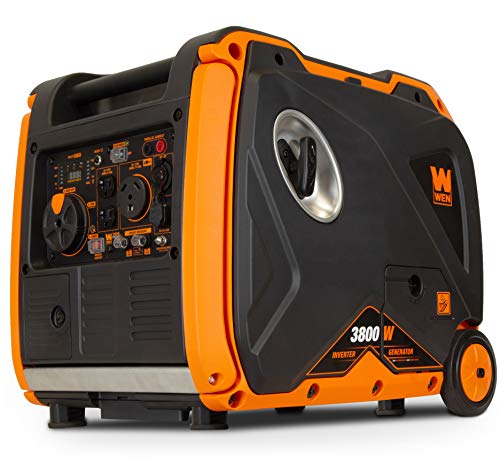
The WEN 56380i covers a useful middle ground: 3800 surge watts and 3400 running watts in an RV-friendly package. At about 57 dB at quarter load, it’s roughly as loud as a window air conditioner, which is impressive for the wattage. Electric start and fuel shutoff (a feature that drains the carburetor to prevent stale-fuel issues during storage) round out a thoughtful feature set for the price.
Compared with the Honda EU2200i Companion, this WEN offers higher output and electric start in a single unit, which is appealing if you don’t want to pair generators.
What Helps Most
- Higher running watts than 2200W units without much more noise.
- Electric start removes pull-cord frustration, especially in cold weather.
- RV-ready outlet plus parallel capability for future scaling.
- Fuel shutoff supports cleaner long-term storage between uses.
Room For Improvement
- Heavier and bulkier than the 2200W Honda models.
- Oil changes and fuel management still required like any gas generator.
Whose Shelf It Belongs On
RVers, food-truck operators, and homeowners who want moderate backup power without pairing two smaller units together.
Swap It Out When
The Honda EU2200i covered earlier is a smarter pick if you prioritize low weight and Honda engine longevity over higher wattage.
This HumsiENK hybrid inverter delivers 8000W continuous and 12000W surge in pure sine wave output (smooth, grid-quality electricity rather than choppy modified sine wave), with native 120/240V split phase for direct home panel connection. The 10000W MPPT solar charger maximizes harvest from your array, and the under-10ms UPS switchover is fast enough that most electronics won’t notice the grid dropped.
Versus the HumsiENK 12000W below, this 8000W model offers the same core features at a more approachable scale for typical homes. UL1741 listing (a North American safety standard for grid-tied inverters) matters for permitting and inspection in many jurisdictions.
What Pays Off
- True split-phase 120/240V output eliminates the need for an external transformer.
- Sub-10ms UPS switching keeps computers and routers from rebooting.
- Pure sine wave output is safe for sensitive electronics and motor-driven loads.
- Scales up to six units in parallel for larger systems.
Things To Weigh
- Batteries and solar panels are sold separately, so total system cost climbs quickly.
- Installation and commissioning typically require a qualified electrician.
Feature Card
The Right Fit
Off-grid homeowners and solar enthusiasts who already own or are planning a battery bank and want a clean, grid-tie-ready inverter.
Consider Something Else When
The HumsiENK 12000W covered next fits you better if your home regularly pulls loads that demand more headroom than 8000W allows.
The 12000W Hybrid Inverter is the top-tier option in HumsiENK’s lineup. It delivers 10000W continuous and 12000W surge in pure sine wave split-phase output, runs a 12000W MPPT solar charger, and bumps charger current to 220A. Workshop machinery, electric ovens, and well pumps all fall comfortably within its capacity when paired with a properly sized battery bank.
Six-unit parallel support means this can serve very large off-grid homes or small commercial sites. Compared with the 8000W sibling, you get roughly 25% more continuous headroom, which matters once you stack central AC, water heaters, and kitchen circuits together.
A Few Strong Suits
- 10000W continuous handles central AC plus heavy 240V appliances at once.
- 220A charger current refills large battery banks faster.
- Pure sine wave output protects sensitive electronics and motor loads.
- Scales to six units in parallel for very large whole-home or light-commercial systems.
Less Ideal Details
- Higher price point than the 8000W sibling, so right-sizing matters.
- Installation is more involved and usually requires a qualified electrician and inspector sign-off.
Feature Overview
Whose Shelf It Belongs On
Owners of larger off-grid homes, small farms, or workshops with heavy 240V machinery who want solar-driven backup at scale.
A Better Fit Elsewhere
The HumsiENK 8000W Hybrid Inverter is the smarter pick if your daily loads stay under 8000W and you don’t need the extra headroom.
Matching Inverter Output To Real-World Loads
Getting the right size matters more than getting the fanciest model. A 2200W inverter handles a fridge, router, and phone charging, but it stalls on a hair dryer plus microwave combination. A whole-home inverter at 8000W to 12000W covers central AC and electric ovens, but it costs more and may be overkill for apartment dwellers who mainly want overnight essentials. The honest read is this: total up the running watts of everything you want backed up, add 20% headroom for startup surges, then pick the smallest inverter that clears that number.
Continuous vs. Surge Output
Continuous wattage is what the unit delivers indefinitely; surge wattage covers brief motor-start spikes from fridges, pumps, and power tools. Many people underestimate surge needs and end up with a generator that stalls when the compressor kicks on.
Inverter vs. Open-Frame Generators
Open-frame generators are louder and produce rougher power. Inverter generators smooth the output, which protects sensitive electronics and keeps noise down. If you value quiet operation or want to run laptops and modern TVs, stick with inverter designs.
Battery Stations vs. Fuel Generators
Battery stations like the BLUETTI Elite 200 V2 are silent and indoor-safe, but capacity is finite. Fuel generators run as long as you can refuel, but require outdoor placement and routine maintenance. Picking between them usually comes down to how long your typical outages last.
Why THD Matters
Total Harmonic Distortion, the percentage of electrical “noise” mixed into the output, is a useful number for sensitive electronics. Anything under about 5% is generally safe; under 3% is excellent and matters for high-end audio gear, computers, and modern appliances with delicate power supplies.
Field Notes Before You Commit
Common Shopping Slip Ups
A frequent mistake is buying a 2200W inverter expecting it to power the whole house, then discovering the well pump alone needs more. Another is ignoring transfer-switch compatibility and ending up with extension-cord spaghetti through the house. Plan the wiring before you fall in love with the wattage.
Where The Extra Money Goes
Higher-tier models cost more for quieter operation, lower THD, longer runtime, and better build quality. The upgrade is worth it for whole-home backup, sensitive electronics, or daily-use off-grid setups, but overkill for occasional weekend camping trips.