

Brought a CNC into the garage, you’ve got a new kind of weekend problem: how do you pick the right mill, the right spindle, and the right accessories without overshooting your budget or undershooting your projects? This roundup walks through nine solid options across entry-level frames, mid-range workhorses, and add-on gear, so you can match the machine to the kind of work you actually plan to cut.
The Essentials At A Glance

PLSROVACIX 5-Piece V-Groove CNC Router Bits Set, 1/8″ Shank

Genmitsu 4th Axis Rotary Module for 4040/3030 CNC

Twotrees TTC450 Pro All-Metal CNC Router (NEMA 57)

PLSROVACIX 800x400mm CNC Router, 300W Spindle, Ball Screws

FoxAlien XE-PRO CNC Router, 400W Spindle, Ball Screws
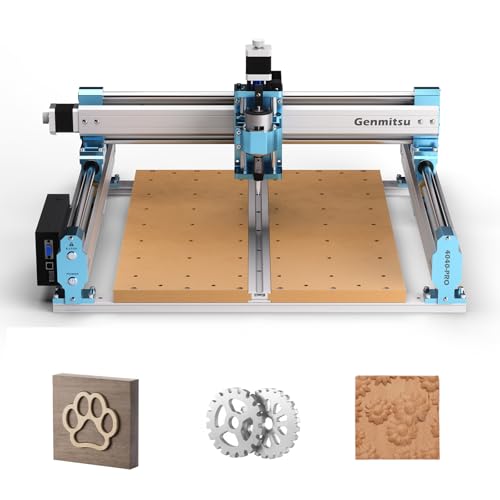
Genmitsu 4040-PRO CNC Router, Metal/Acrylic Milling

Genmitsu 710W Compact CNC Router, 65mm Spindle

Genmitsu PROVerXL 6050 Plus CNC Router, 300W Spindle

Masuter 6 CNC Router, 400x400mm, 300W Spindle
A Breakdown Of The Leading Choices
Bits are the unsung heroes of any CNC setup, and a five-angle V-bit kit covers most of the carving angles you’ll reach for in a home shop. This PLSROVACIX set bundles 20°, 30°, 45°, 60°, and 90° tips on a single 1/8″ (3.175 mm) shank, so it drops into the standard ER11-style collet that ships with most entry-level and mid-range spindles on this list.
Compared with the full machines below, this isn’t a mill at all. It’s the cutter pack that makes the mill useful once you’ve got one. You may find it doubles as a small-shop starter kit, since the angles handle fine lettering as well as deeper relief cuts without buying extras.
Benefits That Matter
- Five common V-groove angles in one case, covering everything from hairline detail to bold sign lettering
- 1/8″ shank fits the standard collet on most desktop CNC mills in this roundup, including the Genmitsu 710W spindle
- Flat-bottom tip geometry produces sharp inside corners instead of the rounded bottoms typical of basic V-bits
- Cuts cleanly through wood, acrylic, soft aluminum, and PCB blanks for mixed-material projects
Worth Bearing In Mind
- Cutting edge is small and brittle, so dropped bits or aggressive plunge feeds tend to chip the tip
- Aluminum work requires slower feed rates and light passes; rushing the cut generates burrs
- Storage case basics only, so you’ll likely want a foam-lined drawer to keep tips from knocking together
Quick Technical Notes
Best Suited To
Hobbyists making signs, inlays, and 3D carvings in wood and acrylic who want one kit instead of chasing bits piecemeal.
Swap It Out When
You mostly cut metal and need carbide end mills, in which case the FoxAlien XE-PRO’s bundled tooling path is a better starting point.
A 4th-axis rotary module turns a flat-bed CNC into a lathe-style carver. This Genmitsu unit is designed as a drop-in upgrade for the 4040-PRO, 4040-PRO MAX, 3030-PROVer Ultra, and 3030-PROVer MAX frames, which are some of the most common machines in the home-shop ecosystem.
Where earlier picks cut flat sheet, this add-on opens the door to cylindrical work. You may find it appealing if you carve drum bodies, table legs, chess pieces, or routed signs around round columns, since the rotary axis handles wrap-around geometry that a flat bed can’t touch.
What Makes Sense
- Adds full rotary carving capability to compatible Genmitsu 4040 and 3030 frames without buying a second machine
- Enables angled and curved features that a 3-axis setup can’t reach on its own
- Drop-in mount design reduces the wiring and alignment work you’d expect from a custom rotary build
- Integrates with common CAM software that supports 4-axis toolpaths for indexing or full wrap-around cuts
Honest Caveats
- Only fits specific Genmitsu frame models, so it’s not a universal rotary upgrade
- Requires a CAM package that supports 4-axis toolpaths, which adds a learning curve beyond flat-carving workflows
- Workpiece length is limited by the X-axis travel of the host frame, so very long columns won’t fit
Right Fit For
Existing Genmitsu 4040 or 3030 owners who want to expand into cylinders, tapered legs, and complex curved parts without buying a separate lathe.
A Better Fit Elsewhere
First-time CNC shoppers should start with the Masuter 6 desktop mill and add this module later, since a rotary axis on an unfamiliar frame can overwhelm a beginner.
The TTC450 Pro leans into user-friendliness with a 3.5-inch IPS capacitive touchscreen built right into the control box. NEMA 57 stepper motors drive the axes, which is a step up in holding torque from the smaller NEMA 17 setups common on cheaper kits, so it holds position better during heavier cuts.
Unlike the bare-bones Masuter 6 entry machine below, this one ships ready for expansion. The control box includes a dedicated 4th-axis port, a laser module port, and a 500W spindle control port, so the upgrade path is built into the wiring harness rather than something you retrofit later.
Reasons It Performs
- Capacitive touchscreen speeds up job setup, file loading, and jogging compared with button-only controllers
- NEMA 57 steppers provide higher holding torque for cleaner cuts in hardwood and aluminum
- Integrated ports for 4th-axis, laser, and 500W spindle expansion avoid later rewiring headaches
- All-metal frame adds rigidity over plastic-chassis kits in the same price neighborhood
Points To Note
- Touchscreen firmware updates occasionally lag behind third-party CAM software changes
- 500W spindle port is an upgrade path, not a bundled feature, so plan for the second purchase if you want spindle power
- All-metal frame is heavier than aluminum-extrusion rivals, so the bench needs to handle the load
Feature Snapshot
Who Should Grab It
Makers who want a touchscreen-driven, expandable platform and plan to grow into rotary work, laser engraving, or a more powerful spindle over time.
Look Elsewhere When
You need the largest possible cutting envelope, in which case the PLSROVACIX 800x400mm frame offers more bed space without paying for expansion electronics.
Where the smaller desktop picks in this roundup fit on a shelf, this PLSROVACIX router demands real bench space. The work area measures 31.5″ x 15.75″ x 3.74″ (800 x 400 x 95 mm), and the frame is built around ball screws and linear guides on all three axes for a manufacturer-stated accuracy under ±0.03 mm.
Closed-loop stepper motors watch for missed steps and correct them on the fly, which is reassuring during long jobs in hardwood or aluminum where a stalled motor can ruin a workpiece. You may find the bed size especially useful if you cut full cabinet door panels, signage blanks, or multiple small parts in a single setup.
Standout Benefits
- Generous 800 x 400 mm work envelope handles full sheet goods, cabinet doors, and multi-part nesting
- Ball screws on every axis reduce backlash for cleaner edge finishes than lead-screw alternatives
- Closed-loop steppers catch and correct stall conditions that would scrap a workpiece on open-loop machines
- 300W spindle handles wood, acrylic, and soft metals without an immediate upgrade
- Optional X-axis extension kit grows the work area for oversized builds
Practical Considerations
- Footprint is larger than the Genmitsu 4040-PRO and PROVerXL 6050, so workshop layout planning matters
- ±0.03 mm accuracy depends on a flat, stable bench and proper spoilboard tramming
- Closed-loop steppers cost more to replace if a driver board fails mid-project
Key Product Details
Made For
Workshop owners who cut full sheet goods, cabinet components, or multiple parts per setup and want ball-screw precision without jumping to industrial pricing.
Consider Something Else When
Your shop is small and most projects stay under 12 inches square, since the Masuter 6 desktop mill covers that range with a smaller footprint.
Speed is the headline here. Four NEMA 23 closed-loop steppers drive the axes through 1204 ball screws, and the manufacturer rates the max moving speed at 5000 mm/min, roughly 2.5× faster than open-loop stepper kits. The 400W spindle also adds a little more cutting muscle than the 300W units on most rivals.
Compare that to the Genmitsu 4040-PRO below, which uses lead screws rather than ball screws, and the difference shows up in cycle time. You may find the XE-PRO appealing if you run production-style batches of signs or cut many small parts and want shorter job times.
What Helps Most
- 1204 ball screws on all axes deliver faster rapids and lower backlash than typical lead-screw setups
- 400W spindle cuts deeper passes in hardwood and aluminum than the 300W machines in this list
- Closed-loop steppers recover from stall events, useful for unattended overnight jobs
- Frame is upgradable to linear rails later, so you can stiffen the motion system as needs grow
- Quieter operation than open-loop steppers at high feed rates
Points To Keep In Mind
- Linear-rail upgrade is sold separately and adds meaningful cost beyond the base price
- Closed-loop stepper drivers generate more heat than open-loop boards, so enclosure airflow matters
- Spindle collet and tooling choices still need to match the 1/8″ ER11 standard used elsewhere in this roundup
Built With In Mind
Makers running repeat jobs, small production runs, or anyone who values shorter cycle times and wants the option to stiffen the frame with linear rails later.
Not Your Match When
You need the largest possible work envelope, in which case the PLSROVACIX 800x400mm router offers more bed area for similar spindle power.
The 4040-PRO earns its name from the 400 x 400 mm work area, a sweet-spot size that fits most hobby projects without dominating the shop. Its reinforced hybrid spoilboard pairs with a center aluminum support bar to fight the sagging that plagues lighter frames during deep cuts.
Dual 16 mm HSS steel tubes on each axis, paired with lead-screw drives, give the motion system a stiffer feel than typical hobby kits. You may find this especially helpful in metal and acrylic work, where flex shows up immediately as chatter marks or dimensional drift.
Points In Its Favor
- Reinforced hybrid spoilboard with aluminum support bar keeps the work surface flatter across larger cuts
- Dual 16 mm HSS tubes per axis add rigidity for cleaner edges in metal and acrylic
- Lead-screw motion keeps maintenance simple compared with belt-driven designs
- 400 x 400 mm bed fits cabinet parts, signs, and a healthy nest of small jobs
Where It May Fall Short
- Lead screws are slower than the ball-screw setups on the FoxAlien XE-PRO and PLSROVACIX 800×400
- Spindle is sold separately on many configurations, so the all-in cost climbs quickly
- HSS tubes are stiff but heavier than aluminum extrusions, so moving the machine takes planning
Whose Shelf It Belongs On
Hobbyists cutting mixed materials, especially metal signs and acrylic panels, who value a stiff frame and a flat spoilboard more than maximum speed.
Where A Sibling Pick Shines
Speed-focused production work fits the FoxAlien XE-PRO better, since ball screws and 400W spindle power shorten cycle times noticeably.
This isn’t a mill frame but the spindle many of these mills use. The 710W compact router runs from 6500 to 30000 RPM across six speed ranges, with soft-start and constant-torque control that keeps cuts smooth even under load.
Typical run-out is rated under 0.05 mm, and a customized 1/8″ ER11 collet and nut come in the box, so it drops onto any of the Genmitsu frames in this list. You may find it the right choice if your stock spindle feels underpowered for hardwood or you’re chasing cleaner finishes in aluminum.
The Upside
- 710W motor cuts hardwoods and soft metals with more authority than stock 300W spindles
- Six-speed range (6500 to 30000 RPM) covers everything from plastics to aluminum on one tool
- Soft-start and constant-torque control reduce stalling under variable loads
- Under 0.05 mm run-out supports fine-detail engraving and tight tolerance parts
- Standard 1/8″ ER11 collet accepts the same bits as most other machines in this roundup
Small Caveats
- It’s a spindle upgrade, not a complete machine, so you still need a frame to mount it on
- Brush-style motors require eventual brush replacement, though many owners report long service intervals
- Higher RPM settings generate more noise and benefit from dust extraction
Perfect Match For
Existing CNC owners whose stock spindle runs hot in hardwood or aluminum and who want a drop-in 1/8″ ER11 replacement with more torque.
Reach For A Different Pick When
You don’t already own a compatible CNC frame, in which case the Genmitsu 4040-PRO or PROVerXL 6050 Plus bundles a complete working system.
The PROVerXL 6050 Plus brings serious size to the Genmitsu lineup with a 23.62″ x 19.69″ x 4.53″ (600 x 500 x 115 mm) work envelope. Dual HG-15 linear rails replace the round rail designs on smaller Genmitsu machines, and a single Y-axis T10 lead screw supports the gantry.
Compared with the Genmitsu 4040-PRO above, this frame is meaningfully larger and stiffer. You may find the wider envelope especially useful for cabinet panels, full door signs, and larger 3D carvings where the part simply won’t fit on a 400 mm bed.
What Earns Its Place
- Dual HG-15 linear rails deliver smoother motion and longer life than round rail designs
- 600 x 500 mm work area handles full cabinet panels and oversized signs
- Redesigned all-metal frame improves rigidity and reduces vibration at higher feed rates
- Single Y-axis T10 lead screw simplifies alignment compared with dual-drive Y designs
- Quieter operation than earlier Genmitsu models, according to commonly reported feedback
Trade-Offs To Consider
- Larger frame demands more floor space and a sturdier bench than the 4040-class machines
- T10 lead screw is cheaper to maintain than ball screws but slower than the FoxAlien XE-PRO
- 300W spindle handles most projects but tops out sooner than the 400W FoxAlien or the 710W Genmitsu router upgrade
Who It Suits Best
Shop owners building cabinet panels, large signs, and 3D carvings who want a Genmitsu-supported frame with linear-rail motion in a mid-size envelope.
Skip It When
You mainly cut small parts and want faster rapids, in which case the FoxAlien XE-PRO’s ball-screw motion gets through jobs more quickly.
The Masuter 6 is built for first-time owners, with pre-assembled components that shorten the path from box to first cut. The 400 x 400 mm work area matches the Genmitsu 4040-PRO’s class, while the 300W spindle handles the same wood, plastic, and soft-metal lineup you’d expect from an entry-level mill.
Where the Twotrees TTC450 Pro above leans into expansion ports and a touchscreen, this one leans into simplicity. You may find it less intimidating if you’ve never calibrated a CNC before and want a desktop frame that focuses on the basics.
What Stands Out
- Pre-assembled components shorten setup time for first-time CNC owners
- 400 x 400 mm work area covers the typical beginner project size
- 300W spindle cuts wood, plastic, and soft aluminum without an immediate upgrade
- Compact desktop footprint fits on a sturdy workbench in apartments and small shops
- Compatible with common ER11 collets, so the bit set earlier in this list works right out of the box
A Few Limitations
- 300W spindle tops out in dense hardwood or thick aluminum plate, where the FoxAlien XE-PRO has more headroom
- Simpler controller means expansion paths are more limited than the Twotrees TTC450 Pro
- Desktop footprint is small for its class, so larger projects require multiple setups or an extension
Who Will Love This
First-time CNC owners, apartment workshop users, and anyone who wants a quick-build desktop mill that covers the basics without a steep learning curve.
Where Another Pick Suits Better
Makers planning to grow into rotary work or laser engraving should consider the Twotrees TTC450 Pro for its built-in expansion ports.
Matching The Right Mill To Your Workshop
A CNC purchase usually comes down to three honest trade-offs: how big a work envelope you need, how much cutting power the spindle delivers, and how stiff the frame is around the gantry. Ball screws (the threaded rods with recirculating ball bearings that reduce friction) give you faster rapids and less backlash than lead screws, but they cost more and need occasional lubrication. Closed-loop steppers catch missed steps and reset themselves, which is reassuring during long unattended jobs in hardwood or aluminum.
For most home-shop projects, a 300W spindle on a 400 x 400 mm frame covers signs, inlays, and small 3D carvings without strain. Step up to a 400W or 710W spindle once you start pushing through thicker hardwood, harder acrylic, or soft metals regularly. Linear rails add rigidity and longer life but raise the price, so they make sense on frames you’ll use weekly rather than monthly.
Spindle Power And Material Choice
Spindle wattage matters most when you’re cutting dense material at deeper passes. A 300W spindle handles basswood, pine, and acrylic with light cuts; hardwoods like maple or walnut benefit from 400W and slower feed rates. Aluminum adds another tier of demand, and that’s where the Genmitsu 710W compact router earns its reputation among hobby machinists. Running above the spindle’s comfort zone shows up as burned wood, melted plastic, or chatter marks on aluminum, so right-sizing the motor matters more than chasing peak RPM.
Frame Rigidity And Accuracy
Rigidity is the silent partner of accuracy. A frame that flexes during a deep cut leaves behind tapered walls and rough edges, even if the steppers and screws are perfectly calibrated. All-metal frames, dual steel tubes per axis, and reinforced hybrid spoilboards all reduce flex, which is why the Genmitsu 4040-PRO and PROVerXL 6050 Plus earn their place in this roundup. Linear rails go a step further with smoother motion and longer service life, though the upgrade cost only makes sense for frequent users.
Work Envelope And Project Type
The smallest 400 x 400 mm frames suit signs, inlays, jewelry, and small 3D carvings. The 600 x 500 mm PROVerXL opens the door to cabinet panels and full door signs, while the 800 x 400 mm PLSROVACIX handles full sheet goods and multi-part nesting. Many hobbyists start with a mid-size frame and add an X-axis extension later, which keeps the initial cost lower while leaving room to grow.
Software, Bits, And Accessories
The picks above pair well with standard 1/8″ ER11 collets (a precision collet system widely used in small CNC spindles) and common V-bit sets like the PLSROVACIX five-angle kit. Plan for a CAM software license, basic end mills in carbide for aluminum, and a dust extraction setup if you’ll be cutting MDF or plywood regularly. Add-ons like the Genmitsu 4th-axis rotary module make sense after you’ve mastered flat work and want to push into cylinders.
Key Considerations Across These Picks
Where Shoppers Go Wrong
Two common mistakes trip up first-time CNC owners. The first is chasing the largest frame without checking the workshop bench size, door width, or ceiling clearance, which can turn delivery day into a hassle. The second is buying a high-wattage spindle without upgrading the frame to match, since a flexible gantry negates any advantage the motor adds. Right-sizing the frame, spindle, and rigidity tier together avoids both pitfalls.
Where The Extra Money Goes
Stepping up from an entry-level kit to a ball-screw, linear-rail frame with a 400W spindle adds real capability. The extra cost typically buys faster rapids, cleaner edge finishes in hardwood and aluminum, and longer service life on the motion components. For weekly hobbyists cutting hardwood or metal, that upgrade pays back in shorter cycle times and fewer scrapped workpieces. For occasional sign makers, a 300W entry-level kit remains the smarter spend.




