The tap water at your kitchen sink, your shower, your washing machine: it all flows through the same pipes, picking up sediment, chlorine, and minerals on the way. A whole-home setup treats water at the point of entry, so every faucet in the house benefits, not just the one in the kitchen. If you live in an older home with galvanized pipes, draw from a private well, or just want softer skin after showers, filtering at the main line is the most practical upgrade you can make.
The list below mixes complete systems with replacement cartridges, so you can match what you already own or start fresh. Most homes need a sediment pre-filter paired with a carbon stage, and households on well water usually want a third stage that tackles iron or hardness.
A Side-By-Side Look
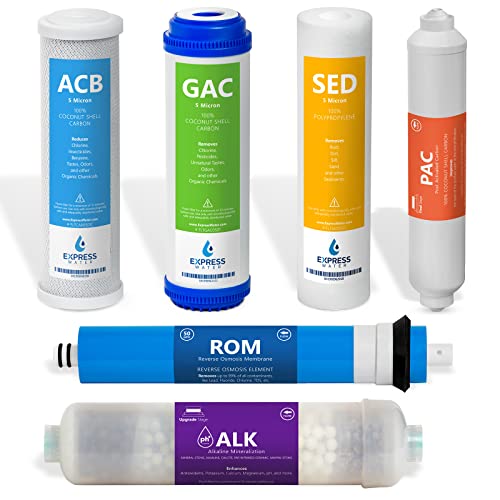
Express Water FLTSETALK065Q Reverse Osmosis Filter Set

Waterdrop WHF21-FG 2-Stage Whole House Water Filter System

Aquaboon 5 Micron 10 x 2.5 Sediment Filter 25-Pack

PUREPLUS 5 Micron PP10 Sediment Filter 6 Pack

Express Water 2-Pack Sediment Replacement Filter

Express Water Under Sink Replacement Filter Set

Waterdrop WHF21-PG 2-Stage Whole House Water Filter System

Waterdrop WF10PG Replacement Cartridge for WHF21-PG
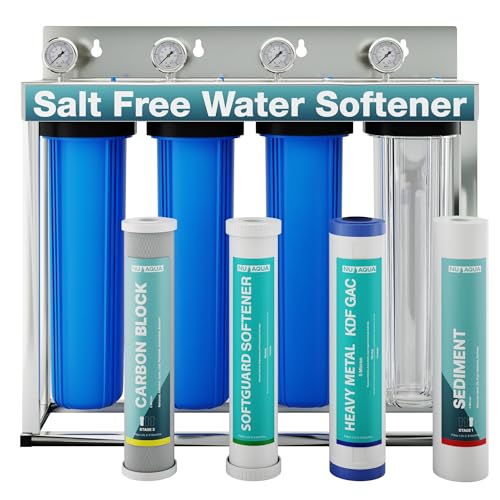
NU Aqua 4-Stage Salt Free Water Softener System
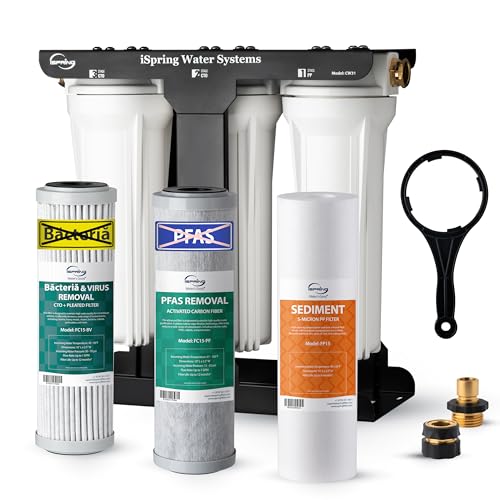
iSpring CW31-PFBV 3-Stage RV Water Filter System
A Breakdown Of The Leading Choices
The Express Water FLTSETALK065Q sits underneath the sink rather than at the main line, so it polishes the water you actually drink and cook with instead of every drop your shower uses. It produces roughly 50 gallons a day, which is comfortable for a household of four that runs a coffee maker, a kettle, and meal prep through filtered water.
The standout piece is the alkaline remineralization stage, which adds back minerals that reverse osmosis (a membrane process that strips dissolved solids from water) tends to remove. If you find plain RO water flat or metallic-tasting, the alkaline cartridge changes that. It’s the pick most likely to win over skeptics who tried RO years ago and bounced off.
Positive Takeaways
- Alkaline stage restores taste and adds minerals to RO-purified water
- Complete filter bundle, so you do not piece together cartridges separately
- 50 gallons per day covers family-sized drinking and cooking demand
- Modular setup that fits standard under-sink housings in most kitchens
Things To Consider
- Only treats one tap, not the shower or laundry line
- Annual cartridge replacement adds ongoing maintenance
Built With In Mind
Families who want noticeably better drinking water and cookware-friendly filtered output, and who already have (or will install) a dedicated under-sink unit.
Skip It When
You need every tap filtered, including the shower: in that case the Waterdrop WHF21-FG serves a whole household instead of just one faucet.
Well water behaves differently from city water, and the WHF21-FG is built around that. Its dual-stage combination specifically targets iron and manganese, two minerals that stain fixtures and ruin water heaters if left untreated. If your private well produces rust-colored water after heavy rain, this is the system designed for that headache.
The 10-inch by 4.5-inch housings are a step up from the slimmer 2.5-inch cartridges, which means longer service life between changes. It also reduces heavy metals like lead, mercury, cadmium, chromium, and copper, so households worried about older plumbing get a broader safety net.
Strengths Worth Knowing
- Targets iron and manganese, the main culprits in well-water staining
- Reduces common heavy metals alongside sediment
- Larger 10×4.5 housing extends time between cartridge swaps
- Works on both municipal and well water sources
Honest Caveats
- Hardness reduction only, no salt-based softening for very hard water
- Larger housings need more wall space near the main shutoff
Feature Snapshot
Who It Suits Best
Households drawing from a private well, especially those noticing orange staining in sinks or a metallic taste in the shower.
Consider Something Else When
You primarily fight chlorine taste and odor on city water: the Waterdrop WHF21-PG is tuned for that job with its coconut-shell carbon stage.
Sediment filters do a thankless job: they catch rust, sand, and silt so the carbon stage behind them can focus on chlorine and taste. The Aquaboon 25-pack handles that grunt work for years on end, which suits anyone who would rather replace cartridges once a decade than shop for them every spring.
At 5 microns, the weave is fine enough to trap visible particles but loose enough to keep flow rates comfortable on a standard residential line. You may find the 2.5-inch diameter limits capacity, so on high-demand homes, expect changes every couple of months rather than twice a year.
What Pays Off
- 25 cartridges cover multi-year replacement cycles in one purchase
- 5-micron rating catches visible sediment without choking flow
- Universal 10×2.5 fit works in most standard housings
- Multi-layered design holds more debris before clogging
Points To Keep In Mind
- Sediment only, so it must pair with a carbon or RO stage
- 2.5-inch cartridges clog faster than 4.5-inch models on heavy sediment loads
Right Fit For
Homeowners with an existing two- or three-stage housing who want to stockpile replacements and avoid mid-winter trips to the hardware store.
Look Elsewhere When
You have not installed a housing yet and want everything bundled: the Waterdrop WHF21-PG ships as a complete system ready to mount.
PUREPLUS plays in the same space as Aquaboon but ships a more manageable six-pack, which makes sense if you want roughly half a year of replacements without committing to a 25-count tower. The PP10 melt-blown polypropylene (a dense synthetic fiber that traps particles as water passes through) construction is the workhorse standard for sediment stages.
The compatibility list is long, including Culligan P5, GE FXHTC, Whirlpool WHKF-DWHV, and many standard 10×2.5 housings. For homeowners inheriting a system whose model number has faded from memory, that broad fit list removes guesswork when reordering.
What Earns Its Place
- Six-cartridge pack balances supply size with shelf space
- Broad compatibility with common residential filter brands
- Melt-blown PP media handles sediment loads reliably
- 5-micron rating pairs cleanly with a follow-on carbon stage
Trade-Offs To Consider
- Sediment-only function, so a separate carbon stage is required
- Smaller 2.5-inch diameter means shorter service intervals on turbid water
Made For
Homeowners who replace cartridges on a fixed six-month cadence and want a known-good drop-in for an existing housing.
Not Your Match When
You want fewer swaps and longer life between changes: the larger 10×4.5 cartridges in the Waterdrop WHF21-FG last considerably longer per cycle.
Express Water’s two-pack is the smallest useful sediment order, ideal for the homeowner who wants one replacement staged plus a spare on a shelf. The cartridges drop into Express Water’s own whole-house housings without fuss, which matters because mixing brands occasionally causes seal complaints.
For households that already use Express Water’s three-stage whole-house system, sticking with the same brand for replacement cartridges tends to keep things quiet. The 5-micron rating is the industry-standard sediment setting, matching most pre-filters on the market.
The Good Stuff
- Two-pack fits neatly in a utility closet without crowding
- Direct fit for Express Water housings, no adapter needed
- 5-micron sediment capture suits most municipal supplies
Where It Is Less Suited
- Only two cartridges, so reorder cycles come around faster than larger packs
- Pre-filter only, must be paired with carbon and finishing stages
Whose Shelf It Belongs On
Existing Express Water system owners who want a one-stop reorder from the same brand they already trust.
Reach For A Different Pick When
You want the longest possible time between reorders: the Aquaboon 25-pack keeps you stocked for years at a stretch.
This three-filter set is the under-sink counterpart to Express Water’s whole-house line, designed for homeowners who already drink from a dedicated filtered tap and just need fresh cartridges. Each filter plays a different role, so replacing all three at once keeps the system balanced.
The 10-inch housings are a familiar size, and the bundle approach avoids the trial-and-error of mixing brands across stages. Express Water engineered each filter to work in sequence, so the sequence matters: sediment, then carbon, then polishing.
The Practical Payoff
- Three-filter bundle refreshes the full system in one purchase
- Direct-fit replacement for Express Water under-sink units
- Sequential design matches the original system tuning
Factors To Consider
- Brand-locked to Express Water under-sink housings
- Annual replacement cycle adds recurring cost
- Treats one tap only, not the whole home
Quick Facts
Best Suited To
Express Water under-sink system owners scheduling their yearly cartridge swap and wanting all stages from one order.
A Better Fit Elsewhere
You want alkaline remineralization added back: the Express Water FLTSETALK065Q includes that stage as part of its filter set.
The WHF21-PG is the city-water sibling to the WHF21-FG reviewed earlier. Where the FG targets iron and manganese, this model leans on a polypropylene sediment filter plus a coconut-shell GAC (granular activated carbon) stage to tackle chlorine taste and odor. Coconut carbon tends to outperform coal-based carbon on smell reduction, which is why it’s popular in premium shower filters too.
For households on municipal water who simply want better-tasting water from every tap and gentler showers, this two-stage system is the straightforward fit. The 10×4.5 housing keeps service intervals reasonable, and replacement cartridges are widely available.
Noteworthy Benefits
- Coconut-shell GAC stage reduces chlorine taste and odor effectively
- PP pre-filter extends the life of the carbon stage behind it
- Whole-house coverage from a single point-of-entry install
- Standard 10×4.5 housing accepts commonly stocked cartridges
Some Limits To Know
- Not designed for iron-heavy well water, where the WHF21-FG fits better
- No dedicated softening stage for very hard water
Feature Rundown
Who Should Grab It
City-water households who want chlorine-free showers and better-tasting drinking water without salt-based softening.
Swap It Out When
You need salt-free hardness reduction: the NU Aqua 4-Stage adds scale-prevention media to the same whole-house concept.
If you already own the WHF21-PG reviewed above, the WF10PG is the matching replacement cartridge. It combines the PP and GAC stages into one unit, simplifying the swap compared to handling two separate cartridges.
It’s also compatible with several other standard 10×4.5 systems, including the 3M Aqua-Pure AP801 and AP810, plus Whirlpool WHKF-GD25BB. If your housing came from a different brand and fits the same dimensions, this cartridge is worth considering before defaulting to the original brand.
Practical Pluses
- Combined PP and GAC in a single cartridge simplifies swaps
- Direct fit for Waterdrop WHF21-PG housings
- Cross-compatible with several 3M and Whirlpool systems
- 5-stage filtration performance in a single drop-in
Details To Watch
- Cartridge only, no housing or mounting bracket included
- Compatibility outside the Waterdrop line should be verified before ordering
Perfect Match For
Homeowners with a WHF21-PG already mounted who need to replace both stages without buying two separate cartridges.
Another Choice May Suit
You do not yet have a housing at all: the Waterdrop WHF21-PG ships with the full mounting hardware ready to install.
The NU Aqua is the pick for homeowners who want softer-feeling water without hauling salt bags or paying for a brine system. It uses template-assisted crystallization media (a catalytic process that changes dissolved hardness minerals into inert crystals that won’t stick to surfaces) to prevent scale, rather than swapping calcium and magnesium out like a traditional softener.
The four-stage design layers sediment, carbon, scale prevention, and a polishing stage. It also reduces heavy metals like lead, mercury, and arsenic, which older plumbing can leach into the water. For households worried about appliance lifespan (water heaters, dishwashers, washing machines), this is the right tool.
Real-World Strengths
- No salt required, so no brine discharge or taste changes
- Preserves beneficial calcium and magnesium in the water
- Four stages tackle sediment, chlorine, scale, and heavy metals
- Protects plumbing and appliances from mineral buildup
A Few Limitations
- Salt-free conditioning does not lower true hardness readings the way ion-exchange softeners do
- Higher upfront complexity than a single-stage system
Who Will Love This
Homeowners who want scale control on appliances and softer skin after showers, but dislike salt-based softening.
Where A Sibling Pick Shines
Your main complaint is chlorine taste and odor: the Waterdrop WHF21-PG focuses its stages on carbon filtration instead of scale prevention.
The iSpring CW31-PFBV breaks from the stationary format and goes where the road takes you. RVers and overlanders deal with unfamiliar water at every campsite, and this three-stage system tackles the most common concerns: sediment from aging park lines, chlorine from municipal hookups, and PFAS (per- and polyfluoroalkyl substances, a class of persistent synthetic chemicals found in some water sources) where they appear.
The third filter claims high removal rates for bacteria and viruses, which is a meaningful upgrade for anyone filling tanks from non-potable sources. Brass fittings and an external mounting bracket suggest the unit is built for vibration, and the small footprint fits most RV utility bays.
Features That Help
- Three-stage treatment covers sediment, PFAS, and microbiological concerns
- Brass fittings resist vibration and corrosion on the road
- External mounting bracket included for easier install
- Compact design fits typical RV plumbing compartments
Worth Bearing In Mind
- Not sized for whole-house residential flow rates
- Cartridge replacements specific to RV use, not interchangeable with home systems
Spec Overview
The Right Fit
RVers, overlanders, and van-lifers who need confident water treatment regardless of the campground hookup.
Not Your Match When
You need a system tied into residential plumbing at the main line: the Waterdrop WHF21-FG is built for permanent whole-house installation.
What To Weigh Before Choosing Full House Water Filtration Systems
Match The System To Your Water Source
City water and well water stress filters differently. Municipal supplies typically need carbon stages for chlorine taste and odor, while well water more often demands iron and manganese reduction. Sediment is common to both, which is why a sediment pre-filter shows up across nearly every configuration. Identifying your source up front avoids paying for stages you do not need, or worse, missing the stage that actually solves your problem.
Think About Cartridge Size And Service Intervals
The 10×2.5-inch cartridges (the slim format) found in the Aquaboon and PUREPLUS packs fit standard housings but clog faster on heavy sediment. The 10×4.5-inch “big blue” format used in the Waterdrop WHF21 series holds more media, so swaps happen every six to twelve months instead of every two. Larger housings cost more and need more wall space, but the longer intervals usually justify it over years of ownership.
Decide What You Actually Want Filtered
Under-sink reverse osmosis treats the kitchen tap only, so the shower and washing machine stay untreated. Whole-house systems treat every tap but use simpler stages that do not polish drinking water to the same degree. Some households run both: a point-of-entry system for general filtration plus an under-sink RO for the cookware and the kettle. There is no single right answer, but knowing which trade-off fits your routine is the decision that shapes everything else.
Key Considerations Across These Picks
Pitfalls Shoppers Hit
The most common mistake is buying a filtration system without identifying the actual problem. People with hard water purchase chlorine-reduction carbon filters and wonder why their shower glass still spots. Others install iron-reduction cartridges on city water and never see the benefit. Match the system’s media to your water report or to the symptoms you actually observe (staining, taste, odor, scale).
Where The Extra Money Goes
Premium whole-house systems like the NU Aqua 4-Stage add scale-prevention and heavy-metal stages that budget two-stage systems skip. Higher-end reverse osmosis sets like the Express Water FLTSETALK065Q include alkaline remineralization, which restores minerals stripped by the membrane. Those additions matter when your plumbing is older, your water is unusually hard, or you simply prefer the taste of remineralized water.
Frequently Asked Questions
How Often Do Whole House Filter Cartridges Need Replacing?
Sediment cartridges typically need replacement every two to six months depending on water clarity. Carbon stages last longer, often six to twelve months, because the sediment pre-filter protects them. Heavy sediment loads shorten those intervals significantly, so check the manufacturer’s rated service life and adjust based on what you actually see.
Can One Whole House System Handle Both City And Well Water?
Most two-stage and three-stage systems handle both, but the specific media matters. A carbon-focused system like the Waterdrop WHF21-PG works fine on city water but will not address iron from a private well. A system designed for both, like the WHF21-FG, targets the contaminants more common in well water. Match the stages to your source rather than assuming any system covers every case.
What Is The Difference Between Filtration And Water Softening?
Filtration physically traps particles and adsorbs chemicals through carbon media. Softening specifically targets hardness minerals, calcium and magnesium, using ion exchange or scale-prevention media. The NU Aqua uses salt-free scale prevention, which changes how hardness behaves without removing the minerals. True softening produces softer-feeling water, while scale prevention mainly protects pipes and appliances.
Is Sediment Filtration Necessary If I Already Have A Carbon Stage?
Yes, in most cases. Sediment pre-filters catch sand, rust, and silt that would otherwise clog the carbon stage prematurely. Running carbon without sediment protection shortens cartridge life and can let visible particles through. The two-stage format exists because each stage does a different job.
How Hard Is It To Install A Whole House Filter System?
Point-of-entry systems typically mount on the main water line before it branches through the house. Most homeowners with basic plumbing experience can handle a single housing install, but soldering, additional shutoff valves, or bypass loops may require a plumber. RV-mounted systems like the iSpring CW31-PFBV are simpler since they use threaded fittings designed for portable use.
Final Take
Your water source, your plumbing age, and the symptoms you actually notice should drive the choice more than spec sheets. City water with chlorine taste points toward a carbon stage, while well water with staining calls for iron reduction. If you want simpler ownership and fewer reorders, the larger 10×4.5 housings are worth the wall space. Match the system to your real situation, and the maintenance cycle stays manageable for years.