Tap water tells a different story in every home. In some neighborhoods it tastes fine but leaves chalky spots on glassware, while in others a faint chlorine edge creeps into every glass. Faucet filtration systems, ranging from under-sink reverse osmosis rigs to gravity-fed countertop units, take that variability out of the equation so you can trust what comes out of the tap. The ten picks below span heavy-duty RO setups, simpler point-of-use filters, and renter-friendly options, so you can match a system to the quirks of your water and the layout of your kitchen.
The Essentials At A Glance

Home Master TMHP-L HydroPerfection RO System

iSpring RCC7P-BLK 5-Stage RO with Booster Pump

APEC Water ROES-50 5-Stage RO System 50 GPD
APEC Water ROES-PH75 Alkaline RO 75 GPD
APEC Water ROES-50X with Extra Filters

APEC Water ROES-PH75X Alkaline RO with Extras

Purewell 3-Stage Gravity Countertop 2.25 Gal
Purewell 8-Stage Gravity Countertop 2.25 Gal

Purewell 3-Stage Countertop 2.25 Gal Spigot
VIVA21 5-Stage RO System with Leak Detector
The Picks, Examined More Closely
The Home Master TMHP-L sits at the heavyweight end of under-sink filtration, pairing a nine-stage cascade with a UV stage that targets microbiological concerns. A DOW Filmtec membrane is the heart of the unit, and the system also pushes the treated water through a two-pass remineralization layer so the output doesn’t taste like flat laboratory water. You get a brushed nickel Lux faucet in the box plus a kit to tee into a fridge’s ice line, which is a useful bundle for a single-bath home with a single fridge.
Compared with the iSpring RCC7P-BLK further down, this Home Master trades a booster pump for UV, so the right pick depends on whether your water problem is pressure or biology. People on hard municipal water tend to appreciate the remineralization step, since it puts a touch of calcium and magnesium back into the glass.
What Makes Sense
- Nine-stage cascade handles sediment, carbon, membrane, and remineralization in one rack.
- DOW Filmtec membrane (a high-rejection reverse osmosis element) is widely respected for contaminant reduction.
- Two-pass remineralization improves taste over stripped RO water.
- UV stage adds a layer of protection against microorganisms in well or older municipal supplies.
- Refrigerator connection kit and dedicated faucet ship in the box.
Things To Consider
- Without a booster pump, slow tap flow can extend tank fill times in low-pressure homes.
- The full nine-stage rack takes up more under-sink space than a five-stage setup.
Key Product Details
Who It Suits Best
Owners on hard municipal or well water who want remineralization and UV in one rack and don’t mind trading cabinet space for a deeper filtration chain.
Skip It When
Low-pressure city homes will do better with the iSpring RCC7P-BLK, since its booster pump keeps the tank filling at a steady clip.
The iSpring RCC7P-BLK leans into a problem many RO buyers hit on day one: thin household water pressure. Its booster pump pushes the feed water up to a working range that a passive membrane can’t reach on its own, which keeps tank fill times reasonable and extends membrane life. The kit ships with a 304 stainless steel black faucet and a top-mounted design that simplifies the hole saw step during installation.
Stacked next to the Home Master TMHP-L, this iSpring gives up the UV and remineralization stages in exchange for a pump-driven five-stage path. For renters and owners with low pressure who don’t want UV, that’s a fair trade.
Where It Helps
- Booster pump handles homes with low feed pressure that would starve a passive RO unit.
- Top-mounted faucet design reduces the chance of a crooked hole in the countertop.
- 304 stainless steel black faucet adds a modern look to a contemporary kitchen.
- Five-stage path targets chlorine, lead, and a wide TDS (total dissolved solids) range.
Worth Noting
- The pump adds a faint hum, which you may hear from a quiet kitchen at night.
- Fridge connection requires a separate ICEK kit.
Made For
Apartment dwellers and city homeowners dealing with low water pressure who want a clean RO install without a UV stage.
Look Elsewhere When
Anyone on well water with microbial concerns will be better served by the Home Master TMHP-L’s UV stage.
The APEC ROES-50 has been a workhorse in the under-sink category for years, and the design has earned that longevity by staying simple. Five stages push feed water through a sediment pre-filter, two carbon blocks, the RO membrane, and a final polishing carbon, with a 50 gallon-per-day capacity that handles most small families. The included tank keeps a reserve of treated water ready so the faucet doesn’t trickle when you fill a kettle.
Compared with the iSpring RCC7P-BLK, this APEC skips the booster pump, so it relies on your existing household pressure. In homes where pressure is healthy, the omission is a cost saving rather than a compromise.
Where It Delivers
- Five-stage filtration covers sediment, carbon, and RO in a compact under-sink rack.
- 50 GPD output comfortably covers a household’s drinking and cooking needs.
- Long-life filters reduce the frequency of swap-outs.
Trade Offs
- No booster pump means slower tank fills in low-pressure homes.
- No remineralization stage, so the water reads as flat on the palate.
- No UV stage, which matters on private well water.
Right Fit For
First-time RO shoppers with healthy municipal pressure who want a proven five-stage setup without paying for extras they won’t use.
Consider Something Else When
People chasing alkaline or remineralized water should look at the APEC Water ROES-PH75, which adds a pH stage on top of the same base system.
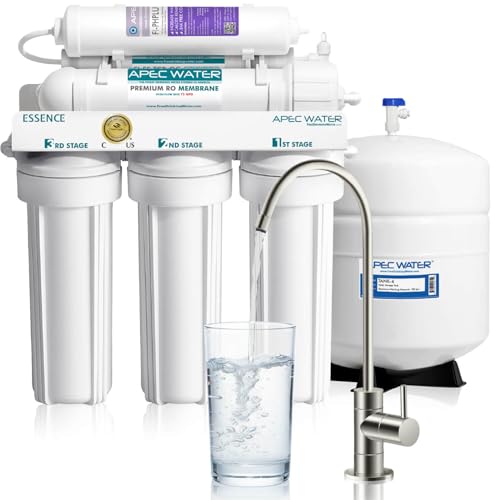
The APEC ROES-PH75 takes the proven ROES-50 platform and stretches it into a six-stage setup that finishes with a remineralization stage. The extra stage nudges pH back up after the RO step strips most minerals, and that tends to land well with people who find flat RO water unappealing. With a 75 gallon-per-day membrane, you also get a faster fill rate for a larger household.
Sitting alongside the ROES-50, this model is the upgrade path for shoppers who like the APEC design but want more capacity and a tastier glass. It still skips a booster pump, so pressure remains a real consideration.
What Works In Its Favor
- 75 GPD membrane fills the tank faster than the 50 GPD sibling.
- Sixth-stage calcite filter adds calcium carbonate back into the water.
- Accepts a feed pressure up to 2000 ppm TDS without complaint.
Points To Keep In Mind
- Calcite stage can raise hardness slightly in already hard regions.
- No booster pump, so a pressure-boosting accessory may still be needed in older homes.
Feature Card
Best Suited To
Families of three or four who want a faster RO system and prefer their water with a touch of mineral character.
Not Your Match When
Very hard water already causing scale headaches will do better with the Home Master TMHP-L’s higher-capacity DOW membrane and dedicated remineralization pass.
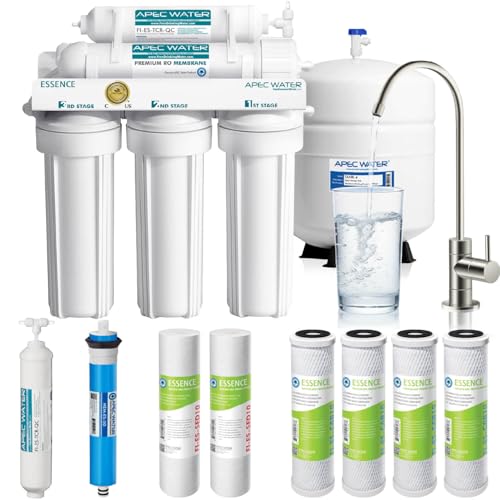
The APEC ROES-50X is the same five-stage ROES-50 core with a useful twist: a full set of replacement cartridges ships in the box. For households that don’t want to think about filter changes for a year or more, having spares ready at install time removes a small but real source of friction. You can stagger swaps and never end up with a system that suddenly has no replacement on hand.
Next to the standard ROES-50, this is the bundle to choose if you already know you’ll be the one changing filters, since the extra cartridge set arrives with the system. Functionally, the water quality is identical day one.
Practical Pluses
- Full set of replacement cartridges included at install time.
- 50 GPD output matches the proven ROES-50 performance.
- Long-life filters cut down on how often you order replacements.
Small Caveats
- No booster pump, same as the base ROES-50.
- You may end up with spare filters that need to be stored in a dry spot.
Who Will Love This
Owners who want a low-maintenance install and would rather have replacement cartridges on the shelf than order them mid-year.
Where Another Pick Suits Better
If you want a tankless-style install with a pump, the iSpring RCC7P-BLK handles low-pressure situations more directly.
The APEC ROES-PH75X is the most layered of the APEC RO family on this list. It keeps the six-stage alkaline path of the ROES-PH75, then layers on an extra high-capacity pre-filter set for stages one through three. NSF/ANSI 58 and 372 certifications (standards that cover RO contaminant reduction and lead content in contact components) cover the system’s contaminant performance and lead content, which is a useful anchor for shoppers who care about third-party validation.
For households that run the RO tap hard, the extra pre-filter capacity means you go longer between stage-one and stage-three changes. People on hard water with sediment issues tend to feel that benefit most.
Useful Highlights
- NSF/ANSI 58 covers contaminant reduction, and 372 covers lead content in the wetted parts.
- High-capacity pre-filter set stretches service intervals on the dirty stages.
- Six-stage path ends with a remineralization stage for taste and pH.
- 75 GPD membrane handles a busy household’s drinking water demand.
A Few Limitations
- More stages mean more filter changes down the line, even if each one is less frequent.
- Pressure sensitivity still applies, since no booster pump ships with the unit.
Key Product Details
Perfect Match For
Heavy-use households that want third-party-verified performance and the longest possible stretch between pre-filter changes.
Swap It Out When
Anyone running on low pressure should look at the iSpring RCC7P-BLK, where the booster pump fixes a problem this APEC model doesn’t try to solve.
The Purewell 3-Stage is a different animal from the rest of the list. It’s a gravity-fed system, so there’s no under-sink plumbing, no electric pump, and no permanent install. You pour tap water into the upper chamber, gravity pulls it through two ceramic filters into the lower 2.25-gallon reservoir, and the ceramic layers handle sediment, chlorine, and a wide range of organic compounds. For renters who can’t drill into a countertop, that zero-install reality is the headline feature.
Compared with the under-sink RO units above, the trade is straightforward: gravity systems are slower and use no pressure-driven membrane, so they don’t strip dissolved solids the way RO does. For people whose main complaint is chlorine taste and visible sediment, that’s still a meaningful upgrade.
Everyday Advantages
- No plumbing or power, so it works in any rental, dorm, or RV.
- Ceramic filters are washable and reusable, cutting long-term cost.
- Stainless steel body holds up to kitchen heat and daily use.
Honest Caveats
- Gravity flow is slow, so plan ahead when filling a kettle or pot.
- Ceramic filters don’t reduce dissolved minerals or salts the way RO does.
- The 2.25-gallon reservoir takes up a chunk of counter space.
Built With In Mind
Renters, students, and anyone in a short-term living situation who wants cleaner water without making a hole in the countertop.
Reach For A Different Pick When
For a deeper reduction of dissolved solids, the APEC Water ROES-50 does more in the same kitchen footprint.
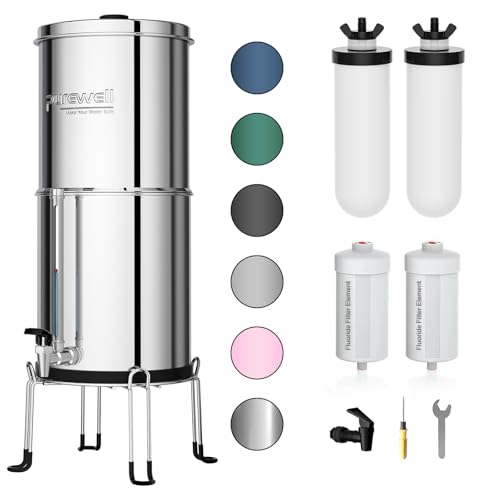
The Purewell 8-Stage takes the basic gravity format and stretches it with two ceramic filters and two additional cartridges, one of which targets fluoride. The result is a still-countertop unit that handles a wider range of contaminants than the three-stage version, including fluoride and several heavy metals. The stainless steel body and metal water-level spigot keep the construction sturdy enough for daily kitchen use.
Side by side with the Purewell 3-Stage further up, the eight-stage path is the right call for shoppers who specifically want fluoride reduction from a non-plumbed system. The slower flow rate and higher replacement cost are the obvious prices for that extra coverage.
A Favorable Mix
- Eight filtration layers cover sediment, chlorine, fluoride, and a range of heavy metals.
- Ceramic layers are washable, which trims the long-term cost of ownership.
- No install, no power, and no countertop drilling.
Possible Compromises
- Flow rate is even slower than the three-stage sibling, since water passes through more media.
- Four filters mean four parts to track and replace on different schedules.
Feature Card
Whose Shelf It Belongs On
Off-grid cabins, travel setups, and small kitchens where plumbing isn’t an option but fluoride and metal reduction still matter.
Not Your Match When
Shoppers with a normal under-sink cabinet should pick the APEC Water ROES-PH75X, which pulls dissolved solids more aggressively.
The Purewell 3-Stage Spigot is the more practical sibling of the basic Purewell 3-Stage earlier in the list. It keeps the same two ceramic filters and stainless body, but adds a metal water-level spigot on the lower chamber so pouring is cleaner and the unit can sit on a higher shelf. Shared kitchens, office break rooms, and small cafes often prefer that kind of access point.
Compared with the three-stage unit without the spigot, this version is the one to pick if multiple people will be drawing water at different times. The filtration behavior is the same, so the difference is purely in daily ergonomics.
Bright Spots
- Spigot design makes pouring clean and controlled at chest height.
- Ceramic filters are washable, keeping the long-term cost down.
- Stainless body is sturdy enough for shared use.
Less Ideal Details
- Spigot can drip if not closed firmly, a minor maintenance note.
- Still no reduction of dissolved minerals compared to RO units.
Quick Technical Notes
Who Should Grab It
Shared kitchens, small offices, and break rooms that want gravity filtration in a countertop-friendly package.
Where A Sibling Pick Shines
For more aggressive contaminant reduction, the Purewell 8-Stage covers a wider list without changing the install format.
The VIVA21 5-Stage rounds out the list with a setup aimed squarely at people installing an under-sink system for the first time. It carries a WQA Gold Seal certification to NSF/ANSI 58 and 372, which means an independent body has reviewed both the contaminant performance and the lead content of the contact components. The included lead-free faucet, storage tank, and a leak detector are the practical extras that lower the cost of entry.
Stacked against the APEC ROES-50, the VIVA21 swaps brand recognition for a more complete out-of-box kit. For shoppers who value that “everything in the box” approach, that tradeoff usually lands well.
Where It Excels
- WQA Gold Seal covers both performance (NSF/ANSI 58) and lead content (NSF/ANSI 372).
- Leak detector is an unusual addition at this tier and reduces under-sink surprises.
- Lead-free faucet and storage tank ship with the unit.
Softer Spots
- No booster pump, so it leans on healthy household pressure.
- Replacement filter availability is narrower than the larger brands on the list.
Right Fit For
First-time under-sink installers who want a certified system with a leak alarm included from day one.
Consider Something Else When
Low-pressure homes will do better with the iSpring RCC7P-BLK, since the booster pump solves a different problem than a leak detector does.
Factors That Matter When Choosing Faucet Filtration Systems
Match the System Type to the Water Problem
Reverse osmosis systems force water through a semipermeable membrane under pressure, stripping dissolved solids like lead, arsenic, and nitrates along with chlorine. Gravity-fed ceramic systems rely on slow physical and chemical filtration, which handles sediment, chlorine, and some organics but not dissolved minerals. Matching the system to the actual contaminant list is more useful than chasing the highest stage count.
Pressure, Space, and Plumbing Access
RO units that depend on household pressure work best in homes with a healthy feed. The iSpring RCC7P-BLK’s booster pump addresses low-pressure buildings, while a simple gravity unit sidesteps the question entirely. Measure the under-sink cabinet before buying: a five-stage rack fits in most kitchens, but a nine-stage unit like the Home Master TMHP-L needs real vertical clearance.
Certifications and Replacement Cartridge Availability
Independent certifications such as NSF/ANSI 58, NSF/ANSI 372, and WQA Gold Seal add a layer of confidence for shoppers who want verified performance. Equally important is the long-term picture: filters wear out, and units from brands with steady cartridge supply tend to be the more forgiving ownership experience.
Key Considerations Across These Picks
Pitfalls Shoppers Hit
A common mistake is picking the unit with the most stages without checking whether the home can support it. Pressure, cabinet size, and the actual contaminant profile matter more than the stage count printed on the box. Another is ignoring replacement filter costs, since the cheapest unit to buy can be the most expensive to maintain over five years.
Where The Extra Money Goes
Higher-tier RO models typically fund a more durable membrane, a remineralization stage, a UV stage, or a more complete accessory kit. Each addition targets a real-world problem: hard water spots, microbiological concerns, or the simple frustration of missing parts at install time. The right tier is the one that solves the problem on the installer’s actual water report, not the one with the most accessories.