

Living with persistent indoor humidity above 50 percent RH (relative humidity, the percentage of moisture the air holds relative to what it can hold at a given temperature) feels miserable in a midsize home. Musty basements, foggy bathroom mirrors, and that sticky summer sheen on hardwood floors all point to a moisture problem a proper dehumidifier can actually solve.
The trick is matching extraction capacity (pints per day at standard AHAM conditions, 80°F/60% RH) and tank routing to your actual floor plan, then living with the noise and maintenance that come with it. This roundup walks through nine models sized for the 1,500 to 6,000 sq ft range, so you can pick what fits your square footage without overspending or under-equipping the space.
A Fast Comparison Of The Options
PLUSCENT 1,500 Sq. Ft 21 Pint Dehumidifier

BANABIE 2500 Sq.Ft Dehumidifier, 32 Pints/Day

Waykar 80 Pints 5000 Sq. Ft Energy Star Dehumidifier
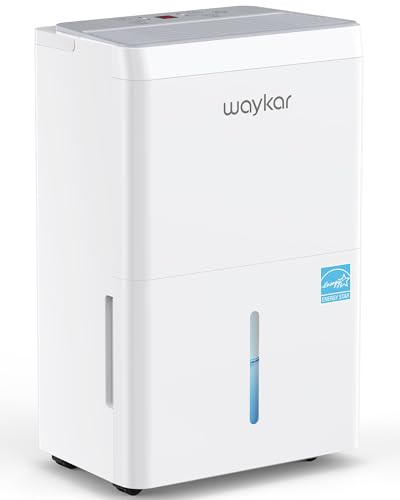
Waykar 6000 Sq.Ft Energy Star Dehumidifier, 120 Pint/Day
Waykar 34 Pints 2000 Sq. Ft. Energy Star Dehumidifier
Waykar 120 Pints 6000 Sq. Ft Energy Star Dehumidifier

VEAGASO Dehumidifier, 28 Pints, 2000 Sq.Ft, 38dB
Waykar 5000 Sq. Ft. 80 Pints Energy Star Dehumidifier
Waykar 2000 Sq. Ft. 30 Pints Energy Star Dehumidifier
Inside Each Recommended Option
For homes that genuinely sit at 1,500 sq ft, sizing down to the PLUSCENT 21-pint model avoids the overkill of bigger compressors cycling on and off in an undersized room. It runs on a modest 160-watt draw, which helps when the unit runs for hours in a bedroom or finished basement.
The included drain hose changes daily ownership for many shoppers, since you can route condensate (the water vapor the unit pulls from the air and condenses into liquid) straight to a floor drain instead of dumping the tank every morning. You’ll still want to check the filter monthly, especially in dusty homes or where pets shed.
The Value In It
- Drain hose included for set-and-forget basement or bathroom use.
- 160W draw keeps operating costs gentle during long dehumidifying seasons.
- 21-pint AHAM rating is well matched to a true 1,500 sq ft footprint.
- Lightweight cabinet is easy to relocate between the basement and a bedroom.
Things To Consider
- Owners commonly report the factory filter needs cleaning every two to three weeks in dusty homes.
- No pump, so gravity drainage needs a downward slope toward the drain.
- At 21 pints, it underperforms in genuinely soggy basements with active water intrusion.
Key Product Details
Whose Shelf It Belongs On
First-time owners in modest homes who want a no-frills, properly sized unit with continuous drainage.
Consider Something Else When
Households with chronically damp basements over 2,000 sq ft will get more out of the BANABIE 32-pint.
The BANABIE 32-pint steps up to a rotary compressor setup, which generally pulls more moisture per kilowatt-hour than piston-style units in the same class. That’s the kind of internal choice you only see if you read the spec sheet carefully, but it shapes long-term running costs.
At a 2,500 sq ft ceiling, it covers a finished basement or an open first floor without needing a second unit in the next room. Owners running it on continuous mode during humid summers typically find tank fills every few days, which makes a gravity drain hose worth adding.
Noteworthy Benefits
- Rotary compressor tends to be quieter and more efficient than older piston designs.
- 32-pint capacity covers a true 2,500 sq ft footprint with humidity to spare.
- Optimized airflow path reduces cold spots in corners where mold often starts.
Honest Caveats
- Empty-tank auto shutoff matters here, since 32 pints a day can fill the reservoir quickly.
- Casters and a top handle would make moving it between floors easier.
- In unheated basements, performance below 60°F typically drops noticeably.
Quick Facts
Who It Suits Best
Families with one consistently damp zone, like a finished basement or a large living room, who want stronger pull than a 21-pint starter.
Skip It When
You need whisper-level operation near a nursery, where the VEAGASO 28-pint sleep mode makes more sense.
Stepping into 80-pint territory means a true Energy Star compressor, which matters if the unit runs eight or more hours a day through muggy summers. Waykar fits that brief at 5,000 sq ft coverage, landing between smaller home units and the commercial-grade 120-pint picks.
For homeowners with a finished basement, the higher daily extraction can drop a 70 percent RH room into the 45 to 50 percent comfort zone within a day or two. That’s a real shift you feel in the air, not just on a hygrometer.
Useful Strengths
- Energy Star rated compressor reduces kilowatt-hour draw over marathon summer sessions.
- 80-pint extraction handles 5,000 sq ft homes with persistent humidity complaints.
- Auto-restart after a power outage is a quiet but valuable feature for storm-prone regions.
Trade-Offs To Consider
- At 80 pints, the internal tank fills fast, so continuous drainage is almost mandatory.
- The cabinet is heavier than smaller picks, which matters on staircases.
- Owners commonly report the air filter needs vacuuming every three to four weeks in pet households.
Technical Highlights
Made For
Owners of mid-to-large homes where a 34-pint unit has clearly run out of headroom and a 120-pint feels like too much.
Look Elsewhere When
You need placement near a bedroom, since the Waykar 6000 sq ft 120-pint quiet variant is tuned for lower noise.
Big extraction and quiet operation usually sit at opposite ends of the trade-off curve, but this Waykar narrows the gap with a 40 dB rating on its lower fan setting. To put that in context, 40 dB is roughly the noise floor of a quiet library, so most evenings it fades behind a TV at moderate volume.
It ships with both a drain hose and a built-in tank, plus an Auto Comfort mode that adjusts fan speed based on the room’s current RH reading. That means less babysitting once you’ve set a target humidity.
The Practical Payoff
- 40 dB low-fan operation suits living areas adjacent to bedrooms.
- 120-pint extraction covers up to 6,000 sq ft with serious moisture load.
- Auto Comfort mode adjusts fan speed without manual tweaks.
- Drain hose included alongside the tank for flexible setup.
Points To Keep In Mind
- The 40 dB figure applies to low-fan operation; high-fan extraction is noticeably louder.
- Auto Comfort mode occasionally over-dries very small rooms without manual adjustment.
- Its footprint is larger than the 30- or 34-pint Waykar picks, so plan floor space.
Best Suited To
Homeowners with open layouts who want serious moisture pull without a turbine-style roar nearby.
Reach For A Different Pick When
You mostly need a nursery-grade sleeper, where the VEAGASO 38 dB sleep mode has a quieter floor.
For homes closer to 2,000 sq ft, the 34-pint Waykar offers a comfortable middle path between entry-level 21-pint picks and the heavy-hitter 80- and 120-pint units. The 90-degree swing louver (the adjustable vent that directs airflow side-to-side) helps spread dried air across a room rather than dumping it in one corner.
It covers apartments and modest single-family homes without the compressor cycling on and off constantly. You’ll likely find yourself emptying the tank every two to three days in typical summer conditions, which is manageable without a permanent drain setup.
Benefits That Matter
- 34-pint capacity gives genuine headroom over a 21-pint starter in real-world humidity.
- 90-degree swing louver distributes dry air across a wider footprint.
- Compact cabinet fits in tight utility corners or closets with venting room.
Softer Spots
- No built-in pump, so upstairs placement requires a manual drain path or pump add-on.
- The 90-degree louver is manual, not oscillating.
- Filter access requires removing the tank, which can feel fiddly in tight spots.
Who Should Grab It
Apartment dwellers and small-home owners who need more pull than a 21-pint unit but don’t want a 5,000 sq ft workhorse.
A Better Fit Elsewhere
Cold basements with temperatures below 60°F get better low-RH performance from the Waykar 30-pint, which extends into the 15 percent range.
At 120 pints per day, this Waykar handles serious water-load situations: damp crawl spaces, post-flood basements, or homes with chronic groundwater seepage. The 90-degree auto swing keeps air moving so the compressor doesn’t have to push as hard to homogenize the room.
Energy Star certification at this extraction rate is the difference between a sensible running cost and a meter that spins uncomfortably fast. You’re still running a heavy appliance, but the certification suggests the manufacturer has done the efficiency work.
Reasons It Performs
- 120-pint daily extraction handles 6,000 sq ft with very high humidity loads.
- Energy Star rating keeps running costs manageable despite the larger compressor.
- Auto swing louver spreads dried air without manual redirection.
Possible Compromises
- Cabinet size and weight demand a permanent-ish placement, not a portable setup.
- Continuous drainage is essentially required at this extraction rate.
- Higher fan speeds can compete with TV audio in open living areas.
The Right Fit
Households in very humid regions or with persistent basement moisture that smaller units can’t keep up with.
Another Choice May Suit
Quieter placement near living space is better handled by the Waykar 6000 sq ft quiet 120-pint unit in this list.
Sleep disruption from a bedroom dehumidifier is one of those quiet dealbreakers you only discover after a week of running it at 2 a.m. The VEAGASO approach here is to lock the fan to its slowest speed in sleep mode and fully dim the digital display, addressing both noise and the glow that keeps light sleepers awake.
At 38 dB on its quietest setting, it’s noticeably below the 54 to 66 dB range typical for many dehumidifiers in the same class. That difference shows up clearly when you set the unit beside a bedside table.
Strong Points
- 38 dB sleep-mode operation ranks below most competitors’ “ultra-quiet” claims.
- Dimmed display removes the typical blue glow that disrupts melatonin production.
- 28-pint extraction suits a 2,000 sq ft bedroom suite without overshooting.
Where It Is Less Suited
- Sleep mode locks fan to a single low speed, so recovery from humidity spikes is slow.
- At 28 pints, it’s undersized for genuinely soaked basement walls.
- The unit lacks a continuous drain hose in some configurations, so check before assuming.
Essential Details
Perfect Match For
Light sleepers, new parents, and shift workers who run a dehumidifier through the night.
Not Your Match When
You need to dry out a chronically damp basement, where the Waykar 80-pint or 120-pint models are the better tool.
Sibling to the Waykar 80-pint basement model, this variant leans toward whole-home placement with a 30 to 80 percent adjustable RH range. That range is broader than typical fixed-setpoint dehumidifiers, which is useful if you want the unit to ramp down in milder shoulder seasons instead of short-cycling.
It’s a sensible fit for two-story homes where you want one unit to handle the main living floor without dragging a second unit upstairs. Expect a noticeable drop in perceived stickiness within the first day of continuous operation in genuine humidity.
A Few Highlights
- 30 to 80 percent RH range handles both very damp and moderately humid days.
- 80-pint extraction covers 5,000 sq ft with one unit rather than two.
- Whole-home placement reduces the need to move the unit seasonally.
Small Caveats
- At 80 pints, you’ll want a permanent drain path set up rather than relying on the tank.
- Floor placement rather than shelf mounting gives the best airflow.
- Owners commonly vacuum the air filter every three weeks in homes with shedding pets.
Built With In Mind
Owners of multi-room homes who prefer one centralized unit instead of scattered smaller dehumidifiers.
Swap It Out When
You’re tackling a very damp basement with active moisture intrusion, where the 120-pint Waykar picks do the work faster.
What sets this Waykar apart is its 15 to 80 percent RH range, which is the lower bound you’ll want in a cool basement where humidity condenses on cold surfaces even when ambient air feels dry. Most dehumidifiers only reach down to 30 percent, which can leave a chilly basement feeling damp at the wall interface.
It’s a 30-pint unit, so it’s properly matched to a 2,000 sq ft footprint without overcycling. Expect quieter operation than 80- or 120-pint siblings, which matters if your basement doubles as a finished living area.
Where It Excels
- 15 percent lower RH bound helps dry cold basements where most units stall at 30 percent.
- 30-pint extraction is appropriately sized for 2,000 sq ft homes without wasteful cycling.
- Energy Star rating keeps continuous basement operation affordable.
What To Weigh
- Below 60°F room temperature, extraction efficiency typically falls, which may require a basement-specific unit.
- No pump, so upstairs placement needs planning for drainage.
- Filter cleaning is a monthly ritual in most homes.
Who Will Love This
Owners of cool, partially below-grade basements where surface condensation is the daily headache.
Where A Sibling Pick Shines
For a true 5,000 sq ft whole-home setup, the Waykar 80-pint or 120-pint variants are the stronger match.
Choosing The Right Capacity For Your Space
Picking a dehumidifier is mostly about three numbers working together: pints per day, square footage rating, and RH range. Match the first two to your actual room size and climate, then verify the third covers your worst-case conditions.
Match Pints To Square Footage
The standard guidance is roughly 12 pints per 1,000 sq ft for moderately humid climates and 25 to 30 pints per 1,000 sq ft for genuinely damp basements or homes near water. Underbuy and the compressor runs constantly without ever hitting the target humidity. Overbuy and you pay more upfront plus waste energy short-cycling in milder weather.
Drainage Setup Drives Daily Chores
A continuous drain hose is the difference between a set-and-forget install and a daily tank-emptying ritual. For units pulling 30 pints or more per day, plan a drain path before delivery. Gravity drainage needs a downward slope, and a built-in pump (a small internal water pump that pushes condensate upward to a drain line, useful when the unit sits below the drain) lets you route uphill to a sink or window.
Noise And Placement Trade Off
Bigger compressors extract more moisture but also push more air, which means more sound. Living areas near bedrooms benefit from sleep modes in the 38 to 40 dB range. Basements and utility rooms tolerate louder operation in exchange for higher pints per day.
What Sets The Top Picks Apart
Common Shopping Slip Ups
The most common miss is sizing by the square footage label alone. A 5,000 sq ft unit in a 1,500 sq ft basement overshoots and cycles endlessly. Equally, a 21-pint starter in a soggy 3,000 sq ft basement never catches up to the moisture load. Climate matters as much as room size.
Why Top Tier Costs More
Higher-tier models earn their price through Energy Star compressors, broader RH ranges, and quieter fan engineering. You pay more upfront and less per kilowatt-hour over years of summer operation. The upgrade pays off most in homes where the dehumidifier runs eight or more hours a day for half the year.
Frequently Asked Questions
How many pints per day do I need for a 1,500 sq ft home?
For moderately humid climates, roughly 18 to 22 pints covers a 1,500 sq ft space. Damp basements or homes in very humid regions benefit from stepping up to 30 to 34 pints to avoid constant compressor cycling.
Where should I place a dehumidifier for best results?
Place the unit centrally in the dampest room with at least six inches of clearance on all sides for airflow. Avoid corners, closets without ventilation, and exterior walls, which tend to run cooler and confuse the humidity sensor.
Do Energy Star dehumidifiers really save money?
Yes, especially on units that run eight or more hours daily. Energy Star certified models typically use 10 to 20 percent less energy than non-certified units at the same pint rating, which adds up across a full humid season.
Can a dehumidifier run continuously with a drain hose?
Yes, that’s actually the recommended setup for 30-pint and larger units. A standard garden hose or the included drain hose connects to a floor drain, sink, or condensate pump for set-and-forget operation.
How often does the filter need cleaning?
In typical homes, vacuuming the air filter every two to four weeks keeps extraction efficient. Homes with shedding pets or active construction dust may need monthly cleaning to prevent the filter from choking airflow.
Wrap Up
The right dehumidifier for a 1,500 sq ft home is the one sized to your actual humidity load rather than your floor plan on paper. Start with a moderate 21- to 34-pint model for typical homes, step up to 80 or 120 pints for genuinely damp basements, and prioritize Energy Star certification if the unit runs long hours. With drainage planned and a filter-cleaning habit in place, the right pick quietly keeps your home comfortable through every humid stretch.




