

Most people only think about a relief valve once something goes wrong: a water heater starts sweating, a pressure washer spits hot water from the wrong spot, or a pool filter refuses to bleed air. That’s the moment a quality brass valve earns its keep. Choosing the right one for the system it lives in keeps equipment safe, extends its service life, and avoids a messy failure down the road.
This guide covers nine brass relief valves spanning residential plumbing, RV water heaters, pressure washer pumps, boilers, pneumatic systems, and pool filters. Each pick has been matched to the job it does best, so you spend less time digging through spec sheets and more time fixing the problem that brought you here.
The Choices Worth Comparing

Cash Acme NCLX-5LX 3/4 Inch Temperature and Pressure Relief Valve
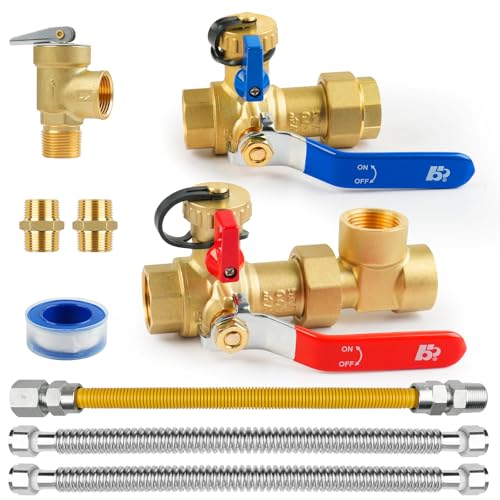
BHVALCON Tankless Water Heater Valve Kit with Gas Connectors

BHVALCON Tankless Water Heater Valve Kit with Ball Valve
210°F 150 PSI T&P Relief Valve with Extension Probe and Lever

Simpson Replacement Thermal Relief Valve for Pressure Washer Pumps

Watts 374A 3/4 Boiler Relief Valve

Timsec 1/4 Inch NPT Thermal Release Valve for Pressure Washer Pump

Milton S-1090-200 1/4″ MNPT ASME Safety Valve

RV40600 Brass Air Relief Valve for Pool Filters
More Details On Our Top Picks
The Cash Acme NCLX-5LX is built around a cast bronze body with brass and stainless internals, the kind of material mix you’d expect from a valve guarding a pressurized water heater. What separates it from a generic replacement is the push-to-connect inlet, which lets you press the valve straight onto copper or CPVC pipe without soldering. For anyone replacing an aging T&P valve on a tank-style heater, that detail alone can shorten the job from an afternoon to a single trip upstairs.
It’s rated to 150 PSI and uses an inert coating on the thermal element to slow mineral buildup. In hard-water regions, that coating can mean the difference between a valve that seats cleanly for years and one that starts dripping after a single season. Compared with the loose parts you’ll find in cheaper rebuild kits, this is a more deliberate, install-and-forget piece.
Useful Strengths
- Push-to-connect design removes the need for a torch on copper or CPVC lines.
- Bronze body with brass and stainless internals resists corrosion in domestic hot water.
- Thermal element coating helps prevent liming that often drips lower-quality valves.
- 150 PSI rating covers standard residential water heater operating ranges.
Honest Caveats
- Push-to-connect fittings require clean, round pipe ends and proper depth marking for a reliable seal.
- The thermal coating helps, but annual testing of the lift lever is still wise in mineral-heavy water.
Key Product Details
Made For
Homeowners replacing an aging T&P valve on a standard tank water heater without pulling out a torch.
Where Another Pick Suits Better
For tankless installations, the BHVALCON Tankless Water Heater Valve Kit with Gas Connectors bundles the matching fittings in one box.
Swapping a tankless water heater usually means hunting down three or four separate fittings before you can even pressurize the line. The BHVALCON kit folds that scavenger hunt into one box: hot and cold 3/4″ NPT isolation valves, a 150 PSI pressure relief valve rated to 200,000 BTU, two brass nipples, a gas line hose, two water line hoses, and Teflon tape. For a first-time installer, having every threaded part land at the same time removes a lot of mid-job trips to the plumbing aisle.
The brass body on each component is lead-free, which matters more than it sounds on a domestic hot water line. Where a plain steel fitting can pit and discolor over time, brass tends to hold up to the temperature cycling a tankless unit puts it through. The kit is also a quiet upgrade over piecemeal valves, since the included relief valve is matched in size and pressure class to the rest of the bundle.
Where It Delivers
- Single-box solution for a full tankless water heater isolation and relief setup.
- Lead-free brass construction on every valve and nipple.
- 150 PSI pressure relief valve sized for 200,000 BTU tankless units.
- Includes Teflon tape to start the install without a second parts run.
Points To Note
- The 18-inch hose lengths may fall short on deeper utility closets, so measure before installing.
- Some jurisdictions require a licensed plumber for gas line work, so the gas hose does not bypass local code.
Feature Snapshot
Best Suited To
DIYers installing a tankless water heater who want every fitting in one box rather than assembling parts piecemeal.
Look Elsewhere When
If your existing service valves are in good shape and you only need a relief valve, the Cash Acme NCLX-5LX is a tighter, purpose-built option.
This BHVALCON kit swaps the gas line hose for a dedicated 3/4″ ball valve, which makes it the better pick when you want a hard-piped gas drop rather than a flexible connector. The rest of the bundle mirrors the previous kit: 3/4″ NPT isolation valves, a 150 PSI pressure relief valve rated to 200,000 BTU, brass nipples, water line hoses, and Teflon tape. The ball valve’s lever handle also gives you a more decisive shut-off than a globe-style valve when you need to isolate the unit for descaling.
Anyone maintaining a tankless water heater knows that periodic vinegar flushes are part of the deal, and a quarter-turn ball valve keeps that service work short. Lead-free brass throughout keeps the kit compliant with modern code, and the same NPT sizing means you can swap it into a standard tankless rough-in without adapters.
What Stands Out
- Quarter-turn ball valve makes descaling and isolation faster than a globe valve.
- Lead-free brass construction on valves, nipples, and relief valve.
- 150 PSI relief valve sized for 200,000 BTU tankless service.
- Includes Teflon tape so the install can start immediately.
Things To Consider
- The ball valve replaces the flexible gas hose, so this kit is best for hard-piped gas drops.
- Like the sibling kit, the 18-inch water hoses may need extensions on deeper installs.
The Right Fit
Installers who prefer a hard gas connection and want a ball valve for quicker maintenance shut-offs.
Swap It Out When
If your existing run already uses a flexible gas connector and you only need to refresh the water side, the BHVALCON kit with Gas Connectors is the more direct fit.
Insulated water heaters and many RV tanks bury the standard T&P probe inside the jacket, where a short sensing rod never reaches true tank temperature. This 210°F, 150 PSI valve solves that with a long extension probe that pushes through up to 1-3/4″ of insulation to read the actual water temperature. It’s also CSA listed, which is a useful signal in regions that watch for third-party certifications on pressure-bearing components.
The manual test lever is right where you’d expect it on a standard T&P valve, and the 3/4″ NPT thread drops into the same port as a residential unit. For an RV owner, that means you can carry one valve for the trailer and the stick-built house without juggling two SKUs. The all-brass body holds up to road vibration better than plated steel alternatives.
A Few Strong Suits
- Extension probe reaches through up to 1-3/4″ of insulation for accurate readings.
- 210°F and 150 PSI ratings cover both RV and residential water heater needs.
- CSA listing provides third-party confirmation of pressure performance.
- All-brass body resists vibration fatigue common in mobile installs.
Practical Considerations
- Confirm the existing port depth, as some compact RV heaters use a shorter probe than this unit.
- Manual lever testing is still recommended every few months, especially before storage.
Quick Technical Notes
Who It Suits Best
RV owners and homeowners with thick foam-jacketed water heaters who need a probe long enough to reach the actual water column.
Another Choice May Suit
For a standard residential tank without heavy insulation, the Cash Acme NCLX-5LX is a simpler drop-in option.
A pressure washer pump that runs in bypass mode for too long builds heat fast, and that heat kills the water seals long before the motor gives out. Simpson’s thermal relief valve (TRV) exists to dump that hot water and admit cooler water through the inlet, protecting the seals and pistons from thermal damage. It threads into the same 1/4″ NPT port used on most consumer-grade pumps, so the swap usually takes a wrench and a few minutes.
Where cheaper TRVs cycle constantly and wear out, this one is built as a failsafe rather than a working component. That means it stays out of the flow path until something has already gone wrong, then vents once to save the pump. For a weekend warrior running a Simpson or similar pressure washer, that’s the right behavior in a part you hope to never see again.
A Few Highlights
- Standard 1/4″ NPT thread fits most consumer pressure washer pumps.
- Failsafe design vents only when pump temperature climbs into the danger zone.
- Direct replacement avoids pump teardown beyond the TRV port.
Some Limits To Know
- Not designed to cycle repeatedly, so chronic bypass operation still shortens pump life.
- Confirm port location on your specific pump before ordering, since some models route it elsewhere.
Product Snapshot
Built With In Mind
Simpson pressure washer owners who need a drop-in thermal valve without redesigning the pump manifold.
Where A Sibling Pick Shines
For a tighter-budget swap on a non-Simpson pump, the Timsec 1/4 Inch NPT Thermal Release Valve covers a similar role at lower cost.
The Watts 374A is a purpose-built boiler relief valve, not a water heater valve in disguise. It’s sized to protect hot water space heating boilers up to roughly 550,000 BTU per hour at the standard 30 PSI setting, which covers most residential boilers and light commercial jobs. The brass body is compact for its capacity, so it slips into tight mechanical rooms where a full-size ASME valve would not fit.
Watts has been making pressure relief components long enough that the 374A shows up in plumbing supply catalogs more than retail listings, which is itself a quality signal. For anyone whose boiler requires annual inspection, that lineage makes documentation easier when an inspector asks for the relief valve spec. It’s a heavier-duty choice than the household T&P valves above, and it belongs on a hydronic system rather than a domestic water heater.
Everyday Wins
- High discharge capacity supports boilers up to 550,000 BTU/hr.
- Compact brass body fits in tight mechanical room piping.
- Standard 30 PSI setpoint matches typical residential boiler relief requirements.
Potential Drawbacks
- Specialized for boiler service, so it is overkill on a domestic water heater.
- Annual testing and discharge line inspection are still required by code in most jurisdictions.
Whose Shelf It Belongs On
Homeowners and light-commercial techs servicing residential hot water boilers who need a high-capacity ASME-rated relief valve.
Reach For A Different Pick When
For a domestic water heater rather than a boiler, the Cash Acme NCLX-5LX is the right scale of product.
The Timsec thermal release valve lands in that useful middle ground where the part is heavy-duty brass but the price tag does not scare off a one-time DIY repair. It threads into a 1/4″ NPT pump port and opens once the inlet temperature climbs past roughly 145°F, which is the same threshold most pressure washer manufacturers build in. The body is brass rather than plated steel, so oil and corrosion don’t chew through it the way they would on cheaper alloys.
One caution worth flagging: thermal valves are not flow components, so this should not be used as a constant bypass. If your pump runs hot every job, the fix is a larger nozzle or shorter hose, not a heavier TRV. Used as intended, it’s a serviceable replacement for a worn-out valve and a sensible spare to keep on the shelf.
Practical Advantages
- Brass body resists oil and corrosion better than plated steel alternatives.
- Standard 1/4″ NPT fits most consumer pressure washer pumps.
- Opens around 145°F, which matches common factory thermal setpoints.
What To Weigh
- Acting as a constant bypass will shorten service life, since TRVs are failsafes by design.
- Verify port depth and orientation on your specific pump before installing.
Right Fit For
DIYers maintaining a residential pressure washer who want a solid brass TRV without paying for a name-brand replacement.
A Better Fit Elsewhere
For Simpson-branded pumps where exact OEM fit matters, the Simpson Replacement Thermal Relief Valve is the safer match.
The Milton S-1090-200 sits in a different category than the water-side valves above. It’s an ASME-rated safety valve designed for compressed air systems, popping at 200 PSI to protect a tank or receiver from over-pressurization. The 1/4″ male NPT thread drops into standard shop air piping, which makes it a familiar sight in any home garage running a 20- to 30-gallon compressor.
Milton has built pneumatic accessories long enough that the S-1090-200 is genuinely interchangeable with the older valves it replaces, which matters when you’re trying to thread into a fitting that’s already been in service for a decade. The ASME code stamp on the body is the part that makes inspectors and shop insurance paperwork happy, and it’s stamped because the valve actually meets that standard, not for marketing.
Benefits That Matter
- ASME-rated for 200 PSI pop-off, matching standard shop compressor tanks.
- 1/4″ male NPT thread fits common air compressor piping.
- Brass body handles repeated thermal cycling without seizing.
Factors To Consider
- Made for compressed air, so it is not interchangeable with water heater or boiler service.
- Annual pull-ring testing keeps the seat from sticking on a rarely-used compressor.
Technical Reference
Who Should Grab It
Home shop owners and small-business techs needing an ASME-rated safety valve for a 175-200 PSI air compressor tank.
Not Your Match When
For water-side relief duty on a heater or boiler, the Cash Acme NCLX-5LX or Watts 374A are the correct tools.
Pool filters trap air pockets that slowly starve the pump of water, and the small valve on top of the filter housing is what you open to bleed that air out. The REVA POOL RV40600 is built for that exact role, with a brass body that tolerates chlorinated water far better than plastic alternatives. It cross-references to the OEM part number 98209800, so it slots into FNS, Clean and Clear, Quad DE, and 4000 series filters without modification.
The yellow-and-black handle is also worth mentioning because pool owners tend to lose small parts in the grass during a bleed. A larger, brighter handle is easier to spot and easier to turn with wet hands. For seasonal filter maintenance, having a brass valve that won’t crack from UV exposure is the difference between a five-second bleed and a five-day repair.
Where It Helps
- OEM cross-reference 98209800 fits multiple Pentair filter families.
- Brass body resists UV and chlorinated water better than plastic stems.
- Bright yellow-and-black handle is easy to locate and turn with wet hands.
Worth Bearing In Mind
- Only fits the specific filter models listed, so check your filter body before ordering.
- O-rings on older filters may need replacement at the same time as the valve.
Perfect Match For
Pool owners maintaining compatible FNS, Clean and Clear, Quad DE, or 4000 series filters who need a direct-fit brass replacement.
Skip It When
For a water heater or boiler relief valve, this is the wrong category entirely: pair with the Cash Acme NCLX-5LX or Watts 374A.
Matching Brass Relief Valves to the Job at Hand
The right brass relief valve comes down to three questions: what fluid is moving through the system, what pressure and temperature that system reaches, and where the valve physically has to thread in. A water heater T&P valve, a boiler relief valve, a pressure washer TRV, a compressor safety valve, and a pool air bleed valve look superficially similar but operate in completely different worlds. Matching the valve to the system is what keeps the equipment safe and keeps inspectors satisfied.
Pressure rating is the next filter. A residential water heater typically wants a 150 PSI T&P valve, while a boiler relief valve is set closer to 30 PSI but with much higher discharge capacity. Pressure washer thermal valves open on temperature, not pressure, so a 200 PSI inlet rating means something different there. Reading the spec sheet against your equipment’s nameplate is the fastest way to confirm a match before you unbox anything.
Material choice matters more than people expect. Cast bronze bodies, brass internals, and stainless trim all resist corrosion in different ways. For chlorinated pool water, brass holds up better than plated steel. For domestic hot water with hard mineral content, a coated thermal element slows the liming that causes weeping valves. For compressed air, brass tolerates repeated thermal cycling without binding in the seat.
Thread size and port style decide whether the install takes five minutes or an afternoon. Push-to-connect fittings, NPT threads, and extension probes each address a different installation challenge. An RV heater with thick foam insulation needs a long probe, while a pool filter only needs the correct OEM cross-reference to drop into the existing manifold.
Picking Wisely Across This Category
Common Shopping Slip Ups
The most frequent mistake is matching by thread size alone. A 3/4″ NPT valve that fits a tankless water heater is not the same valve as a 3/4″ NPT boiler relief, and using one in place of the other risks an undersized discharge port. Always cross-check the pressure rating, temperature rating, and intended fluid before assuming two valves are interchangeable.
Another slip is ignoring the difference between a working valve and a failsafe. A pressure washer thermal relief valve should stay closed during normal use and only open when the pump overheats. If you find yourself needing a valve that vents continuously, the right answer is upstream plumbing, not a heavier-duty TRV.
Where The Extra Money Goes
Spending more on a brass relief valve usually buys better internal trim, tighter machining on the seat, and coatings that resist mineral buildup. In a domestic water heater, that translates to fewer surprise drips and longer intervals between replacements. For a boiler or compressor, higher-tier valves often carry documented ASME or CSA certifications that simplify inspection paperwork.
The upgrade is worth it most on equipment you cannot afford to fail: a boiler in a finished basement, a compressor powering a small shop, or a water heater serving a large family. For a basic pool filter or a backup pressure washer valve, a mid-tier brass pick is plenty.
Frequently Asked Questions
What does a brass relief valve actually do?
A brass relief valve opens automatically when the system it’s mounted on reaches a set pressure or temperature, venting fluid or air to keep the equipment from being damaged. It then reseats once conditions return to normal, acting as a self-resetting safety device.
How often should a relief valve be tested?
Most manufacturers recommend manually lifting the test lever every six to twelve months, plus an annual visual check for dripping or corrosion. Pool air relief valves get exercised more often since they’re opened during routine filter bleeding.
Can one brass relief valve work for multiple systems?
Only if the systems share the same pressure class, temperature range, fluid type, and thread size. A water heater T&P valve is not interchangeable with a boiler relief or a compressor safety valve, even when the threads line up.
Why pick brass over plastic or plated steel?
Brass resists corrosion from hot water, chlorinated pool water, and oil exposure better than plated steel, and it tolerates temperature cycling without cracking the way plastic does. That longer service life is the main reason it shows up on higher-end equipment.
Does a higher pressure rating always mean a better valve?
Not necessarily. A valve rated far above the system’s normal operating pressure may not seat reliably at low pressure and could weep constantly. The right valve matches the system’s actual working pressure and discharge requirements, with margin rather than excess.
The Takeaway
Brass relief valves are the kind of part you install once and then forget about, until the day a cheaper valve would have failed. Match the valve to the system, confirm the pressure and temperature class, and use the right thread style for the port. Any of the nine picks above will do its job well when matched correctly, and the rest is just picking the one that fits your specific repair.




