
A dropped undermount sink is one of those household headaches you don’t see coming until water starts pooling where it shouldn’t. The good news: you don’t always need a contractor or a full countertop replacement. A set of properly chosen undermount sink brackets can pull a sagging basin back into position and hold it there for years. This lineup compares eight bracket kits and support systems built for kitchen and bath sinks, covering clip-style mounts, adjustable support poles, and full repair kits. Whether you’re patching a single loose corner or bracing a heavy double-bowl basin, there’s a configuration here that fits your cabinet, your sink weight, and your comfort level with tools.
A Closer Look At The Lineup

Lusheer Undermount Sink Brackets Galvanized Steel

MY RUSTIC Undermount Sink Repair Kit (Patent)

Homydom Complete Sink Repair Kit System

Qualward Adjustable Stainless Steel Support Pole
Enhon Sink Clips Kit 12 Pack

Enhon Undermount Sink Clips Kit 24 Pack

HAHOME Stainless Steel Support Pole 2 Pack

SHELVTEK 6 Pack Sink Clips Gold
More On The Choices That Made The List
This galvanized steel kit targets the most common scenario: an undermount sink that has dropped a corner and needs reinforcement from below. The brackets are designed to be installed without fully removing the sink, which matters when the countertop is solid surface or stone and pulling the basin would mean breaking a bead of silicone. You work from inside the cabinet with basic hand tools and an Allen wrench.
For most homeowners dealing with a single loosening basin, this is the practical starting point. The galvanized coating helps the steel hold up to the humid, occasionally wet environment under a sink. Depending on your cabinet depth, you may find the rod length just barely covers the span, so measure before ordering.
A Favorable Mix
- No need to detach the sink from the counter, which protects the silicone seal
- Galvanized steel shell resists the damp air found under most sinks
- Engineered to support a double-bowl basin filled with water without bowing
- Backed by a U.S. utility patent, suggesting a specific design rather than a generic clip
Points To Keep In Mind
- Requires working inside a tight base cabinet, so plan for contorted hand positions
- Only one finish option, which doesn’t matter under the sink but limits aesthetic flexibility elsewhere
Who It Suits Best
Homeowners who want to lift and lock a drooping kitchen sink back into place without calling in a countertop crew.
Swap It Out When
Pick the HAHOME Stainless Steel Support Pole instead if your cabinet sees persistent moisture and you prefer stainless hardware.
MY RUSTIC’s kit shares the same patented bracket geometry as the Lusheer option but positions itself as a one-time, long-lasting repair. The pitch is simple: install it once, and you stop having to shim the sink every few months. For a kitchen that has already been repaired two or three times with foam and adhesive, that promise of permanence lands well.
The install sequence is straightforward enough that most DIYers handle it in under an hour with a helper holding the basin level while you tighten. The kit also covers the same patent family, so you know the engineering has been examined. The honest read is that it does the same core job as the Lusheer kit, so your decision comes down to bracket style and availability.
Notable Gains
- Targets the recurring-failure problem, not just a one-off fix
- Shares the patented design, giving a documented mechanism rather than a generic clip
- Works on most undermount kitchen sinks without modifying the counter
- Replaces the foam-and-silicone patchwork that often fails first
Trade-Offs To Consider
- Limited documentation of maximum load ratings compared to some pole-style options
- Brackets sit below the sink, so very shallow cabinets under 24 inches may crowd plumbing
At A Glance
Made For
Homeowners whose sink has already been repaired once and who want a longer-lasting bracket solution.
A Better Fit Elsewhere
Choose the Homydom Complete Sink Repair Kit System if you need five adjustable rods for a heavier double-bowl install.
The Homydom kit is the most fully bundled option on the list: five adjustable rods, an Allen key, and every screw needed for a multi-point bracket installation. That matters for a large double-bowl sink, where supporting just the front edge invites the back to sag later. Five contact points distribute the weight more evenly than a two-rod setup.
The bracket heads swivel, so you can angle each contact pad to seat against an uneven underside of a cast iron or composite sink. The galvanized steel and anti-rust finish target the long-term humidity problem under a kitchen sink. For most kitchens with a standard 30- to 36-inch cabinet, the reach is workable, though you may want a longer rod for deeper farmhouse-style bases.
Noteworthy Benefits
- Five rods spread the load across the entire sink footprint
- Swiveling bracket heads adapt to non-flat sink bases
- All hardware included, so no second trip to the hardware store
- Rated for heavy residential sinks, including stone-composite models
Honest Caveats
- More parts to position correctly, so first-time installers should plan extra time
- Five rods may be overkill for a small single-bowl sink, adding cost without benefit
Right Fit For
Anyone with a heavy double-bowl or cast iron undermount sink that needs load distributed across multiple contact points.
Consider Something Else When
The Qualward Adjustable Stainless Steel Support Pole is the smarter match for a single-bowl sink in a tall cabinet.
Qualward’s pole-style bracket covers the broadest cabinet range in this roundup, adjusting from 29 to 39.5 inches. That span swallows most standard base cabinets and reaches into the deeper 36-inch vanities where shorter rods fall short. The 880-pound load rating gives genuine headroom for a heavy cast iron basin, well beyond what a kitchen sink actually weighs when full.
Unlike the rod-and-clip kits, the single vertical design keeps the cabinet floor clearer for storage bins and cleaning supplies. The stainless steel finish shrugs off the condensation that forms around P-traps. Depending on your existing cabinet cleat height, you may need to add a wood block to land the top bracket pad flat.
What Pays Off
- Wide 29 to 39.5 inch reach covers most residential base cabinets
- 880-pound capacity leaves generous margin for stone or cast iron sinks
- Frees up cabinet floor space compared to multi-rod systems
- Stainless hardware that tolerates splashes and humidity
Where It May Fall Short
- Single-pole design provides one contact point, so uneven sink bases may need shimming
- Shallow 28-inch cabinets may sit below the minimum adjustment range
Feature Snapshot
Best Suited To
Tall-cabinet kitchens and heavy sinks where a single high-capacity pole outperforms a multi-rod spread.
Look Elsewhere When
The Enhon 24 Pack clip set is a better value if you are reinstalling a sink with many small perimeter clips.
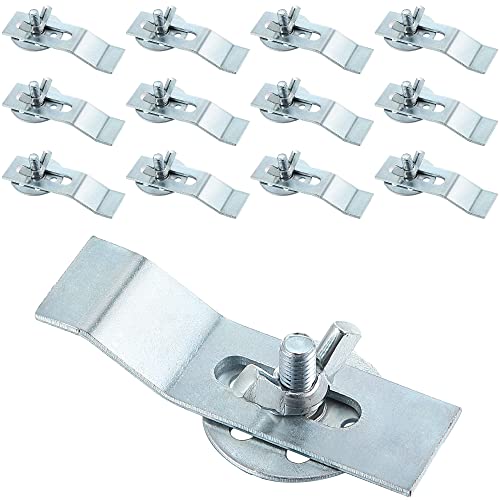
Enhon’s 12-pack is the original-equipment-style clip set used by many sink manufacturers during the factory install. These are the small perimeter clips that grip the sink edge and bolt up to the underside of the countertop. Twelve is a common count for a small to mid-size kitchen sink, so the kit matches a typical install without leftover hardware going to waste.
The zinc-plated steel holds up under normal under-sink humidity, though you may find surface bloom after years in a consistently wet vanity. For someone re-installing a sink that originally used this clip style, the fit is straightforward. The honest read is that these are replacement parts, not a rescue system, so they shine when matched to a sink that already has clip channels.
Everyday Wins
- Twelve clips cover a typical single-bowl or small double-bowl perimeter
- Zinc-plated steel balances cost and corrosion resistance
- Matches factory clip geometry for most residential sinks
- Compact packaging that fits in a small drawer for future repairs
Soft Spots
- Not designed for sinks that have already dropped, only for clean reinstalls
- Requires pre-drilled mounting holes or rails in the countertop substrate
Whose Shelf It Belongs On
Homeowners replacing lost or stripped factory clips during a sink reinstall rather than rescuing a dropped basin.
Reach For A Different Pick When
The Lusheer bracket kit is the right call when the sink has already started to fall and needs lifting support.
The 24-pack version of the Enhon clip set doubles the count for large or unusually shaped sinks. Big double-bowl basins and L-shaped undermounts can easily need 18 to 24 perimeter clips, so buying the smaller pack means a mid-install hardware run. Having extras on hand also covers the inevitable stripped or bent clip that comes out during removal.
The zinc-plated steel shares the same finish as the 12-pack, so the corrosion trade-offs carry over. One thing worth considering is that extra clips you don’t use are not wasted: they store flat in a small box and serve as future replacements when a single clip rusts through. The kit assumes you already have a clip-friendly sink and countertop, since these are perimeter fasteners, not lifting brackets.
Good Reasons To Consider
- Twenty-four clips cover large double-bowl and corner sinks without a second order
- Matches the 12-pack geometry, so you can mix and match across projects
- Extras act as insurance against stripped fasteners mid-install
- Same zinc-plated finish as the smaller kit for consistent corrosion behavior
What To Weigh
- Excess clips are wasted on a single-bowl install, so check your sink’s clip count first
- Like all perimeter clips, they need a solid substrate rail to bolt into
Who Should Grab It
Anyone installing or re-clipping a large undermount sink with many perimeter mounting points.
Where Another Pick Suits Better
The HAHOME two-pack pole system fits better when the sink has already dropped and needs active lift support.
HAHOME’s bracket moves away from zinc-plated steel and uses 304 stainless, which is the same alloy found in kitchen flatware and many sink basins. That matters in cabinets that see steady humidity, a slow leak, or even the occasional forgotten sponge. The two-pack configuration is aimed at the two front corners of a sink that has dropped unevenly, giving a matched pair of supports rather than mismatched singles.
The 17.7 to 31 inch adjustment window is shorter than the Qualward pole’s range, so very tall cabinets will need a different solution. The 440-pound per-bracket capacity is plenty for any residential sink. For most kitchens with a standard 30-inch cabinet, the adjustment lands in a comfortable middle of the range, leaving room for fine tuning.
The Value In It
- 304 stainless construction shrugs off the moisture common under sinks
- Two-pack configuration matches a typical front-corner drop pattern
- Polished finish holds up to occasional wipe-downs during cabinet cleaning
- Per-bracket 440 lb capacity easily covers residential sink weights
Smaller Limitations
- Maximum 31 inch reach falls short of deeper 36-inch cabinets
- Stainless costs more per bracket than zinc-plated equivalents
Technical Highlights
Perfect Match For
Homeowners in humid climates or older homes with persistent under-sink moisture who want stainless hardware.
Not Your Match When
Reach for the Qualward pole if your cabinet depth exceeds 31 inches and needs more vertical travel.
The SHELVTEK 6-pack targets the smallest undermount sink scenario: a bathroom vanity or bar prep sink with just a handful of perimeter clips. Six clips is the right count for a small basin, and the gold-tone zinc-plated finish is purely cosmetic since these sit hidden under the counter. Functionally, the clip dimensions match the industry-standard perimeter pattern, so they swap in where factory clips have rusted or stripped.
This kit assumes the sink has not yet dropped. If the basin is already sagging, these clips will not lift it back; that is what the Lusheer and MY RUSTIC kits are designed to do. For most small-vanity owners, this is the right size to keep on hand for the next time a clip pulls loose from the substrate.
Strong Points
- Six clips match the typical small vanity or prep sink
- Industry-standard dimensions fit most factory clip rails
- Compact 6-pack avoids the leftover waste of a 12 or 24 count
- Useful as a spare-parts kit for future single-clip replacements
Possible Compromises
- Gold-tone finish is cosmetic only, since clips sit out of sight
- Not designed to lift a dropped sink, only to re-secure a sound one
Who Will Love This
Anyone with a small bathroom vanity or bar sink that uses six perimeter clips and needs a tidy replacement set.
Skip It When
The MY RUSTIC kit is the better tool if your vanity sink has visibly separated from the countertop and needs active lift.
What Matters Most Before Choosing Undermount Sink Brackets
Confirm Why Your Sink Failed
Before ordering any bracket kit, identify the actual failure mode. A sink that has dropped one corner usually needs lifting brackets like the Lusheer or MY RUSTIC kits, which push the basin back up from below. A sink whose original clips rusted through needs a perimeter replacement set like the Enhon 12-pack or SHELVTEK 6-pack. Choosing the wrong type means buying hardware that does not address the real problem.
Measure Your Cabinet Reach
The vertical clearance between the cabinet floor and the underside of the sink determines whether a fixed-rod kit or an adjustable pole fits your opening. Most kitchen cabinets land in the 28 to 32 inch range, while deeper vanities may need 36 inches or more. The Qualward pole spans 29 to 39.5 inches, while the HAHOME bracket tops out at 31 inches. Measure twice before ordering to avoid a bracket that cannot extend high enough.
Match Capacity To Sink Weight
A small stainless steel sink weighs around 15 pounds empty, while a cast iron double-bowl can exceed 80 pounds before water is added. All the kits on this list handle residential sinks comfortably, but the load rating still matters when you factor in a full basin of standing water. Higher ratings simply give more margin if the support ever takes an unexpected load.
Choose The Right Material For Your Environment
Zinc-plated steel handles normal humidity fine and costs less. Stainless steel makes sense in bathrooms or older homes where cabinet floors see repeated dampness. Galvanized steel is a middle option that adds a zinc coating over the base metal. For most kitchens with a dry cabinet floor, any of the three will hold up for years.
Key Considerations Across These Picks
Where Shoppers Go Wrong
A common slip is assuming all undermount sink brackets work on any sink. Clip kits require factory clip rails on the sink edge; lift kits require working room under the basin. Another misstep is underestimating cabinet depth and ordering a rod that cannot extend to the sink underside. Measure the gap between the cabinet floor and the lowest point of the sink before picking a kit.
When Paying More Pays Off
Spending up for stainless steel or a higher load rating makes sense in wet cabinets and on heavy sinks. A polished 304 stainless bracket resists corrosion that would eventually pit a zinc-plated part. A higher load rating is insurance against future surprises, like a heavy garbage disposal adding vibration and weight to one side of the basin.
Frequently Asked Questions
What is an undermount sink bracket?
An undermount sink bracket is a support fitting installed between the underside of an undermount sink and the cabinet floor or framing. It holds the basin in place so the weight of the sink and its water does not pull the rim away from the countertop.
Can undermount sink brackets fix a dropped sink?
Yes, lift-style brackets like the Lusheer and MY RUSTIC kits are specifically designed to push a sagging basin back up and hold it there. Perimeter clip kits cannot lift a dropped sink; they only re-secure a sink that is still in its proper position.
How do I know which bracket size I need?
Measure the vertical gap between the cabinet floor and the lowest point on the underside of the sink. Match that measurement to the adjustment range listed for each bracket kit, allowing room for fine tuning.
Do I need to remove the sink to install brackets?
Most lift-style brackets are designed to be installed without removing the sink. You work from inside the cabinet, position the bracket, and tighten until the sink sits level again.
How long do undermount sink brackets last?
Galvanized and zinc-plated brackets commonly last for many years in dry cabinets, while stainless steel brackets can outlast them in damp environments. Lifespan depends more on cabinet humidity than on bracket material alone.
The Takeaway
The right undermount sink bracket depends entirely on what went wrong. A sink that has dropped needs a lifting kit, a sink with stripped clips needs a replacement perimeter set, and a heavy sink in a wet cabinet calls for stainless hardware with a high load rating. Match the kit to the failure mode, measure your cabinet, and the repair tends to hold for years.