

A leaking angle stop under the sink, a burst hose bib in February, a refrigerator line that needs to come off for the summer: a reliable shut off valve turns any of those into a ten-minute job instead of a panicked call. The picks below cover PEX/crimp installs, push-to-connect retrofits, RO feed adapters, and outdoor hose end valves, so you can match the fitting to the pipe rather than the other way around.
The Shortlist At A Glance

Jingzan Feed Water Adapter Kit, G1/2 x 3/8″ Compression x 1/4″ Push-to-Connect

SharkBite 22222-0000LF Brass Push Ball Valves, 1/2″ (4 Pack)

EFIELD 1/2″ PEX Barb Crimp Brass Ball Valve, 2-Pack

SUNGATOR 3/4″ Brass Push Fit Ball Valve, 2-Pack

SharkBite 1/2″ x 3/8″ Compression Straight Stop Valve 23037-0000LF

1/2″ Brass PEX Ball Valve with White T-Handle, 2-Pack

DBR Tech Garden Hose Shut Off Valve 3/4″ Brass, Full Flow (2026 Edition)
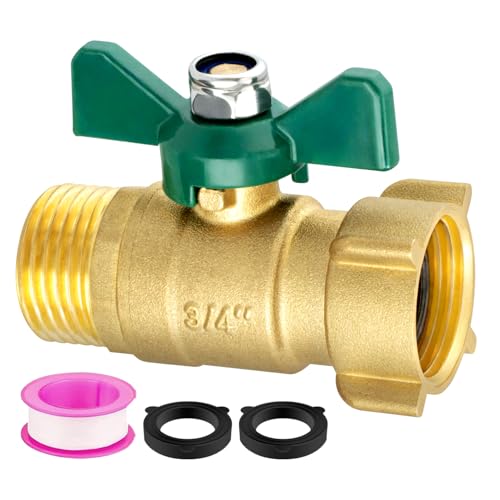
Kruuvax 3/4″ GHT Garden Hose Shut Off Valve with 360° Swivel

DBR Tech Garden Hose Shut Off Valve Brass with Easy On/Off Lever

DBR Tech Garden Hose Shut Off Valve 3/4″ Brass, Heavy Duty Leak-Proof
A Deeper Look At The Lineup
The Jingzan kit solves a very specific headache: tapping a saddle valve or angle stop to feed a reverse osmosis system, ice maker, or compact fridge water line without cobbling together mismatched fittings. The package includes the main feed adapter, a metal 3/8″ compression female to G1/2 male reducer, and a 1/4″ push-in to 3/8″ OD converter. Where the SharkBite 1/2″ Push Ball Valve (Pick 2) targets whole-home repipes, this one is purpose-built for the small tubing that runs to a filtration unit.
You thread the metal reducer onto whichever side of the main valve matches your existing shutoff geometry, then push the 1/4″ line home until it seats. Tubing is not included, so plan to reuse what you have or buy a length separately.
The Value In It
- Three-piece kit covers G1/2, 3/8″ compression, and 1/4″ push-in from a single order
- Metal thread reducer can install on either side of the valve for a flexible fit
- Push-to-connect end means no soldering or special tools for the 1/4″ run
- Compact size tucks behind an RO tank or under a fridge without crowding the supply
Things To Consider
- Tubing is not bundled, so the kit alone is not a complete install
- Only one metal reducer is included, even though the geometry can swap sides
Who It Suits Best
Homeowners adding an under-sink RO filter or refrigerator water line on an existing 3/8″ compression or G1/2 supply stop.
Look Elsewhere When
The SharkBite 1/2″ x 3/8″ Compression Straight Stop Valve 23037-0000LF (Pick 5) is the better swap when you need a true quarter-turn fixture stop, not a feed adapter.
SharkBite’s push-to-connect ball valve is the workhorse of the category, and a 1/2″ four-pack makes sense for anyone staging a multi-fixture repipe. Brass construction and compatibility with PEX, copper, CPVC, PE-RT, and SDR-9 HDPE mean you do not have to think about what is already in the wall before buying.
You push the pipe in, the stainless teeth grip, and the EPDM o-ring seals, no torch, no crimp tool, no glue. Compared to the EFIELD 1/2″ PEX Barb Crimp Ball Valve (Pick 3), this one trades the lower cost of a crimp install for a much faster mechanical connection that can be removed with a disconnect clip.
Where It Delivers
- Push-to-connect design eliminates soldering, crimping, and solvent welding
- Works across five pipe materials, so mixed plumbing in older homes is not a problem
- Full-port brass body keeps flow restriction minimal on 1/2″ lines
- Four-pack pricing spreads out to a per-valve cost that makes sense for whole-home work
Worth Noting
- Push connections cost more per fitting than a plain crimp barb
- Stainless grip teeth mean the pipe cannot be reused after removal without re-cutting
Made For
DIYers running a small PEX or copper repipe who want one valve type that handles every transition.
Consider Something Else When
The SUNGATOR 3/4″ Brass Push Fit Ball Valve (Pick 4) is the better match on a 3/4″ trunk line where the 1/2″ port here would bottleneck flow.
EFIELD’s crimp ball valve is the bare-bones answer to a basic PEX isolation point. A two-pack arrives with hot and cold handle colors, so you can sort supply and return on a manifold without reaching for paint pens. The barb-style body uses standard PEX fittings, so you crimp (or clamp) it onto the line with the same tool you already own.
Versus the 1/2″ Brass PEX Ball Valve with White T-Handle (Pick 6), this is a slightly different handle geometry, red and blue instead of white, but the install workflow is identical. If you are not committing to push-to-connect, this is the budget path.
Bright Spots
- Color-coded red and blue handles speed up manifold organization
- Full-port brass body holds back less pressure than restrictive globe valves
- Two-pack is sized for a small addition or a couple of fixture branches
Points To Note
- Requires a crimp or clamp tool, which not every homeowner owns
- Compatibility is limited to PEX with stainless clamps or copper crimp rings
Right Fit For
Shed builders and basement finishing projects where the rest of the run is already PEX and a crimp ring is the standard method.
Skip It When
The SharkBite 1/2″ Push Ball Valve (Pick 2) is the smarter choice on a one-off repair where renting or buying a crimp tool does not pencil out.
The 3/4″ SUNGATOR is built for the larger-diameter work that a 1/2″ SharkBite cannot touch, think water heater tie-ins, branch feeds for a small addition, or main shutoff replacement in a tight basement. Push-fit installation means the pipe goes in by hand, then you rotate the body for clearance in a wall cavity. A disconnect clip pops the joint back apart.
It is a meaningful step up in flow capacity from any of the 1/2″ options earlier in this list, and the brass body handles the same PEX, copper, and CPVC combinations that the SharkBite push valve does.
Key Advantages
- 3/4″ port maintains volume on branch lines that would choke a 1/2″ valve
- Removable and reusable design supports future reconfiguration
- Post-install rotation helps align the handle in a crowded mechanical room
Trade Offs
- Push-fit at 3/4″ requires firm hand pressure, and the disconnect clip is a separate purchase
- Not rated for gas lines despite the heavy-duty appearance
Who Will Love This
Contractors and serious DIYers replacing a water heater stop or branch shutoff on a 3/4″ supply without hauling out a torch.
Reach For A Different Pick When
The EFIELD 1/2″ PEX Barb Crimp Ball Valve (Pick 3) is the right call on a pure PEX manifold where 3/4″ ports would be overkill.
This is the angle stop that lives under most bathroom sinks and behind most toilets, and SharkBite’s version replaces a corroded multi-turn valve without disturbing the supply stub. The 1/2″ push-to-connect inlet feeds a quarter-turn ball, and the 3/8″ compression outlet takes a standard faucet or toilet supply line. Sleek chrome finish keeps it from looking like an eyesore in a visible cabinet.
Unlike the full-port SharkBite 22222-0000LF (Pick 2), this is a fixture stop designed for one specific job. The body is compact enough to fit behind a wall-hung vanity where a longer valve simply will not sit flat.
Positive Points
- Quarter-turn full-port ball drops the time to shut off from multiple rotations to a single flip
- Wet-line install means you do not have to drain the house to swap an old stop
- Push-in inlet accepts PEX, copper, CPVC, PE-RT, and SDR-9 HDPE
Honest Caveats
- Chrome-plated exterior can show water spots in humid under-sink cabinets
- 3/8″ compression outlet needs a fresh ferrule and nut on the supply line side
Best Suited To
Anyone replacing a stubborn multi-turn stop on a toilet or vanity without calling a plumber.
Swap It Out When
The Jingzan Feed Water Adapter Kit (Pick 1) is the smarter pick when the goal is feeding a filter or fridge, not isolating a fixture.
Forged lead-free DZR brass and a quarter-turn T-handle describe most of the appeal here. DZR, or dezincification-resistant brass, resists the zinc-leaching corrosion that can pit ordinary brass fittings in hard-water areas, so the body holds up longer on potable lines. The T-handle is also easier to grip with wet hands than a slim lever.
The valve conforms to ASTM F1807 for PEX insert fittings, and it works with both stainless clamps and copper crimp rings. The 2-pack lands at a friendly per-unit cost, which is the main reason it sits beside the EFIELD (Pick 3) in the budget tier.
Standout Benefits
- Forged DZR brass body resists dezincification in aggressive water
- T-handle geometry gives more leverage than a paddle in tight spots
- Compatible with both clamp and crimp PEX systems, so you do not have to match a tool
A Few Limitations
- White handle finish can scuff over time in a visible mechanical area
- Rated working pressure of 125 psi at 73°F is standard but not high-pressure
Perfect Match For
Budget-focused homeowners running a hydronic baseboard loop or a small PEX repipe where lead-free certification matters.
Where Another Pick Suits Better
The SharkBite 22222-0000LF (Pick 2) is the upgrade path when you would rather skip the crimp tool altogether.
The first outdoor pick in this roundup moves away from PEX and into the threaded world of garden hose threads (GHT). DBR Tech’s full-flow design aims to keep water pressure steady at the nozzle, the kind of detail that matters when you run a 100-foot hose to the back of a yard. The 3/4″ brass body feeds an oversized butterfly handle that is comfortable to operate even with gardening gloves on.
Where the Kruuvax 360° Swivel (Pick 8) emphasizes maneuverability at the spigot, this one emphasizes throughput. The trade-off shows up when you want to angle the valve out of the way; the fixed body does not pivot.
Useful Strengths
- Full-flow internal bore preserves pressure across long hose runs
- Brass body tolerates sun, hose reel coiling, and seasonal temperature swings
- Oversized butterfly handle is glove-friendly
Points To Keep In Mind
- Fixed orientation means the handle position is set once you screw it on
- Standard 3/4″ GHT thread does not adapt to quick-connect hose systems without a separate adapter
Built With In Mind
Homeowners with a long rear-yard hose who notice pressure drop with standard hose shutoffs.
Not Your Match When
The Kruuvax 3/4″ GHT Garden Hose Shut Off Valve (Pick 8) makes more sense at a wall spigot where a 360° swivel would prevent kinks.
Kruuvax leans into the swivel joint, which is genuinely useful when the spigot sits behind a downspout or a planter. You thread the valve on, then rotate the outlet end 360° until the hose points where you want it to go. The internal ball and wide stainless bore are built to keep flow high without restricting the stream at the nozzle.
Compared to the DBR Tech 3/4″ Full Flow (Pick 7), you give up a fraction of straight-through simplicity for the freedom to reposition the hose without unscrewing the valve. For a permanent patio setup, that flexibility usually wins.
What It Does Well
- 360° rotatable swivel prevents hose kinks at awkward spigots
- Wide stainless bore aims to maintain pressure over the run
- Standard 3/4″ GHT threads fit any North American outdoor hose bib
Room For Improvement
- Swivel joint can introduce a small drip path if not hand-tightened fully on first install
- More moving parts than a fixed shutoff, so longevity depends on rubber seal care
Whose Shelf It Belongs On
Patio and deck owners who route a hose around furniture or planters every weekend.
A Better Fit Elsewhere
The DBR Tech 3/4″ Brass Heavy Duty Leak-Proof (Pick 10) is the simpler choice for a hose reel where a swivel is unnecessary.
DBR Tech’s lever-handle variant is the comfort pick. The rubberized grip stays grippy when your hands are wet or muddy, and the lever geometry makes one-finger shutoff realistic. Double O-rings and a backup washer work together to keep the connection drip-free over a full season, which matters more than people expect on a hose that lives outside.
It is built in the same brass family as the rest of the DBR Tech outdoor lineup, so the body weight and threading match Pick 7 and Pick 10. The difference is purely ergonomic.
The Good Stuff
- Rubberized lever grip stays secure with wet or gloved hands
- Double O-ring seal design targets drip-free long-term use
- Brass body tolerates outdoor storage and freeze-thaw cycles better than plastic
Small Caveats
- Lever can catch on a hose reel drum if the valve sits too close to the reel
- Rubber grip may degrade faster in direct, year-round sun than a bare metal handle
Who Should Grab It
Anyone who waters after a workout, after gardening, or with arthritic hands and wants a glove-friendly grip.
Another Choice May Suit
The DBR Tech 3/4″ Full Flow (Pick 7) is the right call when butterfly handles, not levers, are the priority.
The compact sibling in the DBR Tech outdoor line keeps the brass body but trades the oversized butterfly handle for a slimmer profile. That shorter handle is the difference-maker on a hose reel, where a big handle would catch the drum every rotation. Internally, the precision-machined bore still pushes enough flow for most watering routines.
This sits beside the Kruuvax (Pick 8) as the streamlined option, no swivel, no rubberized lever, just a straight brass shutoff that disappears against the spigot. For everyday garden use, that restraint is the selling point.
Everyday Wins
- Compact handle fits close to a hose reel without catching
- Brass construction matches the longevity of the larger DBR Tech models
- Simple straight-through design has fewer parts that can wear out
Softer Spots
- Smaller handle is harder to operate with thick winter gloves
- No swivel, so the hose direction is fixed once installed
The Right Fit
Households with a wall-mounted hose reel or a tight spigot alcove where a bulky handle would be in the way.
Where A Sibling Pick Shines
The DBR Tech Garden Hose Shut Off Valve with Easy On/Off Lever (Pick 9) is the better ergonomic choice when grip matters more than clearance.
Choosing The Right Shutoff For Your Plumbing
The first decision is the pipe material, because every valve in this list is rated for a specific subset of PEX, copper, CPVC, PE-RT, and HDPE, and the wrong match will either fail to seat or leak within months. Measure the outside diameter of the line you are tapping and confirm the valve’s nominal size before ordering.
Next, weigh install method against tooling. Push-to-connect valves like the SharkBite 22222-0000LF and the SUNGATOR 3/4″ cost more per unit but skip the need for a torch or a rented crimp tool, which is a real savings on a one-off repair. Crimp and clamp systems like the EFIELD and the 1/2″ T-Handle valve are cheaper per fitting and produce a permanent joint, ideal when you are running a whole new branch.
Finally, think about the environment. Indoor supply stops need a quarter-turn full-port ball and a low-profile body for cabinet clearance. Outdoor hose valves live in the sun and the cold, so brass bodies and rubber-sealed handles outlast plastic every time. The compact DBR Tech or the swivel Kruuvax covers most patio scenarios; the full-flow DBR Tech or the lever-handle DBR Tech covers performance and grip respectively.
Smart Shopping Tips For Shutoff Valves
Common Slip Ups To Avoid
The single most common mistake is mismatching nominal and actual pipe size, a 1/2″ valve on a 5/8″ OD line, or a 3/4″ valve on a 7/8″ line, and it shows up as a fitting that never seats or a seal that fails on the first pressure cycle. Always measure the outside diameter of the existing pipe before choosing.
A second trap is over-tightening a compression fitting. The ferrule does the sealing, not the torque, and a cracked ferrule from a wrench turn too far leaks slowly for months before it bursts. Hand-snug plus a quarter turn is the safe pattern.
Why The Higher Tier Costs More
Premium shutoff valves spend the extra money in three places: forged DZR brass instead of cast brass, full-port ball geometry instead of reduced port, and EPDM seals rated for hot water cycling. Those upgrades show up as longer service life on a hot supply line and fewer pressure drops at the fixture.
For most homeowners, the upgrade is worth it on a main shutoff or a hot-side stop that gets daily use. For a one-time ice maker line behind the fridge, a budget push-to-connect fitting is plenty.
Frequently Asked Questions
What Size Shutoff Valve Do I Need For A Main Water Line?
Main supply lines in most homes are 3/4″ on the street side and 1/2″ on branch runs to fixtures. Match the valve nominal size to the pipe you are cutting into, then verify outside diameter with a tape measure before crimping or pushing.
Can I Install A Push-To-Connect Valve On A Wet Line?
Yes, push-to-connect valves from SharkBite and SUNGATOR are rated for wet-line installation, so you can cut into a live supply and push the new fitting home without draining the house. Keep a towel handy because a small amount of water will escape at the cut.
How Often Should A Shutoff Valve Be Replaced?
A quality brass ball valve lasts 10 to 20 years in typical residential service, but signs of corrosion, a stiff handle, or a persistent drip at the handle stem are the cues to swap it. Outdoor hose valves have shorter life spans because of UV and freeze exposure, so inspect them each spring.
Are All PEX Shutoff Valves Compatible With Crimp Rings?
Most PEX barb valves, including the EFIELD and the 1/2″ T-Handle model, are designed to work with both stainless clamp rings and copper crimp rings, but always confirm the listing before buying. Push-to-connect valves do not use either ring system; the grip teeth and o-ring handle sealing on their own.
Do Garden Hose Shutoff Valves Reduce Water Pressure?
Standard hose shutoffs with a reduced internal bore can noticeably drop pressure across long runs. Full-flow designs like the DBR Tech 3/4″ Full Flow are built to keep the bore close to the hose ID, which preserves pressure at the nozzle for a more useful spray pattern.




