
Aerobic septic systems rely on a steady stream of air pushed through the treatment tank to keep beneficial bacteria alive, and the linear diaphragm aerator pump is the workhorse doing that pushing day after day. Picking the wrong one means muffled alarms, premature diaphragm failures, or an aerator that runs louder than your AC compressor on a hot July afternoon. The ten pumps below cover everything from compact 60 LPM units for small homes to heavy-duty 120 LPM workhorses for larger wastewater flows, so the right match comes down to your system size and noise tolerance.
A Snapshot Of The Selections

HIBLOW HP-80 Pond Aerator / Septic Linear Air Pump
HIBLOW HP-60 Pond Aerator / Septic Linear Air Pump

HIBLOW HP-120LL Pond Aerator / Septic Linear Air Pump

MS-80 Septic Linear Air Pump Pond Aerator
HIBLOW HP-100LL Pond Aerator / Septic Linear Air Pump

VCRAZE KP-Series Linear Air Pump Aerator

AquaMiracle AP-80 Linear Air Pump Aerator

AquaMiracle All-in-One Koi Pond Aerator Kit
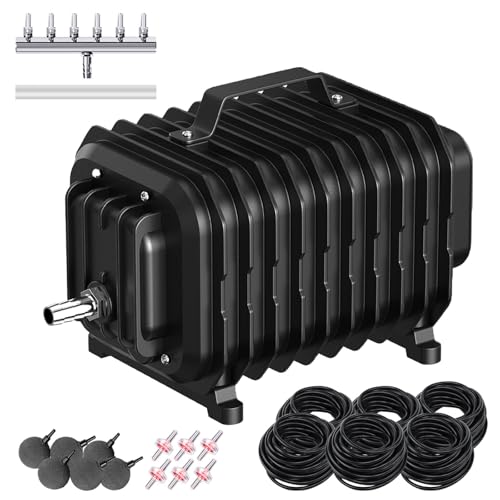
Devopet Pond Aerator Kit 3500-Gallon

ANILUV LP-80 Septic Tank Linear Air Pump
The Strengths Of Each Pick
The Hiblow HP-80 has earned its reputation by doing the boring stuff well: moving roughly 80 liters of air per minute through a 500-gallon-per-day aerobic system without complaint. It sits in the same flow class as the Gast SPP-80 and Thomas 5078 series, which makes it a drop-in option for homes already running those older units.
For most suburban homes on a standard aerobic system, the HP-80 hits a comfortable middle ground between output and longevity, and the diaphragm design has proven itself across thousands of installations. Compared with the smaller HP-60 covered below, you get noticeably more airflow for larger drain fields, though you trade some of that whisper-quiet operation.
The Case For It
- Drop-in compatibility with the most common legacy 80 LPM pumps on the market
- Higher airflow than the HP-60, supporting longer diffuser runs in mid-size drain fields
- Long diaphragm life relative to cheaper clones, reducing annual maintenance in real homes
- Suitable for koi ponds up to roughly 0.6 acre, doubling as a pond-side aerator when needed
Trade Offs To Consider
- Louder than the HP-60, so placement near bedroom windows matters
- Replacement diaphragms are pricier than no-name aftermarket kits
Feature Card
Best Suited To
Suburban homeowners with a 500 GPD aerobic system looking for a long-service, no-drama replacement.
Swap It Out When
The HP-60 is a better fit for smaller systems where absolute quiet matters more than extra airflow capacity.
Step down from the HP-80 and you land at the HP-60, a pump built around the idea that a septic aerator should not announce itself every time the compressor kicks on. The electromagnetic drive keeps vibration, pulsation, and starting current low, so the unit settles into a background hum rather than a buzz.
Cabins, small homes, and properties where the pump chamber sits near outdoor living space benefit most from the HP-60’s quieter character. Output is lower than the HP-80, so you want to verify your diffuser needs match before committing, but for the right-sized system this is the kind of pump you forget is running.
Where It Delivers
- Noticeably quieter operation than larger 80 and 100 LPM models
- Low starting current, gentler on remote electrical setups
- Oil-less contamination-free air output for cleaner septic chambers
- Automatic pressure limiting protects internal diaphragms from spikes
Some Limits To Know
- Lower airflow rules out larger drain fields and high-demand systems
- Outdoor UL-rated variants may cost more than indoor versions
Built With In Mind
Homeowners running smaller aerobic systems who care more about noise and longevity than maximum airflow.
Consider Something Else When
You need to feed a longer diffuser run or larger 600+ GPD system, where the HP-100LL fits better.
The HP-120LL is Hiblow’s top-tier residential pump, designed for wastewater systems that need real volume. With roughly 120 LPM of airflow, it covers ponds up to about an acre at shallow depths and feeds larger aerobic treatment units without straining.
What sets the LL suffix apart is the rebuild path: the diaphragms can be replaced a couple of times over the unit’s life, so you are not throwing the whole pump away at the first sign of wear. For properties where downtime is not an option and the pump runs 24/7, that serviceability is worth real money over the lifespan.
Useful Strengths
- Highest airflow in the Hiblow residential lineup
- Diaphragms can be rebuilt multiple times, extending total service life
- Outdoor-rated design for exposed installation
- Strong fit for ponds up to roughly one acre at shallow depths
Points To Note
- Higher noise output than the smaller HP-60 and HP-80 units
- Power draw climbs alongside airflow, so budget-conscious buyers may look elsewhere
Quick Facts
Whose Shelf It Belongs On
Larger residential aerobic systems and serious pond owners who want serviceability alongside high airflow.
Reach For A Different Pick When
Smaller homes can skip the HP-120LL and save money with the HP-100LL or HP-80.
Moonshan’s MS-80 leans into versatility, shipping with three connector sizes and a 17-hole manifold so you can adapt the pump to whatever tubing you already have in the yard. The aluminum housing shrugs off corrosion, which matters when the unit sits outdoors through humid summers and wet winters.
The 80 LPM flow class matches what most 500 GPD aerobic systems expect, so retrofitting an aging system is straightforward. Where it really shines is hybrid properties that run both a septic system and a koi pond, since you can route air to multiple destinations without buying extra adapters.
Useful Touches
- Three connector sizes included for flexible installation
- Aluminum body resists corrosion in outdoor pump chambers
- Operating noise held under 60 dB for quieter placement near living space
- Works at depths up to about 6.5 ft in pond applications
Possible Compromises
- Brand recognition is thinner than the Hiblow lineup
- Long-term diaphragm availability is less documented than legacy brands
The Right Fit
Homeowners with mixed septic and pond setups who want flexible installation options without buying adapters separately.
Look Elsewhere When
You prefer a brand with decades of documented field history, in which case the HP-80 is a safer choice.
The HP-100LL sits squarely in the middle of Hiblow’s residential range, and that middle position is exactly why it works for so many homes. With 100 LPM on tap, it covers 600 GPD aerobic systems comfortably while still fitting under the umbrella of the same rebuild-friendly design used in the larger HP-120LL.
For most properties, the HP-100LL is the kind of pump that just disappears into the background of homeownership. It runs, the system stays healthy, and you only think about it when the annual service reminder pops up. Compared with the HP-80, you gain headroom for longer diffuser runs without paying the noise premium of the 120.
What Pays Off
- Drop-in replacement for Gast SPP-100, HP-100, and Thomas 5100 series
- Diaphragms rebuildable, lowering lifetime cost
- Handles ponds up to roughly three-quarters of an acre
- Quieter than the HP-120LL at slightly lower output
Things To Weigh
- Pricing tends to land above the HP-60 and HP-80
- Not the right call for very small systems where airflow is overkill
Perfect Match For
Owners of 600 GPD aerobic systems who want headroom and rebuild support without jumping to the 120 class.
Where A Sibling Pick Shines
Quieter setups on smaller systems will get more value out of the HP-60.
VCRAZE offers the KP series in three flow ratings, so the same product line covers a 40 LPM, 60 LPM, or 80 LPM install depending on which model you choose. The full-copper motor coil is the kind of detail that tends to matter a few winters in, when cheaper aluminum windings start to cook under continuous duty.
For koi keepers running everything from a small backyard feature pond to a multi-thousand-gallon setup, the KP family lets you scale without switching brands. The 80 LPM KP-80 lands closest to the airflow of the Hiblow HP-80 covered above, but at a noticeably different price tier and feature set.
Notable Upsides
- Three flow ratings cover small to mid-size ponds
- Full-copper motor coil for cooler running and longer motor life
- Multi-layer noise reduction design for quieter outdoor operation
- Higher pressure output handles longer airline runs
Honest Caveats
- Septic-system track record is thinner than the Hiblow brand history
- Replacement parts sourcing requires more digging than legacy brands
Feature Snapshot
Who Will Love This
Pond keepers who want a flexible product line with multiple flow options from a single brand.
Not Your Match When
You are replacing a Hiblow-compatible septic system and want a guaranteed drop-in match, where the HP-100LL fits cleanly.
The AP-80 earns its “super powerful” label by moving about 85 liters per minute, which puts it at the top of the 80-class aerators in this lineup. The heavy housing material and sealed design contribute to the multi-layer noise reduction, so even with the extra airflow the unit stays reasonably quiet.
Restaurants running live seafood holding tanks and hydroponic growers benefit most from the high-pressure output, since both applications push air through diffusers that resist flow. Compared with the VCRAZE KP-80 covered earlier, you trade some flexibility in product line sizing for a single high-flow unit.
Practical Advantages
- 85 LPM airflow at the top of the 80-class range
- Heavy-duty sealed housing for better noise control
- Full-copper motor supports continuous-duty operation
- Compatible with hydroponic, fish farm, and septic use cases
Small Caveats
- Larger and heavier than lower-flow competitors
- Power consumption scales up with the airflow, so running costs are higher
Who Should Grab It
Commercial operators and serious pond keepers who need maximum airflow without stepping up to a 100 or 120 LPM unit.
A Better Fit Elsewhere
Residential users on standard 500 GPD systems can save money with the Hiblow HP-80.
This AquaMiracle kit is the closest thing to a turnkey aeration system on the list, bundling a 12W linear pump, four 25-foot rolls of airline tubing, four 2-inch air stones, four check valves, and a 4-way manifold in a single box. For someone setting up their first koi pond, that removes about a dozen separate shopping trips.
Airflow lands around 254 GPH at 3.63 PSI, which is sized for ponds up to 3000 gallons. It is a low-wattage setup, so running costs stay gentle, though it is firmly on the pond side of the septic-or-pond line rather than a true wastewater workhorse.
Well-Handled Touches
- Complete kit with tubing, stones, valves, and manifold included
- Low 12W power draw keeps operating costs modest
- Four diffuser outputs for even oxygen distribution
- Check valves protect the pump from backflow during shutdowns
Potential Drawbacks
- Not sized for residential septic aeration at 500+ GPD
- Limited ceiling if your pond grows beyond 3000 gallons
Made For
First-time pond owners who want everything in one box and prefer a guided install over sourcing parts separately.
Skip It When
Your main goal is replacing a septic aerator, in which case the Hiblow HP-80 or ANILUV LP-80 fits better.
The Devopet kit mirrors the AquaMiracle approach with a complete bundle, but stretches coverage to roughly 3500 gallons while keeping the motor at a friendly 10 watts. The reinforced nylon housing and pure-copper motor point to decent build quality for the price bracket.
For smaller ponds that need a complete kit without the bigger price tag, this lands in a useful middle ground. The 317 GPH airflow is on the modest side, so large koi loads or deep-water setups may want to look at the higher-output AquaMiracle AP-80 instead.
Notable Gains
- Complete tubing, stone, and valve kit included
- Coverage up to 3500 gallons for the size bracket
- Low 10W power draw keeps running costs down
- Pure-copper motor for better efficiency at low wattage
Areas To Watch
- Lower airflow than dedicated high-output pumps like the AP-80
- Nylon housing is durable but lighter than aluminum competitors
Right Fit For
Small-pond owners who want a complete kit and low power draw, prioritizing cost over maximum output.
Another Choice May Suit
Higher fish loads or larger ponds benefit from the AquaMiracle AP-80 instead.
ANILUV’s LP-80 targets the residential 500 GPD septic system directly, and the spec pairing of 80 LPM airflow with a 1/2-acre pond rating gives it some flexibility for hybrid properties. Pairing it with a separate diffuser handles the oxygenation work, but that diffuser is sold separately, so budget for it.
The build aims at durability for continuous-duty operation. For homeowners who want a straightforward septic replacement without paying the legacy-brand premium, the LP-80 sits in an interesting spot, though the brand’s track record is shorter than Hiblow’s decades of field history.
Where It Helps
- Specifically designed for 500 GPD septic applications
- Covers ponds up to about half an acre at 11 ft depth
- Continuous-duty design aimed at 24/7 operation
Worth Bearing In Mind
- Diffuser sold separately, adding to the total install cost
- Brand history is shorter than established competitors
Who It Suits Best
Homeowners replacing a 500 GPD septic aerator and open to newer brands for value.
Look Elsewhere When
You want a longer documented service track record, where the Hiblow HP-80 is a safer pick.
What To Weigh Before Picking A Septic Aerator Pump
Match Airflow To System Size
Aerobic treatment units specify a required airflow in liters per minute, and matching that number is the single biggest decision. A 500 GPD system typically wants around 60 to 80 LPM, while 600 GPD units push toward 100 LPM, and larger flows step up to 120 LPM. Oversizing wastes electricity, while undersizing starves the bacteria that actually treat the wastewater.
Noise, Location, And Daily Living
A linear diaphragm pump produces a steady hum, and the location of the pump chamber relative to bedrooms, patios, and outdoor living areas matters. Quieter pumps like the Hiblow HP-60 keep things civilized at close range, while higher-output units benefit from burying the chamber farther from the house or adding a sound-dampening enclosure.
Rebuild Path Versus Replacement Cycle
Some pumps, particularly the Hiblow LL series, are designed with rebuildable diaphragms that can be replaced a couple of times over the unit’s life. Others are sealed units intended for full replacement. For remote or critical installations, the rebuild path often pays back the higher initial cost.
Pond Versus Septic-Only Use
Several pumps on this list pull double duty as pond aerators, but a dedicated koi pond setup usually wants more diffuser distribution than a single-outlet septic pump. All-in-one kits like the AquaMiracle and Devopet options handle the pond case cleanly with bundled tubing and stones, while dedicated septic pumps stay focused on airflow delivery to a single chamber.
Common Sticking Points Shoppers Run Into
Mismatching Flow Class To System Size
Buying the wrong LPM rating is the most common slip-up, and it shows up as either chronic system alarms or premature diaphragm wear from overwork. Check your aerobic system’s documentation for the required airflow before settling on a pump, and stay within the recommended range rather than guessing upward.
Skipping The Diffuser Or Manifold
A pump alone does not oxygenate anything, and assuming a bundled kit without checking the box contents leads to extra sourcing trips. The all-in-one kits on this list solve that problem, while bare pumps require separate purchase of airline tubing, diffusers, and often a manifold for multi-diffuser setups.
Forgetting The Rebuild Story
Choosing a sealed unit without a rebuild path means a full replacement when diaphragms fatigue, which can be expensive over a decade of ownership. The LL-suffix Hiblow models and similar rebuildable designs extend service life and lower total cost, even when the initial outlay is higher.
Where The Higher Tier Actually Earns Its Place
Better Diaphragm Compounds And Motor Windings
Premium pumps often use full-copper motor coils and higher-grade diaphragm materials, which run cooler and last longer under continuous duty. That difference shows up in year three, year five, and beyond, when cheaper pumps start needing service while the better-built units keep running.
Tighter Tolerances And Lower Vibration
Higher-tier pumps tend to run with less vibration and pulsation, which translates to quieter operation and less mechanical wear on the housings and mounting hardware. For installations near living space or in pump chambers where vibration transmits through walls, the smoother operation is worth a real premium.
Rebuild Capability And Parts Availability
The biggest long-term differentiator is whether the pump can be serviced rather than replaced. Pumps with documented rebuild paths and accessible replacement diaphragms pay back their higher cost over years of ownership, while sealed units force a full swap at end of life.
Frequently Asked Questions
How Long Does A Septic Aerator Pump Typically Last?
Most quality linear diaphragm pumps last between three and seven years before diaphragm replacement, and rebuildable units can extend total service life well beyond a decade with periodic maintenance.
Can I Use A Pond Aerator Pump For My Septic System?
Some pumps handle both duties, but you need to verify the LPM rating matches your aerobic system’s specification, since undersized airflow leads to system failure regardless of how well the pump works for pond use.
What Is The Difference Between HP And LL Suffix Models?
LL models in the Hiblow lineup refer to the long-life rebuildable design, where diaphragms can be replaced rather than requiring a full pump swap, while standard HP models are typically sealed units.
How Often Should Diaphragms Be Replaced?
Common practice suggests inspecting diaphragms every two to three years and replacing them when airflow drops or noise increases noticeably, though heavy-use installations may need earlier service.
Are Quieter Pumps Worth The Extra Cost?
For pump chambers near living space, quieter pumps like the HP-60 are worth considering, but for remote installations the noise difference rarely justifies paying more for the same airflow class.
The Takeaway
The right septic system aerator pump comes down to matching your system’s flow requirement, weighing noise and rebuild needs, and choosing a build quality that fits your installation environment. The Hiblow lineup remains the safest pick for most homes, while newer options like the ANILUV LP-80 and AquaMiracle kits give budget-focused shoppers more flexibility. Use the picks table to filter by LPM class and badge, then lean on the reviews for the practical ownership details that spec sheets skip over.