Hooking up to a campground spigot sounds simple, until the line pressure surges past what your hoses and fittings can handle. A solid regulator sits between the spigot and your freshwater hose, trimming incoming pressure down to a safer range before it reaches your plumbing. The picks below lean on brass bodies, factory-set or adjustable outputs, and the kind of build that survives weekend trips and full-time road life. You’ll find purpose-built RV regulators alongside general low-pressure gauges that pair well with regulator setups for ongoing diagnostics.
The Choices Worth Comparing

Camco Brass Marine/RV Water Pressure Regulator

Hourleey Brass RV Water Pressure Regulator with Filter Screen

Valterra Lead-Free Brass Water Regulator for Camper/Trailer
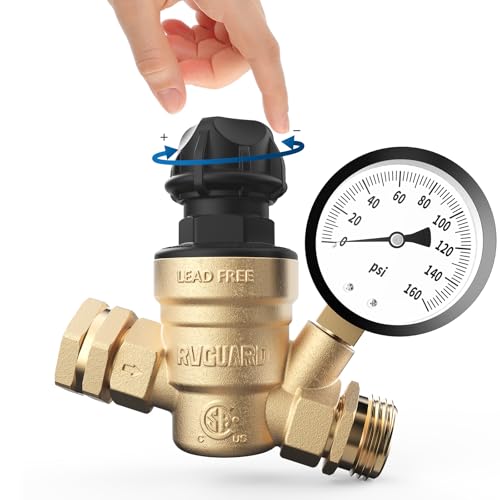
RVGUARD RV Water Pressure Regulator Valve with Adjustable Knob

BPSSDI 0-3 Psi Low Pressure Capsule Gauge

BPSSDI 0-5 Psi Low Pressure Capsule Gauge

BPSSDI 0-30 Psi Glycerin-Filled Low Pressure Gauge

BPSSDI 0-30 Psi Low Pressure Gauge with Tape

BPSSDI 0-100 Psi Low Pressure Gauge

BPSSDI 0-60 Psi Glycerin-Filled Low Pressure Gauge
Why These Options Stand Out
Few names carry as much weight in RV plumbing as Camco, and this brass regulator sits at the top of that reputation. It’s designed for both RV and marine freshwater systems, attaching between a campground spigot and your hose to trim incoming pressure to a safer range. For full-time road life or frequent weekend trips, that pre-set protection matters: hose bursts and fitting cracks become expensive the moment pressure spikes past your plumbing’s comfort zone.
The lead-free brass construction addresses a quieter concern, namely water safety for drinking and cooking on the road. Unlike the plastic-bodied regulators that show up at lower price tiers, this unit leans on metal for the pressure-bearing surfaces. Once installed, the workflow is essentially set-and-forget.
Why It Works Well
- Solid brass body holds up to repeated connect/disconnect cycles at the spigot.
- Factory-set output protects plumbing without manual adjustment.
- Drinking-water-safe material composition suits freshwater tanks and onboard sinks.
- Broad compatibility with standard 3/4-inch hose threads used at most U.S. campgrounds.
- Long-standing reputation across RV forums and service centers.
Worth Noting
- No built-in gauge, so verifying output pressure requires a separate inline meter.
- Heavier than plastic alternatives, which can stress a plastic spigot fitting if not supported.
Whose Shelf It Belongs On
Full-time RVers and anyone who relies on their rig’s plumbing for drinking, showering, and dishwashing across long stretches.
Consider Something Else When
Variable-pressure needs point you toward the RVGUARD RV Water Pressure Regulator Valve, which lets you dial output by hand.
The Hourleey regulator steps in where budget matters but brass construction still matters more. Its body resists the kind of pressure spikes that burst cheaper plastic fittings, and the built-in stainless filter screen catches sediment before it reaches your hose or onboard plumbing. For weekend campers rolling into unfamiliar parks with uncertain water quality, that extra layer of screening pays off.
Output lands in the standard 40 to 50 psi band, the sweet spot for most RV plumbing systems. Installation is a hand-tight fit on standard 3/4-inch garden hose threads, so no specialty tools or plumber’s tape come into play.
Notable Gains
- Integrated stainless filter screen catches rust and grit from older campground lines.
- Brass construction at a budget-friendlier tier than premium competitors.
- Wide compatibility with standard 3/4-inch hose fittings.
Honest Caveats
- Filter screen requires periodic removal and rinsing to stay effective.
- Factory-set output is not user-adjustable without swapping units.
Built With In Mind
Budget-conscious campers who still want brass durability and a debris-catching screen for older or rural water supplies.
Skip It When
Adjustable output matters for your setup, in which case the RVGUARD RV Water Pressure Regulator Valve offers a tunable knob instead.
Valterra’s lead-free brass regulator prioritizes water safety over flashy features, which is exactly what some owners want. The lead-free designation gives peace of mind for anyone drinking from the tap, cooking pasta, or filling pet bowls. For families traveling with kids, that material transparency carries real weight.
Functionally, it behaves much like the Camco unit above: a fixed-output regulator that drops incoming spigot pressure to a 40 to 50 psi band. Connect it once at the spigot, run your hose, and the regulator handles the rest. Compare that to the Hourleey option’s added filter screen, and Valterra’s pitch lands on simpler, clean water delivery without extra moving parts.
Noteworthy Benefits
- Lead-free brass composition suits health-conscious households and onboard drinking water.
- Broad compatibility with standard campers, travel trailers, and campground spigots.
- Sturdy brass body tolerates outdoor storage between trips.
Trade Offs
- No debris-filter screen, so pairing with a separate pre-filter helps in older parks.
- Fixed output offers no adjustment for specialty plumbing pressures.
Who Should Grab It
Safety-focused owners, families with children, and anyone who prioritizes drinking-water material certifications above add-on features.
Look Elsewhere When
Debris-heavy water supplies call for the Hourleey Brass RV Water Pressure Regulator with Filter Screen.
Where most regulators ship with a fixed output, the RVGUARD unit hands you a knob. Twist clockwise to raise pressure, counterclockwise to drop it, and the factory ships at 45 psi as a sensible default. For owners running pressure-sensitive fixtures or quirky older plumbing, that adjustability removes the guesswork that fixed regulators leave behind.
No tools are required for adjustment, which keeps the workflow quick at the spigot. The same hand-tight threading used across this category means installation stays in the same drill as the Camco and Valterra units above.
The Helpful Details
- Hand-adjustable knob removes the need for tools or regulator swaps to change pressure.
- Factory default at 45 psi suits most RV plumbing right out of the box.
- Suits campers, travel trailers, and broader RV plumbing setups.
Minor Gripes
- Knob adjustment can drift if bumped during travel, so a periodic check helps.
Quick Facts
Right Fit For
Owners who run variable-demand plumbing, mixed fixture types, or older rigs that benefit from fine-tuned pressure control.
A Better Fit Elsewhere
Set-and-forget owners who want fewer moving parts will find a simpler match in the Camco Brass Marine/RV Water Pressure Regulator.
Stepping away from regulators themselves, this BPSSDI gauge opens the door to actually measuring what’s flowing through your lines. The 0 to 3 psi window targets very low pressure, making it useful for testing delicate systems where a wider gauge would bury meaningful readings in needle movement. A capsule-style mechanism drives accuracy at the bottom of the scale.
The 2.5-inch dial stays readable without dominating an equipment bay, and the 1/4-inch NPT lower mount threads into standard test ports. Stainless construction on the case shrugs off shop moisture.
Well-Handled Touches
- Capsule measurement system supports accuracy in the low-pressure range most gauges skip.
- 304 stainless case tolerates humid garages and workshop environments.
- Zero adjustment screw lets you re-calibrate as wear settles in.
Practical Considerations
- Lower 3 psi ceiling limits usefulness for typical RV line pressures.
Who It Suits Best
Diagnostic-focused owners and tinkerers testing very low pressure applications beyond typical RV hookup ranges.
Reach For A Different Pick When
Standard RV line-pressure verification suits the BPSSDI 0-100 Psi Low Pressure Gauge better.
The 0 to 5 psi sibling extends the capsule gauge’s range just enough to cover slightly broader low-pressure tasks. Same 304 stainless casing, same 2.5-inch dial, same lower-mount threading. Where the 0-3 version above specializes in ultra-low readings, this one leaves a touch more headroom for pressure tests that creep above the 3 psi mark.
Owners running it as part of a diagnostic bench, not a daily RV hookup tool, will appreciate the ruggedness of stainless paired with the capsule element’s stability in fluctuating environments.
What It Does Well
- Capsule element provides steady readings at low pressures where standard bourdon-style gauges struggle.
- Stainless case construction stands up to shop conditions.
- Zero adjustment supports long-term recalibration as internal parts settle.
Room For Improvement
- 5 psi upper limit still falls well below typical RV line pressures.
- No liquid fill, so vibratory environments can cause pointer flutter.
Made For
Garage test bench owners and tinkerers needing a stable low-pressure reference gauge for non-RV applications.
Another Choice May Suit
RV-specific line verification points you to the BPSSDI 0-100 Psi Low Pressure Gauge, which covers the full operating range.
Glycerin-filled gauges earn their keep wherever vibration would otherwise make the needle dance. This BPSSDI 0 to 30 psi unit uses a liquid fill to dampen pointer flutter, which protects the internal mechanism from pump pulsations or rough road wash. For mobile setups where a dry gauge would frustrate, the fill buys readable results and longer service life.
The 2.5-inch dial with dual psi/Bar scale handles water, oil, and air pressure tests, so the gauge outgrows the RV bay if you want it to. Brass and stainless wetted parts cover non-corrosive media without complaint.
What Makes Sense
- Glycerin fill prevents pointer flutter and protects internals from vibration damage.
- Dual psi/Bar scale covers both common unit preferences.
- Weather and temperature resistance for outdoor installations.
Less Ideal Details
- 30 psi ceiling can read tight if you’re verifying higher-range pressure tests.
Feature Snapshot
Best Suited To
Owners diagnosing pumps and lines on rougher terrain where dry gauges would give jumpy, hard-to-read results.
Where A Sibling Pick Shines
Wider diagnostic ranges suit the BPSSDI 0-100 Psi Low Pressure Gauge for full-spectrum pressure testing.
Same 0 to 30 psi range as the glycerin-filled sibling above, but this version skips the liquid fill and ships with thread seal tape in the box. For first-timers installing a gauge into a fitting for the first time, that included tape removes a trip to the hardware store. The food-grade silicone seals and stainless/brass wetted parts keep it suitable for water testing duties.
IP67 waterproofing on the casing helps the dial stay readable in damp conditions by reducing internal condensation.
Useful Highlights
- Thread seal tape included for a complete out-of-box install.
- IP67-rated casing reduces internal fogging in humid environments.
- Dual psi/Bar scale at 2.5% accuracy supports general pressure diagnostics.
Points To Note
- Dry (non-glycerin) design can show pointer flutter in high-vibration settings.
Perfect Match For
First-time installers who want a complete gauge-and-seal kit without sourcing tape separately.
Swap It Out When
Vibration-heavy mobile diagnostics benefit more from the BPSSDI 0-30 Psi Glycerin-Filled Low Pressure Gauge.
Where the other gauges on this list target narrow windows, the 0 to 100 psi BPSSDI gauge covers nearly every pressure scenario an RV owner might encounter. From gentle freshwater pump output to higher air and pneumatic readings, one dial handles the whole spectrum. The dual psi/Bar scale with 2.5% accuracy keeps numbers meaningful across that range.
IP67 waterproofing cuts condensation fog inside the lens, which matters when the gauge lives in a damp storage bay or outside compartment.
A Favorable Mix
- Wide 0 to 100 psi range covers water pumps, pneumatics, and RV hose diagnostics in one unit.
- Stainless case paired with food-grade silicone seals handles non-corrosive media.
- IP67-rated housing reduces internal fogging in damp storage.
Trade-Offs To Consider
- Wider range means less granular resolution at the low end compared to capsule-style gauges.
- Dry design may flicker on rougher roads without a liquid fill.
Who Will Love This
Owners who want a single gauge for water pumps, air lines, and assorted pressure checks rather than specialty units for each.
Not Your Match When
Ultra-low-pressure accuracy matters more than range, in which case the BPSSDI 0-3 Psi Low Pressure Capsule Gauge delivers finer resolution.
The 0 to 60 psi sibling splits the difference between the 30 and 100 psi gauges, sitting in a comfortable middle for water, oil, air, and refrigeration system diagnostics. Glycerin filling does the same dampening work as the 30 psi version, quieting pointer flutter during pump cycles and rough road wash. Weather-resistant construction keeps it readable through summer heat and shoulder-season chill.
Brass and stainless wetted parts are rated for non-corrosive media, so testing potable water lines, oil pressure, or refrigeration evaporators falls within the same gauge’s duties.
Key Advantages
- Glycerin fill prevents pointer flutter and protects the mechanism from pulsation damage.
- Mid-range 0 to 60 psi span balances resolution with broad diagnostic coverage.
- Weather and temperature resistance supports outdoor or unconditioned storage.
- Works across water, oil, air, and refrigeration low-pressure applications.
A Few Limitations
- Not suited for pressures above 60 psi, which rules out some higher-pressure pneumatic work.
Who It Suits Best
Four-season campers and HVAC-curious owners who want one gauge for water lines plus refrigeration and oil diagnostics.
Look Elsewhere When
Maximum range flexibility matters more than mid-band resolution, in which case the BPSSDI 0-100 Psi Low Pressure Gauge stretches further.
What To Weigh Before Picking Rv Water Regulators
Body Material and Water Safety
Brass dominates this category for a reason: it tolerates repeated pressure cycles, resists corrosion at the spigot end, and handles outdoor storage between trips. Lead-free brass variants address the drinking-water concern for anyone cooking, brushing teeth, or filling pet bowls from the onboard tank. Plastic-bodied regulators exist at lower price points, but they trade longevity and temperature tolerance for upfront savings, which rarely pays off over multiple seasons.
Output Pressure and Adjustability
Most RV plumbing runs happily between 40 and 50 psi, which is why factory-set regulators cluster in that band. Fixed output suits owners who want a set-and-forget install: connect, run, done. Adjustable regulators, the RVGUARD unit being the clearest example, give a knob for owners running older fixtures, mixed-demand systems, or pressure-sensitive appliances that benefit from fine-tuning.
Filtering and Water Quality
Campground water varies wildly, from city-grade treated lines to older wells with rust and sediment. Built-in filter screens, such as the one on the Hourleey regulator, catch debris before it reaches your hose interior. For the cleanest install, pairing a regulator with a separate inline pre-filter extends hose and appliance life when water quality is questionable.
Diagnostic Gauges and Ongoing Monitoring
Regulators handle the protection side of the equation, but verifying what is actually flowing through your lines takes a gauge. Glycerin-filled units hold up to road vibration; capsule-style gauges deliver finer resolution at low pressures. Wide-range dials cover more scenarios at the cost of granular low-end readings, so choose based on whether you test mostly water pumps or a mix of systems.
Common Slips And Smart Spending
Pitfalls Shoppers Hit
A common trap is assuming every campground spigot runs at a safe pressure, when in reality municipal lines can spike well past what RV plumbing tolerates. Another miss is ignoring thread compatibility: standard 3/4-inch garden hose threads cover most U.S. parks, but specialty fittings can complicate installs. Skipping thread seal tape on gauge connections is a smaller but real leak source that adds up over time.
Where The Extra Money Goes
Premium-tier brass regulators cost more because of denser castings, tighter machining tolerances, and lead-free material certifications. Adjustable units carry added complexity in the knob mechanism and internal regulation spring. Higher-end gauges earn their price through liquid filling, stainless cases, and IP-rated sealing. The upgrade pays off when you run year-round, travel through variable water quality, or want one component to last a decade of trips rather than a handful of seasons.
Frequently Asked Questions
Do Rv Water Regulators Actually Matter?
Yes, campground spigot pressure can spike well beyond the 40-50 psi range that RV plumbing is designed for, and a regulator caps that pressure before it reaches your hoses and fittings.
Can You Install One Without Tools?
Most regulators thread onto standard 3/4-inch garden hose fittings by hand, so no specialty tools are required for the basic install, though thread seal tape helps on gauge connections.
How Often Should You Replace A Regulator?
Brass regulators commonly last across many seasons of regular use, but periodic inspection for leaks, corrosion, or sticking output behavior is a smart habit, especially before long trips.
Is Lead-Free Brass Worth The Premium?
For anyone drinking, cooking, or brushing teeth from the onboard freshwater system, lead-free brass removes a meaningful concern and is a worthwhile upgrade over standard brass.
Do You Need A Gauge If You Already Have A Regulator?
A regulator protects the plumbing, but a gauge verifies the actual pressure being delivered, which is useful for troubleshooting weak showers, slow fills, or pump-related issues.
Wrap Up
The right RV water regulator depends on whether you want simple protection, adjustable output, or built-in debris filtering, and the picks above cover each of those lanes without overlap. Pair whichever regulator you choose with a compatible gauge if you plan to verify pressure or troubleshoot pump behavior over time. The brass-bodied options lead on longevity, and adjustable models earn their keep when your plumbing setup demands flexibility.