

Smart RGB light bulbs turn a plain room into a mood you control with your phone or your voice. The hardest part is sorting through eight similarly named picks and figuring out which one actually fits your fixtures, your Wi-Fi setup, and the way you live. This guide breaks down what each bulb offers, where it shines, and where it falls short, so you can match the right bulb to the right room without overspending or under-buying.
The Main Contenders

Philips Hue Smart 60W A19 LED Bulb 2-Pack (White & Color)
Aputure Accent B7C Smart LED Bulb 7W RGBWW
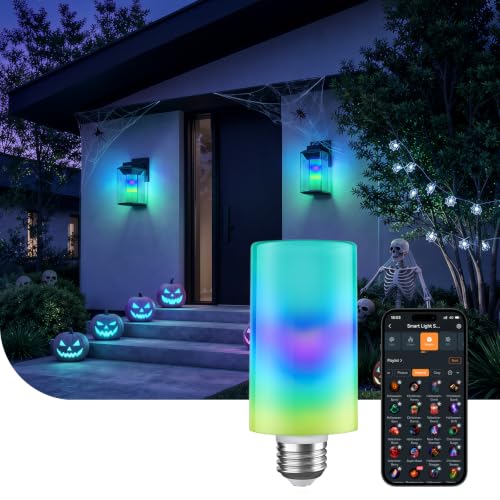
Linkind Smart Light Stick T19 Color & White
Philips Hue Smart B39 Candle E12 Color Bulb

Lightinginside Smart Light Bulbs 100W 4-Pack

Lightinginside Smart E12 LED Bulbs 60W 4-Pack

Linkind Smart Light Bulbs (Alexa/Google/AiDot)

Lightinginside Smart Light Bulbs 6-Pack SmartLife
Inside Each Recommended Option
The Philips Hue A19 is the bulb most people picture when they hear “smart lighting.” It screws into a standard E26 socket, outputs 800 lumens at a 60W equivalent, and shifts across warm white, cool white, and millions of colors without a clunky hub on day one.
You can run up to 10 bulbs in one room over Bluetooth through the Hue app, then graduate to the Hue Bridge when you want automations, remote access, and Matter compatibility. In a living room or bedroom where reliability matters more than rock-bottom cost, this 2-pack covers a small setup in one shot.
What It Does Well
- Bluetooth control works without a hub for the first ten lights, easing the setup for newcomers.
- Compatible with Alexa, Google Assistant, and Apple HomeKit once paired, so it flexes with whichever assistant you already use.
- Adding the Hue Bridge unlocks automations, away-from-home control, and Matter support for mixed smart homes.
- Color reproduction feels balanced for everyday ambiance rather than gimmicky.
Points To Keep In Mind
- You pay a premium per bulb compared with the Lightinginside multi-packs later in this list.
- Remote control and full automation require the separately sold Hue Bridge.
Whose Shelf It Belongs On
People building a long-term smart-home system and willing to invest in the Hue ecosystem from the start.
Skip It When
The Lightinginside 6-Pack is a better fit if you’re color-curious but want to light an entire apartment for noticeably less.
The Aputure B7C is less a “smart home” bulb and more a portable production tool. CRI (Color Rendering Index, a measure of how accurately a light reveals true colors) of 95+ and TLCI (Television Lighting Consistency Index, the broadcast equivalent) of 96+ put it firmly in cinematic territory, and the on-board battery means it can run untethered from a fixture for short shoots.
If you record interviews at a desk, light a podcast corner, or just want your living-room hue to look right on camera, this is the only pick on the list aimed squarely at creators. Everyone else will likely find the price steep for general lighting duty.
Practical Pluses
- High CRI and TLCI scores make skin tones and product shots look natural on camera.
- RGBWW tuning (red, green, blue plus dedicated warm and cool white diodes) covers a 2,000K to 10,000K color temperature range for everything from candlelight to daylight.
- Built-in FX modes, such as fire, lightning, and pulsing, speed up mood work without custom programming.
- The internal battery frees you from a wall socket when scouting locations.
Worth Noting
- At 7W, output is modest compared with the 100W-class Lightinginside bulb reviewed later.
- Priced well above consumer smart bulbs; the value is wasted if you only need accent lighting.
The Right Fit
Filmmakers, YouTubers, and TikTok creators who care about accurate on-camera color.
Reach For A Different Pick When
The Lightinginside 100W 4-Pack makes more sense for someone wanting bright everyday room color without the cinema tax.
The Linkind T19 throws the standard A19 silhouette out the window. At roughly 57 x 131 mm in a slim T19 tube shape with an E26 base, this stick bulb is meant to be seen. Hang it bare in a pendant, drop it into a floor lamp, and the elongated form becomes part of the room’s design language.
It’s also one of the brighter non-Hue options on the list at 850 lumens, and it leans on 2.4 GHz Wi-Fi plus voice assistants for control. Owners commonly report that pairing with a standard on/off switch and avoiding old dimmer walls keeps the bulb flicker-free.
Well-Handled Touches
- The stick format reads as décor first, gadget second, which is rare in this category.
- 850-lumen output handles medium rooms without needing a cluster of bulbs.
- Standard E26 base fits most existing fixtures, so no rewiring is required.
Room For Improvement
- Limited to 2.4 GHz Wi-Fi networks, not compatible with 5 GHz routers.
- Not designed to work with traditional dimmer switches; pairing one commonly causes buzzing or flicker.
- No Thread support, and it does not pair inside Tuya or Smart Life ecosystems.
Who It Suits Best
Design-minded renters lighting a dining pendant or accent lamp where the bulb itself becomes part of the look.
Consider Something Else When
The Philips Hue B39 candle bulb is a better match when your fixture is a chandelier with E12 sockets instead of a single exposed E26 pendant.
The Philips Hue B39 is the candle-shaped counterpart to the A19 reviewed first. It uses the smaller E12 candelabra socket, draws about 9W to deliver 450 lumens at a 40W equivalent, and targets the decorative fixtures the A19 physically can’t fit into.
Think chandeliers over a dining table, sconces in a hallway, or a small lamp where a flame-tip shape looks right. Like its sibling, Bluetooth gets you going on day one and the Hue Bridge opens up the full feature set later.
Points In Its Favor
- Sized specifically for E12 fixtures where most smart bulbs simply don’t fit.
- Full warm-to-cool white plus millions of colors in one bulb.
- Same Alexa, Google Assistant, and Apple HomeKit compatibility as the rest of the Hue line.
- Bridge integration brings Matter support, letting it join a mixed-device smart home.
Things To Consider
- 450 lumens is dim by main-room standards; a single bulb works for accents, not for lighting a whole kitchen.
- Costs more per bulb than the Lightinginside E12 multi-pack below.
Best Suited To
Homeowners with chandeliers, sconces, or candelabra lamps who want full smart control without swapping fixtures.
Look Elsewhere When
The Lightinginside E12 4-Pack is a smarter call when you need several candelabra sockets lit affordably rather than one premium flame-tip.
Where the Hue A19 puts out 800 lumens, this Lightinginside 4-pack delivers 1350 lumens per bulb at a 100W equivalent. That’s the difference between a single accent and a room flooded with tunable light.
The package covers a medium-sized open-plan living area or a long kitchen run with one purchase. Owners commonly use the SmartLife app for grouping, schedules, and routines, then hand off everyday control to Alexa or Google.
What Pays Off
- High 1350-lumen output suits larger spaces where one bulb per fixture is the plan.
- Four-pack pricing lowers the cost per socket compared with single-bulb Hue boxes.
- Dimming through the app or voice avoids the flicker that traditional wall dimmers cause.
Trade Offs
- Dimming through a physical dimmer switch is not supported and may cause flicker.
- The SmartLife app experience feels less polished than the Hue app for automations.
Made For
Open-plan living rooms, finished basements, or anywhere you want one bulb per fixture without splitting into multiple packs.
Not Your Match When
The Linkind T19 stick makes more sense for an exposed-pendant setup where slim design matters as much as lumen count.
This Lightinginside E12 4-pack covers four candelabra sockets at once, dropping the per-bulb cost well below a single premium candle bulb. The 60W-equivalent output lands between the Hue B39 and the brighter Lightinginside A19 reviewed above.
The standout feature here is BLE (Bluetooth Low Energy) backup, which means lights stay controllable locally when the home Wi-Fi drops. For renters or anyone who has lived through a router reboot at the worst moment, that fallback alone justifies the pick.
The Value In It
- BLE backup keeps lights controllable locally when Wi-Fi is offline.
- Second-generation BLE plus Wi-Fi dual-channel chip pairs noticeably faster than older generations.
- Four-pack fills a chandelier or multi-socket sconce in one order.
Points To Note
- SmartLife app is the required starting point before Alexa or Google picks them up.
- Color rendering and app polish are a step below the Hue candle bulb, by design.
Who Should Grab It
Renters with multi-arm chandeliers who want voice control plus a Wi-Fi-outage safety net.
Swap It Out When
The Philips Hue B39 candle is a better fit when only one or two fixtures matter and you want the smoothest app experience possible.
Linkind’s AiDot-path bulb keeps things simple: no hub, no extra bridge, no subscription. The AiDot app walks through setup, then the bulbs surface in Alexa or Google Home for everyday voice commands like dimming a bedroom light while cooking dinner.
This is the entry-level pick for anyone who wants color and dimming without committing to a Hue-class ecosystem. In a kid’s room, a guest space, or a rental, the lack of long-term lock-in is the whole appeal.
Features That Help
- Hub-free setup means one fewer device on the shelf and one fewer account to manage.
- Three-step pairing through AiDot gets the bulbs talking to Alexa or Google quickly.
- Color and tunable white in one bulb at a budget-friendly tier.
Where It May Fall Short
- AiDot automation depth is more limited than Hue or Matter-driven systems.
- Color accuracy isn’t tuned for video work the way the Aputure B7C is.
Right Fit For
First-time smart lighting owners who want color and voice control without managing a hub.
A Better Fit Elsewhere
The Philips Hue A19 is the better long-term call once you plan to expand beyond a handful of bulbs.
The 6-pack version of the Lightinginside bulb is built for whole-room retrofits. Six bulbs cover a living room, a hallway, and a bedroom in one box, dropping the effective cost per fixture well below anything from the Hue line.
Setup runs through the SmartLife app, then hands off to Alexa or Google. Pairing benefits from the same upgraded BLE + Wi-Fi chip seen in the E12 4-pack, so the first bulb connects faster than older-generation smart bulbs typically do.
Everyday Perks
- Six bulbs cover most apartments in a single purchase, simplifying group control.
- Upgraded dual-channel chip shortens the initial pairing and reconnection times.
- Voice control through Alexa and Google covers the most common commands.
Honest Caveats
- SmartLife app is functional but feels less refined than Hue for layered routines.
- Color tuning accuracy sits below the Aputure B7C reviewed earlier.
Perfect Match For
Apartment dwellers retrofitting an entire space with color and dimming on a budget.
Another Choice May Suit
The Linkind AiDot bulb is a smarter pick when only two or three fixtures need smart control.
What Matters Most Before Choosing Smart Rgb Light Bulbs
Match the socket before you fall in love with the spec sheet
The fastest way to waste money is picking a bulb that doesn’t physically fit your fixture. E26 is the standard screw base in North America, while E12 (candelabra) shows up in chandeliers, sconces, and small accent lamps. Confirm what your fixture accepts before reading a single review. The Philips Hue B39 covers E12 setups, the Linkind T19 sticks to E26, and the Lightinginside lineup spans both.
Decide whether you want a hub or not
Hue-class systems ask you to commit to a hub (or bridge) for full automations, away-from-home control, and Matter support. Hub-free bulbs like the Linkind AiDot model and the Lightinginside SmartLife bulbs get going in minutes, but automations live inside a single app. Beginners starting with a single room often prefer the hub-free path; whole-home builders tend to outgrow it within a year.
Brightness and color accuracy tell different stories
Lumens measure how bright a bulb gets, while CRI (Color Rendering Index) and TLCI (Television Lighting Consistency Index) measure how truthfully colors appear under it. The Lightinginside 100W bulb wins on raw output, while the Aputure B7C wins on accuracy for on-camera work. For everyday living rooms, a balanced 800 to 1350 lumen bulb with adequate CRI covers most moods.
Voice control ecosystem shapes daily life
Every bulb on this list claims Alexa and Google Assistant support, but the smoothness varies. Hue pairs deeply with Apple HomeKit once bridged, which matters if you live in that ecosystem. The Lightinginside and Linkind bulbs route through SmartLife or AiDot first, which adds one extra layer before voice commands land. Pick the path that matches the assistant you already use daily.
Key Considerations Across These Picks
Pitfalls Shoppers Hit
The most common regret is buying a beautiful smart bulb for a fixture with a physical dimmer switch, then watching it flicker or buzz every evening. Smart bulbs and traditional dimmer walls do not mix; control brightness through the app or voice instead. The second pitfall is grabbing a 5 GHz Wi-Fi router and a 2.4 GHz-only bulb, which simply will not pair. Confirm your router’s band before unboxing.
Where The Extra Money Goes
The jump from budget Lightinginside packs to a Hue bulb pays for a more refined app, deeper automation logic, and Matter compatibility for mixed-device homes. That premium lands well when you plan to add more bulbs, sensors, and switches over time. For a single-room experiment or a rental, the budget tier delivers 80 percent of the experience for a noticeably lower cost per socket.
Frequently Asked Questions
Do smart RGB bulbs work without Wi-Fi?
Some, like the Lightinginside E12 4-Pack, include a BLE (Bluetooth Low Energy) fallback that keeps local control working when Wi-Fi drops. Others, including the Linkind AiDot bulb, lose remote features until the network returns, but basic on/off through a standard wall switch still works.
How long do these smart bulbs typically last?
Most LED smart bulbs in this category are rated for around 15,000 to 25,000 hours of use, which translates to roughly a decade of normal household use before noticeable dimming. Heavy daily scenes and bright color cycles can shorten that window somewhat.
Can I mix brands in one app?
Sometimes. SmartLife groups many Lightinginside bulbs together, and AiDot handles the Linkind lineup, but cross-brand mixing usually requires a hub like Hue Bridge or a Matter controller to unify routines. Plan around the ecosystem you actually want, not the one a single bulb forces on you.
Are smart bulbs safe to leave on all night?
Yes, LEDs run cool compared with incandescent bulbs, and smart models add scheduling and sunrise automations that often reduce overnight runtime. Set a bedtime routine in the app so the bulbs turn themselves off rather than relying on a wall switch.
Do I need a special switch?
A standard on/off switch is fine for every bulb on this list. The warning is against traditional dimmer switches, which modulate power in a way that confuses smart bulbs and causes flicker. Dim through the app or voice instead.
The Takeaway
The smartest RGB bulb is the one that fits your fixture, your assistant, and your appetite for hubs. Hue earns its place in long-term systems, Lightinginside packs shine in whole-room retrofits, Linkind sticks suit exposed pendants, and Aputure serves creators who care about on-camera color. Pick the pick that matches your room first, and the rest of the decision usually lines up behind it.
