

Setting up a HomeKit-friendly home used to mean juggling bridges, hubs, and one too many apps. Today’s smart bulbs connect over Matter (a universal smart-home standard that lets devices from different brands talk to each other), Thread (a low-power mesh networking protocol that extends your smart-home reach without crowding Wi-Fi), or Wi-Fi, and they show up in the Apple Home app with barely a tap. The lineup below covers the shapes, brightness levels, and price tiers that actually make sense for real rooms, from a single bedside lamp to a full chandelier retrofit. Each pick has been judged on its HomeKit behavior first, with app support, color quality, and ecosystem flexibility close behind.
A Quick View Of The Lineup

Philips Hue Smart 60W A19 LED Bulb (2-Pack)

Philips Hue Premium Smart Bulbs (2-Pack)
Philips Hue Smart B39 Candle Bulb (1-Pack)

Philips Hue A19 LED Smart Bulb (3-Pack)

Eve Energy (Matter) Smart Plug

Eve Motionblinds Upgrade Kit for Roller Blinds

LIFX Smart Light Bulbs A19 (Matter, 2-Pack)
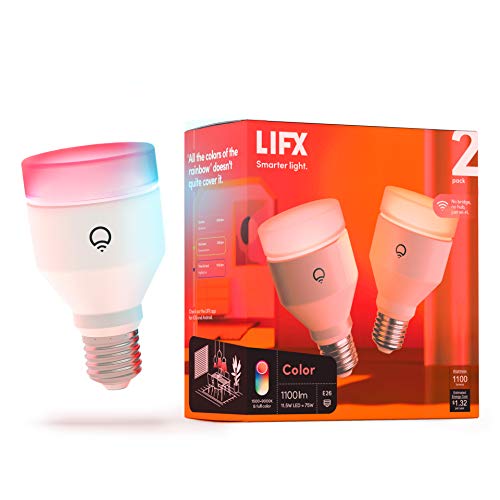
LIFX Smart Light Bulbs A19 (1100LM, 2-Pack)

LIFX Color Smart Light Bulbs (2-Pack, 800 Lumens)
The Strengths Of Each Pick
The Philips Hue A19 2-pack is the lowest-friction way to drop into HomeKit with a name you already trust. Each bulb pushes 800 lumens at a 60W equivalent, fits a standard E26 socket, and runs the full color-and-white spectrum that Apple Home exposes natively. For most apartments, that’s enough to light a living room corner or a couple of bedside lamps without ever opening the Hue app.
Bluetooth control works out of the box for up to ten bulbs in one room, so first-timers can skip the hub entirely. The catch is that HomeKit remote access and automations from outside the home need the optional Hue Bridge, which adds a small upfront step. For anyone who wants solid colors, dependable HomeKit pairing, and a clean path to expand later, this starter kit lands in a useful sweet spot.
The Case For It
- Bluetooth pairing means HomeKit sees the bulb in seconds without extra hardware
- Color and tunable white range covers everything from a warm evening glow to crisp task lighting
- Hue Bridge unlocks automations, away-from-home control, and Matter bridging down the line
- Standard A19 shape fits most floor and table lamps already in your home
- Two-bulb pack keeps per-bulb cost reasonable for a first upgrade
Points To Note
- Remote access and cross-room scenes still depend on the separate Hue Bridge
- Replacing one bulb after a Bluetooth-only setup can mean re-pairing through the app
Key Specs
Best Suited To
First-time HomeKit users who want one trusted brand across a couple of lamps without committing to a hub.
Skip It When
You’re planning to fill a multi-room home right away; the Philips Hue Premium Smart Bulbs (2-Pack) is the better building block for that.
The Philips Hue Premium bulbs target the upper end of the Hue family, advertising 16 million colors and the full Hue feature set rather than the cut-down Bluetooth experience. These need a Hue Bridge to function, which is worth knowing before you buy. For committed Hue households, that bridge requirement turns from a limitation into an asset.
The payoff shows up in deeper HomeKit scenes, stable multi-room routines, and the kind of color accuracy that holds up under a movie screen or in a dining nook. Where the Editor’s Choice pick above feels like a starter, this 2-pack is what you reach for once you’ve decided the Hue ecosystem is the right one for your home.
Positive Points
- 16 million color steps give scenes a level of nuance that budget bulbs can’t match
- Hub-based pairing keeps HomeKit control snappy even with many bulbs on the network
- Works with Apple Home, Alexa, and Google Assistant for cross-platform voice control
- Fits standard lamps and overhead fixtures, so there’s no fixture-specific shopping
- Hue ecosystem path unlocks dimmer switches, light strips, and outdoor lighting later
Worth Bearing In Mind
- Without an existing Hue Bridge, the bulbs won’t connect at all
- Pricing is higher than entry-level alternatives, and the bridge adds to the total
Made For
Households already running a Hue Bridge who want richer color and a multi-room foundation.
A Better Fit Elsewhere
You don’t yet own a hub and want the cheapest path to color; the LIFX Smart Light Bulbs A19 (Matter, 2-Pack) runs without a bridge.
Standard A19 bulbs don’t fit a candelabra socket, and that’s the entire reason the Hue B39 candle bulb exists. This 40W-equivalent candle uses the smaller E12 base and puts out 450 lumens, which sounds modest but lands just right for a chandelier or a wall sconce where the bulb is part of the look. You get the same White and Color Ambiance treatment as the bigger Hue A19, including full HomeKit support.
It’s a single-pack, so most people will need a handful of these for a full fixture. Used in the right place, it pulls double duty: lighting and accent color, both addressable from your iPhone.
What Pays Off
- E12 base fits chandeliers, sconces, and decorative fixtures the standard A19 can’t
- Same HomeKit pairing logic as the larger Hue family keeps setup familiar
- Color and tunable white make the fixture part of a room-wide scene
- Compact B39 shape doesn’t crowd multi-socket fixtures visually
Less Ideal Details
- Single-bulb pack means a full chandelier retrofit requires multiple purchases
- 450 lumens is too dim for primary room lighting on its own
Perfect Match For
Anyone with decorative fixtures who wants smart color without breaking the visual line of the chandelier.
Reach For A Different Pick When
You’re lighting a kitchen or living room; the Philips Hue A19 LED Smart Bulb (3-Pack) covers those sockets with more output.
The Hue A19 3-pack exists for one reason: putting a full room on HomeKit without buying singles. You get three of the same White and Color Ambiance bulbs that anchor the first pick on this list, just in a larger bundle that tends to land at a friendlier per-bulb price. For a bedroom, a den, or an open living area, three is often the minimum that lets scenes actually feel different from one switch flip.
Set up the same way as the 2-pack: pair over Bluetooth first, then graduate to a Hue Bridge for away-from-home access. The honest read is that this is the right pick once you’ve decided Hue is the brand you’re building around.
Useful Highlights
- Three-bulb bundle covers a full room with one purchase decision
- Identical HomeKit and Matter behavior as the smaller Hue packs
- Tunable white range handles evening wind-down and daytime focus equally well
- Compatible with Alexa and Google Assistant alongside Apple Home
Trade Offs
- Three-pack pricing still climbs once you factor in a Hue Bridge for full control
- Brightness per bulb is unchanged at 60W equivalent, not designed for very high ceilings
Feature Snapshot
Right Fit For
HomeKit households ready to outfit a full room with one dependable brand at a better per-bulb cost.
Not Your Match When
You’re starting from scratch and want to test a single socket first; the Philips Hue A19 LED Bulb (2-Pack) is the lower-commitment option.
The Eve Energy smart plug isn’t a bulb at all, but it earns its spot on a HomeKit lighting list for a specific reason. Plug a lamp into it and any dumb bulb becomes HomeKit-controllable, including schedules, automations, and Siri voice. For renters or anyone with a fixture they can’t easily rewire, this is often a faster win than swapping every bulb in the room.
Eve built this around Matter over Thread with a strict no-cloud policy: scheduling and control stay local to your network. For shoppers wary of bulbs that ping a vendor server every time they turn on, that’s a meaningful difference.
Notable Upsides
- Turns existing lamps into HomeKit devices without rewiring or bulb swaps
- Matter over Thread support keeps setup fast on modern Apple hubs
- No cloud account required, which protects local-only control
- Compatible with Apple Home, Alexa, Google Home, and SmartThings
Trade-Offs To Consider
- Doesn’t add color or dimming to a fixture that uses a non-dimmable bulb
- Thread border router required for full HomeKit benefit, which means a HomePod or Apple TV nearby
Whose Shelf It Belongs On
Renters and existing homeowners who want HomeKit control of lamps they already own.
Consider Something Else When
You want per-bulb color and dimming from a single purchase; the LIFX Color Smart Light Bulbs (2-Pack, 800 Lumens) delivers that without a plug.
The Eve Motionblinds kit lives one category over from a bulb, but it rounds out the HomeKit picture in a way lighting alone doesn’t. Instead of replacing your existing roller shades, this motor retrofit installs into compatible tubes and adds HomeKit scheduling, automations, and voice control. Closing blinds at sunset or opening them at sunrise then becomes part of the same scene as your bulbs.
Matter support means it joins the same Apple Home architecture the rest of this list runs on, no extra app required if you only want Siri and Home routines.
A Few Highlights
- Retrofits existing roller blinds rather than forcing a full shade replacement
- Matter compatibility keeps it inside the Apple Home ecosystem
- Schedule and automation support pairs naturally with bulb-based lighting scenes
Practical Considerations
- Requires a Thread border router, such as a HomePod or Apple TV, for full functionality
- Compatibility depends on existing blind tube size, so check specs before purchasing
Who Should Grab It
Shoppers building a whole-room HomeKit experience who want lighting and shading under one app.
Swap It Out When
You only need a bulb for a single room; the Philips Hue A19 LED Smart Bulb (3-Pack) is the simpler starting point.
LIFX has always been the “no hub required” answer in the smart-bulb world, and this A19 Matter pack keeps that tradition alive. Each bulb connects directly to your 2.4 GHz Wi-Fi and pairs with Apple Home over Matter without any bridge hardware on your end. For renters and small-space dwellers, that’s the deciding factor.
You get 800 lumens per bulb, full RGBW color, and a tunable white range that runs from a warm 2700K (a candle-warm tone) to a crisp 6500K (daylight white). The LIFX app layers on 200+ themes if you want to play with palettes; HomeKit alone handles the everyday scenes.
Real Benefits
- Matter pairing skips the bridge that some competitors require
- Direct Wi-Fi setup keeps the parts list short for first-time smart-home shoppers
- CRI 90 color rendering (a measure of how accurately a bulb shows true colors) keeps reds, skin tones, and wood finishes looking natural
- Tunable white range covers both relaxing evenings and daytime focus tasks
A Few Limitations
- 2.4 GHz Wi-Fi only, which can be crowded in dense apartment buildings
- Some LIFX app themes require the vendor app rather than HomeKit alone
Quick Facts
Built With In Mind
Apartments and small homes where a bridge feels like overkill but HomeKit color and dimming still matter.
Where A Sibling Pick Shines
You’re lighting a high-ceiling room or an open floor plan; the LIFX A19 (1100LM, 2-Pack) pushes more brightness per socket.
When one bulb needs to do the work of two, the LIFX SuperColor A19 at 1100 lumens steps up. It’s a 75W equivalent, which means fewer fixtures on the ceiling and no dim spots in tall rooms. Open-plan living areas, lofts, and high-ceiling kitchens are the obvious targets.
Like the other LIFX pick, it runs over Wi-Fi with Matter support, no hub required. The trade-off is a slightly larger bulb and a higher per-bulb price than the 800-lumen LIFX pack.
The Good Stuff
- 1100 lumens comfortably fills larger rooms from a single fixture
- Direct Wi-Fi and Matter pairing keep the setup short
- Full RGB color and tunable white in one bulb
Honest Caveats
- Larger physical size may not fit every lampshade or enclosed fixture
- Higher per-bulb cost than the 800-lumen LIFX pack
Who Will Love This
Homeowners with open layouts or vaulted ceilings who want fewer bulbs doing more work.
Look Elsewhere When
Your fixtures are close to the wall or shade-mounted; the LIFX Smart Light Bulbs A19 (Matter, 2-Pack) is a more compact everyday choice.
The LIFX Color A19 is the long-running member of the lineup and the one most casual HomeKit shoppers end up comparing against. Two A19 bulbs at 800 lumens, E26 base, Matter compatibility, and the LIFX app’s theme library. It’s the least dramatic pick on this list, and that’s part of why it works.
For someone who wants a couple of lamps to dim, change color, and react to a HomeKit scene without buying anything else, this is the sensible middle ground. Wi-Fi only on the 2.4 GHz band, so make sure your router reaches the room where these will live.
Benefits That Matter
- Standard 800-lumen output fits everyday rooms without surprise
- Matter support pairs cleanly with Apple Home for scenes and automations
- No bridge hardware required for full functionality
- LIFX app adds 200+ themes for moments HomeKit alone doesn’t cover
Small Caveats
- 2.4 GHz Wi-Fi only, so signal strength in distant rooms matters
- Some color and theme features are richer in the LIFX app than in Apple Home
Right Fit For
Anyone who wants a familiar, well-reviewed HomeKit color bulb without spending on a hub or premium tier.
A Better Fit Elsewhere
You’re outfitting a whole-home Hue setup; the Philips Hue Premium Smart Bulbs (2-Pack) is the better long-term match.
What To Weigh Before Buying Smart Bulbs For HomeKit
A HomeKit label on the box tells you the bulb will pair, but it doesn’t tell you how it behaves after a year of daily use. Start with the connection model. Hue bulbs need that bridge for full HomeKit control. LIFX bulbs ride your existing Wi-Fi, which is convenient but shares bandwidth with everything else in the house. Eve leans on Thread, which is fast and low-power, but needs a Thread border router such as a HomePod or Apple TV to reach its full potential. Match the technology to the gear you already own.
Next, look at the socket and the lumen count. A standard A19 with an E26 base covers most table and ceiling fixtures, while a B39 candle bulb with an E12 base is the only way into chandeliers and decorative sconces. Brightness varies more than people expect; 800 lumens replaces a 60W bulb comfortably, while 1100 lumens takes over a 75W role for high ceilings. Color rendering index (CRI) matters if you care about accurate skin tones, food photography, or art on the wall.
Finally, plan for how a bulb dies. Smart bulbs tend to last years, but the firmware that runs them evolves, and compatibility shifts over time. Buying from brands with a track record of pushing updates, and using Matter where possible, gives you a better shot at staying compatible with the next HomeKit revision.
Key Considerations Across These Picks
Mistakes Worth Dodging
The most common slip-up is buying a bulb that’s HomeKit-ready but not actually HomeKit-activated. Some bulbs need a separate bridge or hub before Apple Home can see them at all. Another trap is assuming any smart bulb will dim smoothly through HomeKit, when in reality the dimming curve is set by the bulb firmware and varies brand to brand. Always confirm the bulb handles on/off, dimming, and color changes through Apple Home, not just through its own app, before committing to a multi-bulb purchase.
Where The Extra Money Goes
Paying more in this category usually buys three things: richer color reproduction, hub-based reliability, and broader compatibility. A premium Hue pack backed by a bridge behaves more predictably when you stack twenty bulbs on one network, which a hub-free Wi-Fi setup can struggle to match. Higher-tier LIFX models add wattage for high-ceiling rooms and stronger color saturation. For a one-bedroom apartment, the value tier often does the job. For a larger home with many fixtures on one network, the premium tier earns its keep through stability rather than new features.
Frequently Asked Questions
Do all smart bulbs work with Apple HomeKit?
No. Only bulbs that advertise HomeKit, Matter, or specific Apple Home compatibility will show up in the Apple Home app. Always check the compatibility list before buying.
Do I need a bridge or hub for HomeKit bulbs?
It depends on the bulb. Hue bulbs generally need the Hue Bridge, while LIFX bulbs connect directly to Wi-Fi. Matter-over-Thread devices need a Thread border router like a HomePod or Apple TV.
Can I use HomeKit bulbs without an iPhone?
You need an Apple device for setup, but you can control HomeKit bulbs from an iPad, HomePod, or Apple TV afterward. A Mac also works as a home hub.
Are smart bulbs worth it for renters?
Yes, especially Wi-Fi or Matter bulbs that don’t require rewiring. Plug-in options like the Eve Energy smart plug also add HomeKit control without altering fixtures.
How long do smart bulbs typically last?
Most LED smart bulbs are rated for many years of normal use. Lifespan depends on daily hours on, dimming patterns, and firmware support from the manufacturer.
Closing Remarks
A good HomeKit bulb should disappear into the routine: tap a scene, walk into a lit room, never think about it. The picks above cover the common paths to that outcome, from a single starter bulb to a hub-backed whole-home setup. Pick the one that matches your rooms, your router, and how much fiddling you actually enjoy, then build from there.
