

Well water carries its own personality into your home, and sometimes that shows up as rusty faucets, sulfur smells, or sediment at the bottom of a glass. A whole-house system tackles those issues at the point of entry, so every shower, washer load, and kitchen tap benefits from one decision. The picks below cover sediment-only cartridges, multi-stage systems with carbon, and specialty filters aimed at iron and manganese. You’re choosing based on your well’s specific profile, your household size, and how hands-on you want maintenance to be.
A Fast Comparison Of The Options

Aquaboon 5 Micron String Wound Sediment Filter 6-Pack

3M Aqua-Pure AP917HD Replacement Cartridge

3M Aqua-Pure AP810 Replacement Filter

GE FXHTC Replacement Filter

PUREPLUS 2-Stage KDF & Coconut Carbon

3M Aqua-Pure AP904 Sanitary Quick Change

PUREPLUS 2-Stage with Pressure Gauges

PUREPLUS Clear Housing Iron & Manganese
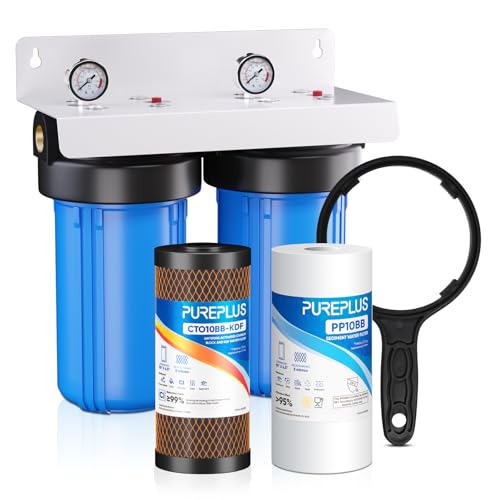
PUREPLUS PP Sediment & KDF Carbon Block

PUREPLUS 2-Stage Chlorine, Iron, Manganese
Taking A Closer Look At The Options
For homeowners whose main complaint is sandy or rusty water, a string-wound sediment cartridge does the heavy lifting before finer filtration even enters the picture. The Aquaboon 5 micron cartridge drops into standard 10-inch housings, and the six-pack format means a year or more of replacements stays within reach without repeated trips to the store.
Wound fibers create a gradient density that traps larger particles on the outside and finer grit deeper in the media, which is why these cartridges are a sensible first stage. They aren’t built to tackle chlorine or sulfur smell, but pairing one with a carbon stage addresses most common well complaints.
What Works In Its Favor
- Five-micron rating captures fine rust and sand that pass through cheaper spun cartridges
- Universal 10 x 2.5-inch sizing fits most standard housings, including the WHKF-WHSW mentioned in compatibility
- Six-pack stretches a single purchase across multiple change cycles
- String-wound design holds more sediment than pleated alternatives of similar size
- Simple swap-out means no special tools or plumber visits for routine changes
Things To Consider
- Sediment-only filtration won’t address chlorine taste, sulfur odor, or hardness
- Pressure drop increases as the cartridge loads, so heavy sediment wells may need more frequent swaps
Who It Suits Best
Budget-minded homeowners with clean well water that just needs sediment knocked down before reaching faucets and appliances.
Skip It When
Your water carries noticeable chlorine taste or sulfur smell, and the GE FXHTC Replacement Filter covers those contaminants in a single cartridge.
The AP917HD slots into the AP900 series housing and earns its “HD” label by handling high-volume households with serious sediment pressure. For a family of five running two showers, a dishwasher, and laundry back-to-back, the cartridge’s larger capacity translates to fewer change-outs than smaller replacements.
Compared to the Aquaboon 6-pack that started this list, this is a single-cartridge upgrade for homeowners who already own the matching AP903 head. The higher dirt-holding capacity reduces the frequency of swaps, which matters when your well runs heavy after storms or spring runoff.
Standout Benefits
- Engineered for higher flow rates common in busy households
- Drop-in compatibility with the AP903 system head eliminates guesswork on fit
- Longer service life between changes reduces maintenance trips to the basement
- 3M Aqua-Pure is a recognizable brand in residential water treatment
Worth Noting
- Requires the existing AP903 housing, so it isn’t a standalone purchase for first-time installers
- Single cartridge packaging means replacement purchases come sooner than multi-packs
Made For
Homeowners already running an AP903 system who want a longer-lasting sediment cartridge without switching brands.
A Better Fit Elsewhere
First-time buyers shopping for a complete system should consider the 3M Aqua-Pure AP904 Sanitary Quick Change instead.
The AP810 has been a workhorse for the AP801 series for years, and many homeowners stick with what their installer originally mounted. Drop-in compatibility across the AP801, AP801-C, AP801T, and AP801B means a single SKU covers multiple setups, which simplifies reordering.
The grooved surface design increases the filter’s effective area, so dirt capacity rises without enlarging the housing footprint. For smaller homes with one or two bathrooms, that’s usually enough to stretch the cartridge through a full season of normal use.
Practical Pluses
- Compatible across several AP801 variants, which simplifies stocking replacement cartridges
- Grooved media pattern extends dirt-holding capacity over standard smooth cartridges
- Targeted at homes with up to two bathrooms, hitting a common residential sweet spot
- No tools required for routine swaps once the system is installed
Minor Gripes
- Sediment-focused filtration doesn’t touch chlorine taste or odor complaints
- Homes beyond two bathrooms may exhaust capacity faster than expected
Best Suited To
Owners of legacy AP801 systems who want a no-fuss sediment replacement without re-plumbing anything.
Look Elsewhere When
You need both sediment and chemical reduction in one cartridge, and the GE FXHTC Replacement Filter addresses multiple contaminant types at once.
The FXHTC covers more ground than the pure sediment cartridges that opened this list, and that’s why it lands in homes dealing with chlorine, sediment, and rust all at once. It fits the GXWH40L, GXWH30C, GXWH35F, GXWH38F, and GNQH38S systems, so cross-checking your existing head before ordering is worthwhile.
The standard 10 x 4.5-inch form factor is widely supported, which means replacement shopping rarely turns into a treasure hunt. Where the Aquaboon 6-pack handles sand, the FXHTC adds chemical reduction to that role, which matters when municipal water mixes with well sources or when a private well carries trace chlorine from treatment tabs.
Well-Handled Touches
- Multi-contaminant reduction in a single cartridge simplifies maintenance
- Broad compatibility with several GE whole-house system heads
- Standard 10 x 4.5-inch sizing fits most full-size filter housings
- Reasonable service life for typical household water usage
Room For Improvement
- Requires one of the listed GE systems, so standalone buyers should pair it with a matching housing
- Heavy sediment wells may shorten cartridge life below the suggested interval
Right Fit For
Households on a GE system who need a single replacement cartridge to handle sediment and chlorine simultaneously.
Swap It Out When
Your priority is heavy metal reduction instead, where the PUREPLUS 2-Stage KDF & Coconut Carbon covers that profile more thoroughly.
PUREPLUS takes a different swing at well water with a two-stage approach that combines KDF media with coconut shell carbon block. KDF stands for kinetic degradation fluxion, a copper-zinc media that targets heavy metals through electrochemical reaction. The coconut carbon block that follows polishes chlorine taste and odor, which is the more familiar role carbon plays in home filtration.
This is where the roundup shifts from replacement cartridges into complete two-stage systems. The first stage RFN10BB-CKDF tackles lead, mercury, and arsenic while also catching sediment, rust, and sand. The second CTO10BB block is certified to NSF/ANSI 42 for chlorine reduction, which means an independent testing body has verified the performance claim.
What Makes Sense
- Two distinct stages target heavy metals and chlorine separately rather than asking one cartridge to do everything
- NSF/ANSI 42 certification on the carbon block adds a layer of verified performance
- Coconut shell carbon typically outperforms coal-based carbon for chlorine and VOC reduction
Trade Offs
- Two-stage systems require more installation space and plumbing than single-housing setups
- Replacement cartridges cost more than basic sediment swaps
- DIY installation is approachable but does call for shutoff valves and basic plumbing skills
Who Should Grab It
Homeowners with confirmed heavy metal concerns or sulfur smell who want staged media targeting different problems.
Not Your Match When
Iron and manganese staining is your primary complaint, and the PUREPLUS Clear Housing Iron & Manganese system is built for that specifically.
The AP904 marks a different approach from the cartridge-only entries earlier in this list: it arrives as a complete system with a Sanitary Quick Change (SQC) head that lets you twist old cartridges out and new ones in without touching the media itself. That matters when a spent filter is loaded with whatever your well pulled out of the ground, and direct contact is something you’d rather avoid.
Inside, the media addresses sediment, chlorine taste and odor, and scale. The 100,000-gallon rated capacity gives it a long leash between changes, which suits families who don’t want to track filter swaps on a calendar.
What Earns Its Place
- SQC design keeps hands away from spent filter media during changes
- Targets sediment, chlorine, and scale in one system
- 100,000-gallon capacity stretches replacement intervals for typical households
- Heavy-duty framing suits homes with above-average water demand
A Few Limitations
- Whole-system cost sits above cartridge-only purchases
- Doesn’t address iron or manganese beyond what sediment filtration handles
The Right Fit
First-time whole-house buyers who want a complete install with cartridge swaps that don’t require touching the filter media.
Where Another Pick Suits Better
Shoppers focused on heavy metal and chlorine in a staged setup should consider the PUREPLUS 2-Stage KDF & Coconut Carbon option.
This PUREPLUS setup builds on the two-stage concept from earlier but adds the kind of monitoring features that homeowners actually use. Pressure gauges on each housing tell you when a cartridge is loading up, because the gauge needle climbs as flow restriction increases. For someone who’s forgotten a change date before, that’s a useful nudge.
The first stage uses a grooved PP10GBBD sediment filter with three density layers, inner 5 micron, middle 7 micron, outer 10 micron, which captures progressively larger particles. The second stage adds KDF and activated carbon for chlorine, odor, and heavy metal reduction. Standard 10 x 4.5-inch housings with 1-inch inlet and outlet keep plumbing straightforward.
Notable Upsides
- Pressure gauges offer visual confirmation of filter loading between scheduled changes
- Three-layer sediment filter catches a wider particle range than single-density cartridges
- KDF plus carbon targets both metals and chemical taste simultaneously
- 1-inch inlet and outlet reduce flow restriction compared to half-inch plumbing
Points To Keep In Mind
- Two-stage footprint demands more wall space than single-housing systems
- Higher upfront cost than single-stage options
Whose Shelf It Belongs On
Detail-oriented homeowners who like seeing system status at a glance and want a two-stage approach for diverse contaminants.
Reach For A Different Pick When
Your water shows clear staining from iron, and the PUREPLUS Clear Housing Iron & Manganese system addresses that head-on.
Iron and manganese create a specific kind of frustration: orange or black staining on fixtures, laundry, and sometimes the water itself. This PUREPLUS system targets those two contaminants directly, which is a different job from what the chlorine-focused carbon filters handle.
The first stage combines multi-layer sediment and carbon filtration certified to NSF/ANSI 42. The clear housing is a small but meaningful detail, because you can see when the sediment layer is filling up rather than guessing based on pressure alone.
Key Advantages
- Second-stage media is engineered specifically for iron and manganese reduction
- Clear housing lets you spot sediment buildup visually
- NSF/ANSI 42 certification covers the carbon stage’s chlorine and taste claims
- Multi-layer first stage captures sediment while preparing water for the iron stage
Factors To Consider
- Specialty media means higher replacement cartridge cost than generic sediment filters
- Iron-laden wells may require pre-treatment or more frequent media changes
Built With In Mind
Homeowners with visible iron staining on porcelain or laundry who need a dedicated reduction stage rather than general-purpose filtration.
Consider Something Else When
Your main complaint is sulfur smell and chlorine taste, and the PUREPLUS 2-Stage KDF & Coconut Carbon handles that combination instead.
This PUREPLUS pairing lands in the middle of the roundup for good reason: it covers the most common well water complaints without the specialty media or premium price of the iron-focused options. The first stage PP10BB polypropylene filter is certified by IAPMO R&T to NSF/ANSI 42, and a 5-micron rating handles everyday sediment loads.
The second stage adds KDF and activated carbon block for chemical and heavy metal reduction. Replacement cartridges are widely available from the manufacturer, which matters when you’re committing to a two-stage system for the long term.
A Favorable Mix
- Two-stage approach handles sediment and chemical reduction without specialty pricing
- 5-micron PP filter certified for material safety under NSF/ANSI 42
- Manufacturer replacement cartridges keep ongoing costs predictable
- Compatible with standard 10 x 4.5-inch housing configurations
Possible Compromises
- Doesn’t include pressure gauges like the higher-tier PUREPLUS option
- Not specialized for iron or manganese beyond general sediment capacity
Perfect Match For
General-purpose well water users who want staged filtration for sediment and chemicals without specialty media upgrades.
Where A Sibling Pick Shines
Monitoring filter loading visually matters to you, and the PUREPLUS 2-Stage with Pressure Gauges includes that feature set.
The final pick closes the roundup with a system that aims at three contaminants at once: chlorine, iron, and manganese. The first stage mirrors the multi-layer sediment and carbon design found elsewhere in the PUREPLUS lineup, certified to NSF/ANSI 42 for material safety and chlorine reduction.
The second stage focuses on iron and manganese reduction, making this a sensible option for wells that show a mix of chemical taste and staining problems. The combination approach means one install covers what might otherwise require a separate specialty system.
A Strong Showing
- Three-contaminant targeting in a single two-stage system
- NSF/ANSI 42 certification on the first stage
- Iron and manganese media in the second stage
- Standard housing sizes for straightforward installation
Some Limits To Know
- Heavy iron wells may require pre-treatment to prevent premature media exhaustion
- No built-in pressure gauges for visual filter monitoring
Who Will Love This
Homeowners juggling multiple well water complaints who want one system to address chlorine taste and iron staining together.
Another Choice May Suit
Your well carries mostly sediment and chlorine without iron staining, where the PUREPLUS PP Sediment & KDF Carbon Block handles that profile at lower cost.
What To Weigh Before Choosing A Whole-House System
The first question is what your well actually delivers. Get a water test before buying anything, because chasing the wrong contaminant wastes money on cartridges that won’t address the real issue. Sediment-only cartridges like the Aquaboon 6-pack work for sandy or rusty water, but they do nothing for sulfur smell, hardness, or chemical taste. A basic test from a state extension office or mail-in kit reveals iron, manganese, hardness, pH, and bacterial counts in a few weeks.
The second question is flow rate. A home with one bathroom and two occupants needs far less capacity than a four-bedroom house with two full bathrooms running simultaneously. The AP917HD and AP904 from 3M target higher-demand households, while the AP810 fits smaller footprints. Whole-house filters that undersize flow create pressure drops you’ll notice at the showerhead.
Third, think about maintenance willingness. Two-stage systems like the PUREPLUS lineup offer better filtration but require swapping two cartridges instead of one. Sanitary quick-change designs reduce mess during swaps, while clear housings let you spot sediment buildup visually. Pressure gauges, like those on the PUREPLUS 2-Stage with gauges, provide early warning before flow restriction becomes obvious at the tap.
What Sets Whole-House Picks Apart
Where Shoppers Go Wrong
The most common slip is buying a filtration system without testing the water first. A sediment cartridge in a home with high iron won’t fix orange staining, and a carbon filter won’t touch bacterial contamination. Matching the filter media to the actual contaminant profile matters more than brand recognition or price.
Another trap is underestimating flow requirements. A 4.5-inch diameter housing with a restrictive cartridge creates noticeable pressure loss when two fixtures run at once. Sizing the system to peak household demand avoids that frustration from day one.
What The Higher Tier Buys
Premium two-stage systems add specialized media like KDF for heavy metals or iron-specific stages that basic sediment cartridges simply can’t match. The upgrade also brings monitoring features like pressure gauges and quick-change housings that reduce maintenance hassle over years of ownership.
Higher-tier builds also tend to use larger housings with 1-inch inlet and outlet plumbing, which preserves flow rate better than the half-inch fittings common on budget options. For a family home with real water demand, that flow headroom pays off every day.
Frequently Asked Questions
How often do whole-house filter cartridges need changing?
Sediment cartridges typically last two to three months in average well water, while carbon stages stretch to six months. Heavily sedimented wells or high household usage shortens those intervals noticeably.
Do these systems handle iron and manganese staining?
Only specialized iron and manganese stages handle those contaminants effectively. General sediment and carbon cartridges reduce particulates but won’t prevent orange or black staining on fixtures and laundry.
Can I install a whole-house system myself?
Many two-stage systems install with basic plumbing tools, a shutoff valve, and some patience. Sanitary quick-change designs simplify cartridge swaps once the system is mounted.
What’s the difference between KDF and carbon filtration?
KDF media uses a copper-zinc reaction to reduce heavy metals through electrochemical action, while carbon adsorption targets chlorine, taste, and odor compounds. Combining both stages addresses a wider contaminant range.
Will a whole-house filter reduce water pressure?
All filters create some pressure drop, especially as cartridges load with sediment. Larger housings with 1-inch plumbing minimize the effect, while undersized systems show pressure loss during peak demand.
Closing Remarks
The right pick depends on your well’s test results more than any other factor. Sediment-only cartridges handle straightforward rusty water, while staged systems with KDF and carbon address broader chemical and metallic concerns. Match the media to your actual contaminant profile, size the system to your household demand, and you’ll likely wonder how you managed without one.