

Well water tells its own story at every tap, and that story is rarely pretty: orange staining in the shower, grit in the faucet aerators, a faint metallic tang in your morning coffee. Homes that draw from private wells routinely deal with sediment, iron, manganese, and mineral content that municipal treatment usually handles for you. A whole-house system tackles those problems at the point of entry, so every shower, appliance, and glass of water benefits.
This roundup focuses on practical filtration options for well-water households, ranging from drop-in sediment cartridges to complete two-stage setups with pressure gauges. Each pick is reviewed for what it does, where it struggles, and who should actually install it.
The Leading Options At A Glance
The Leading Options At A Glance

PUREPLUS 5 Micron Whole House Water Filter 2 Pack

Culligan P5A Whole House Water Filter 2 Pack

Aquasure Fortitude V2 30 Micron Pleated Sediment Filter

PUREPLUS 1-Stage Whole House Iron & Manganese System

PUREPLUS Clear Whole House Filter Housing

PUREPLUS 2-Stage Grooved Sediment & KDF System

PUREPLUS 10″x4.5″ Whole House Filter Housing

PUREPLUS 2-Stage Clear Housing Iron & Manganese Filter
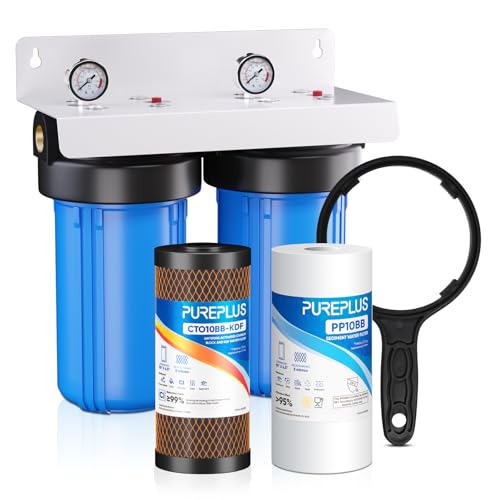
PUREPLUS 2-Stage PP Sediment & KDF Carbon System

PUREPLUS 2-Stage Chlorine, Iron & Manganese Filter
Taking A Closer Look At The Options
For households that mostly battle visible sediment, the PUREPLUS 5-micron 10-by-4.5 cartridge is a straightforward workhorse. Sold as a two-pack, it drops into most standard whole-house housings and goes to work catching sand, rust flakes, and silt that would otherwise cake faucet aerators and stain laundry. In homes with newly drilled or recently agitated wells, this kind of pre-filter does the unglamorous but essential job of protecting downstream equipment.
The 5-micron rating is a meaningful middle ground: finer than a 30-micron pleated screen, so it grabs more, but coarser than a 1-micron carbon block, so it doesn’t choke flow rates during peak morning demand. You may find it needs swapping more often in well water carrying heavy iron or organic load, but for routine sediment, the cadence is reasonable.
What Helps Most
- Dense honeycomb structure holds a meaningful amount of debris before flow drops noticeably.
- Universal 10-by-4.5 sizing fits most standard whole-house housings already on the market.
- Two-pack format means you always have a fresh cartridge ready when the first one loads up.
- Food-grade construction reduces concern about plasticizer leaching into potable water lines.
Trade Offs
- Won’t address dissolved iron, manganese, or sulfur odors that require dedicated media.
- Owners with high sediment loads commonly report shorter service intervals than the rated life suggests.
Feature Snapshot
Right Fit For
Homeowners with visibly cloudy or sandy well water who need an inexpensive first line of defense before installing any specialty media.
Swap It Out When
You discover staining or rotten-egg smells, in which case the Aquasure Fortitude V2 alone won’t help either, but a dedicated iron stage like the PUREPLUS 1-Stage Whole House Iron & Manganese System will.
Culligan has been a household name in water treatment for decades, and the P5A cartridge carries that reputation into a mainstream, easy-to-install drop-in filter. Rated to handle particles larger than 5 microns at a 4-GPM flow rate, it targets the same sediment class as the PUREPLUS cartridge above, with a focus on reducing chlorine taste and odor for homes where the well supply picks up trace treatment residuals from neighboring systems.
The 8,000-gallon rated life is generous for a standard household, though owners with particularly turbid wells will see shorter intervals. Compared to the PUREPLUS 5-micron, the Culligan trades some raw dirt-holding capacity for the brand’s wide service network and replaceable-cartridge availability.
Useful Highlights
- 5-micron sediment capture paired with chlorine taste and odor reduction in a single cartridge.
- 4-GPM flow rating supports typical two-bathroom household demand without pressure complaints.
- Wide Culligan compatibility simplifies sourcing replacements in rural areas.
Points To Note
- Heavily sedimented wells will plug the cartridge faster than the 8,000-gallon rating implies.
- Doesn’t address iron or manganese, so staining fixtures will need a separate dedicated stage.
Whose Shelf It Belongs On
Family homes that want a familiar, easy-to-source cartridge and don’t need specialty media for trace metals.
Look Elsewhere When
You suspect hydrogen sulfide or iron bacteria, where the PUREPLUS 2-Stage Clear Housing Iron & Manganese Filter handles both contaminants in one assembly.
The Aquasure Fortitude V2 takes the opposite approach from the two cartridges above: instead of trapping fine sediment in a dense melt-blown matrix, it uses a pleated 30-micron surface that catches large particles while letting water race through. The pleats dramatically increase surface area, which translates to longer service life and higher flow rates for homes that run multiple fixtures at once.
The washable and reusable design is the headline feature here. Rather than tossing the cartridge every few months, you rinse it under a faucet and reinstall, which keeps long-term ownership costs down for anyone with sediment-heavy well water.
Features That Help
- Reusable, rinse-clean construction cuts replacement frequency and ongoing cost.
- Pleated geometry maximizes dirt-holding capacity without choking flow.
- Large-size format suits whole-house pre-filtration at the point of entry.
Things To Consider
- 30-micron rating won’t catch the finer sediment that 5-micron cartridges like the PUREPLUS or Culligan trap.
- Pleated media requires occasional deep cleaning to prevent biofilm buildup in warm well applications.
Made For
Households with sand-heavy wells that want a low-maintenance first stage before a finer polishing filter.
Consider Something Else When
Your water shows orange staining rather than visible grit, in which case the PUREPLUS 1-Stage Iron & Manganese system targets the actual contaminant.
If your real complaint is orange toilet tanks and brown laundry streaks, the PUREPLUS 1-Stage system focuses on the actual culprit. Iron and manganese are dissolved metals that pass straight through ordinary sediment cartridges, which is why a specialized stage matters. This unit mounts on the main incoming line and protects downstream pipes, water heaters, and appliances from mineral buildup.
The single-stage design keeps installation approachable for homeowners comfortable with basic plumbing work. You won’t get carbon polishing or chlorine reduction here, but you’ll address the staining problem that sends most well owners searching for filtration in the first place.
Noteworthy Benefits
- Targets dissolved iron and manganese that bypass standard sediment cartridges.
- Point-of-entry mounting protects water heaters, boilers, and washing machines from mineral scale.
- Simpler installation footprint than full multi-stage assemblies.
Honest Caveats
- Won’t reduce sulfur (rotten-egg) odor on its own.
- Single-stage design means no carbon polishing for taste and odor improvements.
- Cartridges typically need periodic replacement depending on iron concentration.
Who Should Grab It
Homeowners who already know they have elevated iron from a water test and want a focused, point-of-entry treatment without a full multi-stage rig.
Skip It When
Your water tests show both iron and chlorine byproducts, where the PUREPLUS 2-Stage Chlorine, Iron & Manganese Filter combines both targets in one assembly.
Housings are usually the boring part of a filtration setup, but the clear PUREPLUS housing turns cartridge replacement from guesswork into a glance. The transparent sump lets you see the cartridge inside, so you know exactly when sediment has built up and the filter needs swapping. A built-in pressure gauge adds a second visual cue: when the needle climbs, flow is starting to choke.
The 1-inch NPT inlet and outlet match standard whole-house plumbing, which simplifies installation for DIYers comfortable with PEX or copper transitions. You supply the cartridge separately, so this is a frame waiting for the right media.
The Case For It
- Transparent sump removes the guesswork from cartridge replacement timing.
- Integrated pressure gauge helps diagnose flow restrictions before they become obvious.
- Standard 1-inch NPT connections fit mainstream whole-house plumbing layouts.
Softer Spots
- Housing only; you still need to purchase a compatible cartridge separately.
- Clear plastic requires occasional exterior cleaning in high-UV or outdoor installations.
Best Suited To
DIY-minded homeowners who want visual confirmation of cartridge condition and appreciate the diagnostic value of an integrated gauge.
Where Another Pick Suits Better
You’d rather buy a complete working system out of the box, in which case the PUREPLUS 2-Stage Grooved Sediment & KDF System arrives ready to install with cartridges included.
When you want a single purchase that handles sediment, chlorine, odor, and a range of heavy metals, the PUREPLUS 2-Stage assembly delivers a layered defense. The first stage uses a grooved PP10GBBD sediment cartridge with three layers of graded density, meaning the outer 10-micron layer catches larger debris, the middle 7-micron layer catches medium particles, and the inner 5-micron layer catches the fines. The second stage pairs a 5-micron KDF (kinetic degradation fluxion) and activated carbon block to address chlorine and trace metals.
Two pressure gauges, one per housing, let you track differential pressure across each stage independently. For most well-water homes this is the kind of monitoring that prevents surprise loss of flow during heavy-use mornings.
Useful Strengths
- Three-density grooved sediment cartridge captures more debris before loading up.
- KDF and carbon stage targets chlorine, odor, and trace heavy metals in addition to sediment.
- Dual pressure gauges simplify maintenance timing for each stage.
A Few Limitations
- More complex than a single-stage setup, so installation takes longer.
- KDF media can interact with high-chloramine municipal blends differently than with private wells.
Who Will Love This
Well owners who want broad-spectrum treatment in one assembly and don’t mind a slightly more involved install.
Reach For A Different Pick When
Your water test shows clear iron staining, where the PUREPLUS 2-Stage Clear Housing Iron & Manganese Filter uses dedicated iron-reduction media in the second stage instead of KDF.
Where the clear housing above offers visual monitoring, this opaque PUREPLUS 10-by-4.5 housing focuses purely on plumbing fundamentals. The standard 1-inch NPT connections and familiar dimensions make it a drop-in replacement for aging housings or a blank canvas for a custom filtration stack.
Like the clear model, a built-in pressure gauge helps you catch flow restrictions early. Opaque construction is fine for most installations where the housing sits out of sight anyway, and the bracket pattern fits standard mounting hardware.
A Few Highlights
- Standard 10-by-4.5 form factor accepts the widest range of cartridges on the market.
- Pressure gauge included for routine flow monitoring.
- Industrial-spec design suitable for both residential and light commercial plumbing.
Room For Improvement
- Housing only; cartridge sold separately and must be sourced to match your water profile.
- Less diagnostic value than the transparent housing when troubleshooting sudden pressure drops.
Perfect Match For
Plumbers and hands-on homeowners building a staged system with off-the-shelf cartridges and a dedicated bypass loop.
Not Your Match When
You want a turnkey system, in which case the PUREPLUS 2-Stage Grooved Sediment & KDF System arrives with cartridges pre-paired and ready to mount.
Iron and manganese rarely travel alone. This 2-stage assembly pairs a multi-layer sediment-and-carbon pre-filter with a dedicated iron and manganese reduction cartridge, then wraps both in clear housings so you can see the media darken as it loads. The visual feedback is genuinely useful because iron media can look fine on the outside while the inside is exhausted.
The first stage is IAPMO R&T certified to NSF/ANSI 42, which covers material safety and chlorine reduction claims. That’s a meaningful assurance for any filter plumbed into potable lines.
A Favorable Mix
- Two transparent housings give direct visual feedback on cartridge condition.
- NSF/ANSI 42 certification on the first-stage sediment-carbon cartridge covers material safety.
- Dedicated iron and manganese stage targets the most common well-water staining culprits.
Potential Drawbacks
- Iron-reduction cartridges are consumables that may need more frequent replacement than sediment-only stages.
- Clear housings will discolor over time with iron exposure, though the view of the cartridge remains.
Who It Suits Best
Homes with confirmed iron levels where the owner wants to watch media loading and stay ahead of cartridge fatigue.
Another Choice May Suit
You mainly need sediment pre-filtration in a budget build, where the Aquasure Fortitude V2 washable pleat handles the pre-stage at lower long-term cost.
The PUREPLUS PP Sediment & KDF Carbon System sits between the dedicated iron models and the broader grooved-sediment assembly. A 5-micron polypropylene first stage handles sediment and is certified by IAPMO R&T to NSF/ANSI 42 for material safety, while the second-stage carbon block polishes taste and odor. KDF media within the carbon block extends its reach into heavy-metal reduction, which matters for some well profiles.
This is a balanced pick for households that want cleaner drinking and bathing water without committing to specialty iron media.
Standout Benefits
- Polypropylene first stage is lightweight, corrosion-free, and NSF/ANSI 42 certified for material safety.
- KDF-augmented carbon block improves taste and targets heavy metals.
- Replacement cartridges are designed for straightforward annual swap-outs.
Where It May Fall Short
- Not optimized for high-iron wells where dedicated iron media performs better.
- Two-stage pressure drop will be slightly higher than a single 5-micron housing.
Built With In Mind
General-purpose well households that want cleaner water throughout the home and care about taste improvement.
A Better Fit Elsewhere
Your staining problem is severe and confirmed by testing, where the PUREPLUS 2-Stage Clear Housing Iron & Manganese Filter dedicates the second stage specifically to those metals.
Closing the list is the most all-purpose of the 2-stage systems: a sediment and carbon first stage paired with a dedicated iron-reduction second stage. The PP10BB-CC multi-layer first filter reduces chlorine, taste, odor, sand, rust, and sediment, while the second stage focuses specifically on iron and manganese levels.
For households that want one assembly to address the broadest range of common well-water complaints, this is a logical final stop. The trade-off is that no single media inside is specialized as deeply as the dedicated iron or the dedicated carbon systems.
Positive Points
- Covers sediment, chlorine, taste, odor, iron, and manganese in one purchase.
- First stage IAPMO R&T certified to NSF/ANSI 42 for material safety.
- Dual-stage design simplifies installation compared to assembling separate units.
Trade-Offs To Consider
- Jack-of-all-trades design means iron-staining cases may need heavier media than the second stage provides.
- Replacing two cartridges each cycle costs more than maintaining a single sediment filter.
The Right Fit
Homeowners who want a complete system to address multiple contaminants without buying separate housings for each.
Where A Sibling Pick Shines
Your well water is largely sediment-only, where the Aquasure Fortitude V2 washable pleat handles the pre-stage at lower ongoing cost and maintenance effort.
Choosing The Right Setup For Your Well
Your well water’s actual profile should drive the decision, not the size of the box it ships in. The most expensive mistake is buying a carbon-heavy system when the real problem is dissolved iron that bypasses carbon entirely, or grabbing a sediment cartridge when the staining on your fixtures tells you the issue is mineral-based. A basic water test from a county extension office or mail-in kit costs little and removes most of the guesswork.
Match your filter to the contaminant. Sediment cartridges (like the PUREPLUS 5-micron or Aquasure Fortitude pleat) target visible grit. Carbon and KDF stages pull out chlorine, taste, and odor. Iron and manganese need dedicated reduction media because those metals are dissolved, not suspended. If your well produces sulfur smell, look for systems combining oxidation and carbon stages.
Flow rate matters more than people think. Whole-house filtration on a 1-inch main line running two showers and a dishwasher simultaneously demands cartridges that won’t choke under peak load. Multi-stage assemblies introduce more pressure drop, so gauge-equipped housings become genuinely useful for tracking when media loads up.
Sizing And Flow Considerations
Houses with larger families or multi-bath layouts place higher demand on whole-house filtration during morning and evening peaks. A single-stage 5-micron cartridge on a 1-inch line can usually keep up, but adding a second stage introduces roughly 4 to 8 psi of additional pressure drop under load. If your well pump already runs near its capacity ceiling, that drop will show up as disappointing shower pressure.
Installation And Maintenance Reality
Most PUREPLUS and Aquasure housings in this list are designed for homeowners comfortable with basic plumbing. Bypass loops and pressure-relief steps aren’t optional, though: failing to depressurize a housing before opening it is the most common cause of cracked sumps. Plan on changing sediment cartridges every 3 to 6 months and carbon stages every 6 to 12 months, depending on usage and water quality.
When To Upgrade
If your well produces heavy iron staining, rotten-egg odor, or visible biological growth, single-stage filtration won’t be enough. That’s the moment to move into a 2-stage or 3-stage system with dedicated specialty media, or to layer an oxidation tank ahead of the filter bank. For most households without extreme contamination, a well-matched 1- or 2-stage system is plenty.
Key Considerations Across These Picks
Mistakes Worth Dodging
The single most common slip is buying a sediment-only filter when the real problem is dissolved iron. Sediment cartridges look impressive as they darken with rust flakes, but the iron that’s staining your toilet and laundry passes right through. Test your water first, and pick media that matches the contaminant you actually have.
Another trap is ignoring pressure drop in multi-stage systems. Stacking three housings on a 1-inch line can quietly halve flow during peak demand, which then shows up as disappointing shower pressure that gets blamed on the well pump.
Where The Extra Money Goes
Higher-tier 2-stage systems spend the extra dollars on dedicated specialty media and dual pressure monitoring. Instead of a general-purpose carbon block, you get KDF-augmented carbon or a separate iron-reduction cartridge. Instead of one housing and a guess, you get two gauges that tell you exactly when each cartridge needs swapping.
That upgrade pays off most when your water test confirms multiple contaminants, especially iron paired with chlorine or odor issues. For a single-contaminant situation, the premium tier is harder to justify on performance alone.