

The water that flows through your home should be the least worry in your day, but for anyone dealing with chlorine-heavy municipal supply, metallic well water, hard scale on fixtures, or growing concern about PFAS (per- and polyfluoroalkyl substances, a class of synthetic “forever chemicals” linked to long-term health risks), the right whole-home system changes the daily feel of a house. Showers stop leaving skin dry, coffee tastes cleaner, and the white buildup on faucets softens. The picks below cover sediment-only setups, scale defense, heavy-metal targeting, iron and manganese correction, and the tougher PFAS reduction many households now want, so you can match a system to the water you actually have.
A Quick View Of The Lineup

Aquaboon 3-Stage Whole House Water Filter System with Pressure Gauge
iSpring WGB21B 2-Stage Whole House Water Filtration System

iSpring WGB21B-DS 2-Stage Anti-Scale Whole House Water Filter System
iSpring WGB21B-KS 2-Stage Heavy Metals Whole House Water Filter System
iSpring WGB21B-PB 2-Stage Lead & Chloramine Whole House Water Filter System

iSpring WGB21BM 2-Stage Carbon Block and Iron & Manganese Filter System

iSpring PFAS Whole House Water Filter System WGB21B-PF

iSpring WGB32B-KDS Ultimate Protection Whole House Water Filter System

Aquaboon 10×4.5 Whole House Water Filter Housing

iSpring WGB21B-CPB 2-Stage Cadmium, Mercury, Lead Water Filter System
The Strengths Of Each Pick
The Aquaboon 3-stage system is the kind of unit you point a homeowner at when they want clean water without overthinking it. Three 10-inch by 4.5-inch canisters stack vertically and the included mounting bracket keeps the assembly tidy against a basement wall or utility-room stud.
What separates this from a single-stage housing, like the Aquaboon 10×4.5 reviewed later, is the staged approach: a pleated sediment cartridge catches rust, silt, and dirt before a carbon block pulls chlorine and a polyphosphate stage helps with scale prevention. For most city-water households dealing with cloudy ice and stiff laundry, that combination covers the bases without an oversized footprint.
Features That Help
- Three-stage layout handles sediment, chlorine, and basic scale in one assembly.
- Pressure gauge on the manifold lets you see when a cartridge is clogging before flow drops.
- Included wrench and bracket mean installation hardware is in the box.
- Standard 10-inch by 4.5-inch cartridges keep replacement costs familiar and easy to source.
Things To Consider
- This setup targets general sediment and chlorine rather than specific contaminants like PFAS or lead.
- Plastic canisters hold up well but do require periodic checks for O-ring (the rubber sealing gasket inside the cap) wear during cartridge swaps.
- For very high sediment loads, the pleated cartridge may need replacing sooner than expected.
Who It Suits Best
Budget-conscious households on municipal water who want a tidy three-stage setup for general improvement of taste, odor, and sediment.
Where Another Pick Suits Better
If your water report shows meaningful lead or mercury, the iSpring WGB21B-KS 2-Stage Heavy Metals Whole House Water Filter System targets those with KDF (kinetic degradation fluxion, a copper-zinc media that exchanges electrons to neutralize metals) media instead.
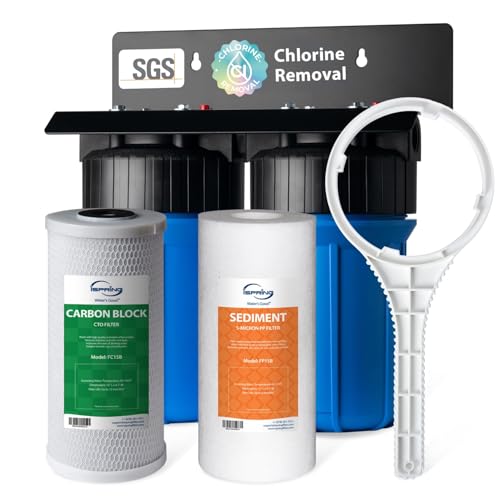
The iSpring WGB21B is the workhorse of this list, and in our view the natural starting point for someone choosing among the lineup. It is a 2-stage setup with a 50,000-gallon capacity rating, which for an average four-person home drinking and showering translates roughly to a full year between filter changes.
The first stage uses a 5-micron polypropylene sediment filter (FP15B) to catch dirt, sand, and rust. The second stage is a CTO (chlorine, taste, odor) carbon block, where coconut-shell carbon (a finer, denser carbon form known for higher contaminant adsorption than coal-based carbon) tightens up taste and odor. Unlike the Aquaboon 3-stage above, this setup is more focused: fewer canisters, less wall space, and a single function done well.
Good Reasons To Consider
- Coconut-shell carbon construction delivers stronger chlorine and VOC (volatile organic compound) adsorption than generic carbon.
- 50,000-gallon capacity keeps annual maintenance to roughly one set of cartridges.
- Removes more than 90 percent of chlorine according to the manufacturer, which shows up as better-tasting coffee and clearer ice cubes.
- The 2-stage layout is approachable for first-time installers with basic plumbing skills.
Points To Keep In Mind
- Standard 1-inch inlet and outlet ports mean you may need a reducer if your home plumbing uses different sizing.
- Does not address scale, iron, or specific heavy metals, so households with those issues should look at the variants.
- For very large families with high daily consumption, the cartridge may need swapping sooner than the rated capacity.
Right Fit For
City water households seeking a focused chlorine and sediment filter that installs in a weekend and stays out of the way afterward.
Consider Something Else When
You need scale protection for water heaters and fixtures, in which case the iSpring WGB21B-DS 2-Stage Anti-Scale Whole House Water Filter System handles that with its anti-scale second stage.
Hard water is a stubborn problem, and that white crust on showerheads and the chalky film on glassware is calcium and magnesium precipitating out of solution. The iSpring WGB21B-DS swaps the standard second-stage carbon block of the WGB21B for an anti-scale polyfilter, and that single change redirects the system’s purpose.
The first stage still pulls chlorine and improves taste using the same CTO carbon block. The second stage uses a polyphosphate (FWDS80K) that conditions hard-water minerals so they pass through plumbing without bonding to surfaces, helping water heaters and fixtures last longer.
The Case For It
- Anti-scale polyfilter protects water heaters, dishwashers, and showerheads from mineral buildup.
- Same proven CTO carbon block as the WGB21B handles chlorine and taste in stage one.
- Patented scale inhibitor formulation also stabilizes chlorine to reduce pipe corrosion.
- Standard 10-inch footprint keeps replacement cartridges widely available.
Trade Offs
- Anti-scale filtration does not soften water, so you may still want a separate softener for very hard supplies.
- No dedicated media for iron, lead, or PFAS beyond the carbon stage.
- Polyphosphate performance can vary with very hot water usage, since the treatment is temperature-sensitive.
Built With In Mind
Homeowners in hard-water regions who want to extend appliance life and reduce scale without committing to a full salt-based softener system.
Look Elsewhere When
Your water has iron staining alongside hardness, in which case the iSpring WGB21BM 2-Stage Whole House Water Filtration System is the better fit with its iron and manganese reducing cartridge.
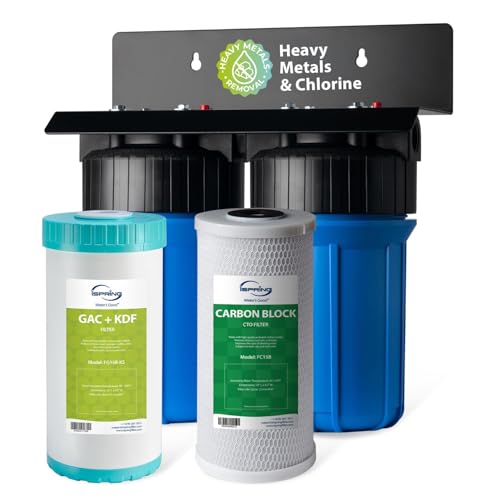
Lead and mercury rarely show up on a municipal water report with a friendly number, but older homes with original copper or lead service lines can leach them into the supply anyway. The iSpring WGB21B-KS is the system’s response to that worry, layering KDF media on top of carbon block.
The first stage is a CTO carbon filter. The second stage uses KDF-55 (a copper-zinc alloy filter media that reduces contaminants through electrochemical reaction) paired with GAC (granular activated carbon, loose carbon pellets rather than a compressed block) to target heavy metals. According to the manufacturer, the unit is rated to remove up to 99 percent of contaminants including chlorine, lead, and mercury, addressing both chemical and metallic concerns in one stack.
What Stands Out
- KDF-55 media exchanges electrons with dissolved metals, neutralizing lead and mercury on contact.
- Up to 99 percent contaminant reduction claim covers cloudiness, bad taste, and foul odors alongside metals.
- 2-stage design keeps wall space modest for a utility room or basement corner.
Where It Is Less Suited
- KDF media performs best on water that enters above a minimum temperature, so installation near a hot-water line can shorten cartridge life.
- Higher media density means slightly more pressure drop (the reduction in water pressure that occurs as flow passes through filter media) than a pure carbon setup.
- Does not specifically target PFAS compounds, which is where the WGB21B-PF later in this roundup differs.
Best Suited To
Well-water households in regions with elevated heavy-metal readings, and city-water homes with aging service lines that may contribute trace lead.
Skip It When
PFAS is your primary concern rather than metals, since the iSpring PFAS Whole House Water Filter System WGB21B-PF is purpose-built for that category.
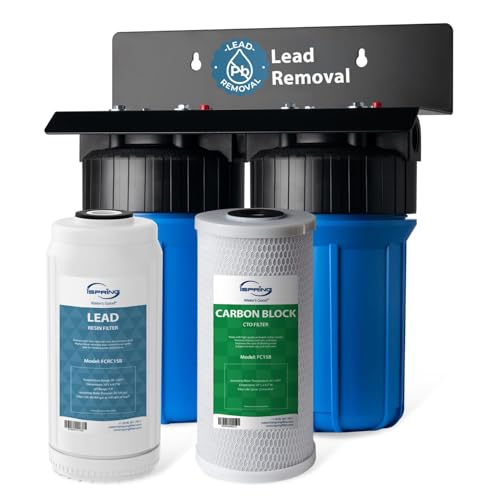
Chloramine is a disinfectant many utilities now use instead of chlorine because it lasts longer in the distribution system, but standard carbon blocks are less effective against it. The WGB21B-PB addresses both that and lead in a single 2-stage unit, which is why we point families with young kids toward it.
The first-stage CTO carbon block handles cloudiness and taste. The second stage uses an FCRC15B lead removal cartridge rated for 50,000 gallons of lead-loaded water, reducing lead from elevated levels down toward the EPA drinking-water action level.
Notable Upsides
- Specialized lead-reduction cartridge targets a contaminant standard carbon often misses.
- Effective against chloramine, the persistent disinfectant many municipal systems have adopted.
- 50,000-gallon cartridge life keeps annual maintenance simple for a family of four.
A Few Limitations
- Does not address scale, iron, or PFAS, so homes with broader profiles need a different pick.
- Higher cartridge cost compared to standard carbon replacements.
- Lead reduction performance assumes periodic cartridge replacement; skipping changes reduces effectiveness.
Made For
Homes with older plumbing and families wanting explicit lead-reduction performance from a whole-home point-of-entry system (a filter installed on the main supply line so all water entering the house is treated).
Swap It Out When
You want broad heavy-metal coverage including cadmium and mercury, where the iSpring WGB21B-CPB 2-Stage Whole House Water Filtration System delivers a wider contaminant profile.
If your well water leaves orange streaks in the toilet bowl and black stains on sidewalk pavers, that is iron and manganese oxidizing in the air, and standard carbon will not catch it. The iSpring WGB21BM exists specifically for that problem.
The first stage uses the same CTO carbon block as the rest of the family. The second stage is an FM15B iron and manganese reducing cartridge rated for iron up to 3.0 ppm down to 0.01 ppm and manganese up to 1.0 ppm down to 0.01 ppm, a meaningful range for typical well water in the U.S.
Notable Gains
- Dedicated iron-and-manganese reduction media tackles staining at the source.
- Same reliable CTO carbon block as the WGB21B handles taste and odor upstream.
- 1-inch inlet and outlet ports keep installation straightforward for most residential plumbing.
Soft Spots
- Iron and manganese media can require more frequent backflushing or replacement in high-mineral wells.
- Does not target PFAS, lead, or mercury specifically.
- Performance depends on the actual dissolved iron and manganese levels, which a recent well-water panel can confirm.
Whose Shelf It Belongs On
Well-water homes with visible staining, metallic taste, or a recent water report showing iron above 0.3 ppm or manganese above 0.05 ppm.
Reach For A Different Pick When
Your main concern is hard-water scale rather than metal staining, where the iSpring WGB21B-DS 2-Stage Anti-Scale Whole House Water Filter System fits better.
PFAS is the category that has moved from research papers to kitchen-table conversations, and the iSpring PFAS Whole House Water Filter System is one of the few whole-home units purpose-built for it. SGS is an independent testing organization, and SGS-tested performance claims are typically stronger than unverified marketing copy.
The 2-stage unit combines a sediment pre-filter with a specialty cartridge rated to remove up to 99 percent of PFAS, PFOA (perfluorooctanoic acid), and PFOS (perfluorooctane sulfonate). PFOA and PFOS are two specific PFAS compounds that were widely used in nonstick coatings and firefighting foam, and they are the ones most water utilities now test for.
A Favorable Mix
- Targets PFAS, PFOA, and PFOS specifically, where most carbon-block systems fall short.
- Independent SGS testing gives the performance claim more weight than marketing copy alone.
- Standard 10-inch cartridges and 1-inch ports keep replacement parts and install familiar.
Honest Caveats
- PFAS-rated cartridges cost more per replacement than standard carbon blocks.
- PFAS reduction requires timely cartridge changes; older cartridges lose adsorption capacity.
- Does not address iron, manganese, or scale, so homes with those issues still need a layered approach.
Who Should Grab It
PFAS-conscious households, especially those near military bases, airports, or agricultural regions where PFAS contamination shows up on regional water reports.
Not Your Match When
Your concern is metals rather than PFAS, since the iSpring WGB21B-KS 2-Stage Heavy Metals Whole House Water Filter System focuses specifically on lead and mercury.
The WGB32B-KDS is the system’s answer to households that do not want to choose between scale, chlorine, and metal concerns. It is a 3-stage unit, which means a taller wall footprint than the WGB21B family, but it covers more ground in one assembly.
It uses the FWDS150K anti-scale filter to sequester calcium and magnesium, the KDF media for metal reduction, and carbon for taste and odor. The patented scale inhibitor also forms a protective layer inside metal pipes, which helps with corrosion in older plumbing.
Useful Strengths
- 3-stage design layers sediment, anti-scale, and KDF media in one manifold.
- Anti-scale inhibitor helps protect water heaters and fixtures from mineral buildup.
- Manufacturer video walkthroughs and a detailed manual make installation approachable for a competent DIYer.
Where It May Fall Short
- Larger footprint than 2-stage systems, so closet installations need planning.
- More cartridges means more recurring replacement cost.
- PFAS reduction is not the headline capability here; that lives with the WGB21B-PF.
Perfect Match For
Households with mixed-quality source water who want scale protection plus metal reduction in a single point-of-entry install.
A Better Fit Elsewhere
You only need a focused 2-stage chlorine and sediment setup, in which case the iSpring WGB21B 2-Stage Whole House Water Filtration System keeps things compact and lower-maintenance.
Not every whole-home water setup needs a sealed cartridge stack. The Aquaboon 10×4.5 is a single-stage housing, an empty canister plus bracket, gauge, and wrench, that lets you choose whichever 10-inch cartridge fits your water profile.
The housing is NSF (NSF International, an independent body that certifies products meet public-health standards) certified, which gives some assurance about material safety under pressure. It uses reinforced polypropylene for the housing body and includes a pressure gauge so you can read flow resistance at a glance.
Real-World Strengths
- NSF certification covers material safety, which is meaningful for any filter under constant pressure.
- 1-inch NPT (National Pipe Thread, the standard tapered thread used for plumbing connections) ports match common residential plumbing.
- Cartridge flexibility lets you swap sediment, carbon, or specialty media without replacing the housing.
Small Caveats
- Single-stage means single-function; you handle only one contaminant group per housing.
- Cartridge is not included, so plan for an extra purchase to actually run water through it.
- For complex contaminant profiles, you may end up stacking multiple housings, which raises cost.
Who Will Love This
DIYers and custom-build homeowners who want a flexible housing for specialty cartridges and are comfortable sourcing filters separately.
Where Another Pick Suits Better
You want a complete ready-to-install system with cartridges included, where the Aquaboon 3-Stage Whole House Water Filter System ships with filters and a bracket in the box.
The WGB21B-CPB rounds out the list because it bundles a broader metal focus into a single 2-stage design. Where the WGB21B-PB targets lead specifically, this version broadens the second stage to cover cadmium and mercury too.
The first stage is a 5-micron polypropylene sediment filter, fine enough to catch particles that would otherwise clog the metal-reduction media downstream. The second stage is an FC15B-PB lead removal cartridge rated for 50,000 gallons and capable of reducing up to 99 percent of lead per the manufacturer.
The Good Stuff
- Multi-metal focus covers lead, cadmium, and mercury in one cartridge pair.
- 5-micron sediment pre-filter protects the specialty media and extends cartridge life.
- 1-inch inlet and outlet ports fit standard residential plumbing without reducers.
Less Ideal Details
- Does not target PFAS or scale, so homes with those issues still need additional filtration.
- Multi-metal cartridges cost more than single-contaminant replacements.
- Real-world heavy-metal reduction depends on incoming concentration, which a recent water panel confirms.
The Right Fit
Mixed-contaminant homes, particularly those with wells or older plumbing where lead, cadmium, or mercury could all show up on a report.
Another Choice May Suit
Your single biggest concern is PFAS rather than metals, in which case the iSpring PFAS Whole House Water Filter System WGB21B-PF targets that emerging category with SGS-tested performance.
What To Weigh Before Picking A Whole-Home Filtration System
Filtration starts with your water, not the marketing. A recent municipal water quality report (often posted online by your utility) tells you what the utility is dealing with, while a private well test tells you what is actually in your groundwater. Match the system’s specialty to the result: chlorine and sediment for city water, iron and manganese for orange-stained wells, KDF media for metal-heavy reports, and PFAS-rated cartridges where forever chemicals are a concern.
Flow rate matters more than people expect. Whole-home filters must keep up with simultaneous showers, laundry, and a running dishwasher. A 1-inch inlet and outlet port keeps pressure drop modest on most residential mains, while undersized ports can noticeably reduce flow at peak times.
Cartridge replacement cadence drives long-term cost. A 50,000-gallon cartridge sounds convenient, but in a four-person household it still needs swapping roughly once a year. Factor replacement cartridge cost into the decision, not just the unit price.
Installation reality: most 2-stage and 3-stage units install on the main supply line after the pressure tank or water meter. Basic plumbing skills cover the work, but shutoff valves, a drain for the initial flush, and adequate clearance above the housing for cartridge swaps are worth planning for. The included bracket and wrench on the Aquaboon 3-stage, or the gauge and bracket on the Aquaboon housing, are small details that save an extra trip to the hardware store.
Certification and transparency: NSF certification on the housing material adds assurance that the canister is safe under constant pressure. Independent testing claims, like the SGS-tested PFAS reduction on the WGB21B-PF, are worth more than unlabeled marketing language.
Smarter Moves Before You Buy
Mistakes Worth Dodging
The most common slip is choosing a filter by stage count alone. Three stages of sediment, carbon, and polyphosphate sounds thorough, but those stages only address general improvement, not PFAS or lead. Look at what each stage actually targets and match it to your water report. Another trap is ignoring cartridge cost: a low-priced unit can carry expensive replacements that outpace the unit itself over five years. Pull the cartridge model number before committing and check the price.
Where The Extra Money Goes
Higher-tier systems, like the 3-stage WGB32B-KDS or the PFAS-focused WGB21B-PF, charge more because the media is more specialized. KDF, anti-scale polyphosphate, and PFAS-rated carbon all cost more per cartridge than basic carbon block. That premium buys narrower contaminant targeting and longer effective life per cartridge, so for households with a specific water profile the upgrade pays off in performance. For households with mild chlorine and sediment only, that same money spent on the WGB21B delivers better everyday value.
Frequently Asked Questions
How long do whole-home water filters typically last?
Most carbon-block cartridges in this list are rated for around 50,000 gallons, which in an average four-person home works out to roughly twelve months. High-sediment or high-iron water can shorten that window noticeably.
Do whole-home filters reduce water pressure?
Any filter adds some pressure drop, but a properly sized 1-inch inlet and outlet port on most of these units keeps it modest. Pressure gauges on the manifold make it easy to see when a cartridge is clogging.
Can I install one of these myself?
Most 2-stage and 3-stage units install with basic plumbing tools and a clear spot on the main supply line. If you are not comfortable cutting into the main or soldering fittings, a licensed plumber is the safer call.
Are these systems the same as water softeners?
No. Filtration systems remove sediment, chlorine, metals, and PFAS, but anti-scale polyphosphate stages only condition minerals. A traditional salt-based softener is still the right choice if you want truly soft water.
Will one of these remove all contaminants from my water?
No single whole-home system targets every possible contaminant, which is why matching the filter to your specific water report matters. The right pick depends on what your water actually contains.
The Takeaway
Choosing among the best whole home water purification systems comes down to your water report and the contaminants you actually want to address. Sediment and chlorine are easy wins for almost any home, while scale, iron, lead, and PFAS each call for a more specific stage or media. The Aquaboon 3-stage and iSpring WGB21B remain smart general-purpose starting points, and the WGB21B-PF, WGB21B-KS, and WGB21BM are there when the water report points to PFAS, heavy metals, or iron. Match the system to your water, keep up with cartridge swaps, and the daily feel of every tap in your house improves.




