Tap water tells different stories depending on where you live. Some homes pull from a municipal plant with mild chlorine aftertaste, others run on wells that carry iron stains or sulfur smells. Hard water leaves scale on kettle walls and shower glass, while older plumbing can leach trace metals nobody wants to think about. Picking the right filter means matching your actual water problem, not chasing the most stages on a spec sheet.
The nine systems below cover the most common scenarios: whole-house treatment for general clarity, specialty media for heavy metals and iron, point-of-use reverse osmosis (a process that forces water through a semi-permeable membrane to strip out dissolved contaminants) for drinking-water polish, plus a couple of supporting parts and pre-filters that round out a complete setup.
The Leading Options At A Glance

Express Water Whole Home Filter System, Essential Protection, 3-Stage

Express Water Whole House Filter System, Heavy Metal, 3-Stage

Express Water Whole House Filter System, Iron & Manganese, 3-Stage

Express Water Whole House Filter System, Ultimate Protection, 3-Stage

Express Water Whole House Filter System, Anti-Scale, 3-Stage

Fortitude V2 Series 30 Micron Pleated Sediment Filter

Elkay Strainer for Elkay/Halsey Taylor 55996C
VIVA21 5-Stage Reverse Osmosis System with Lead-Free Faucet
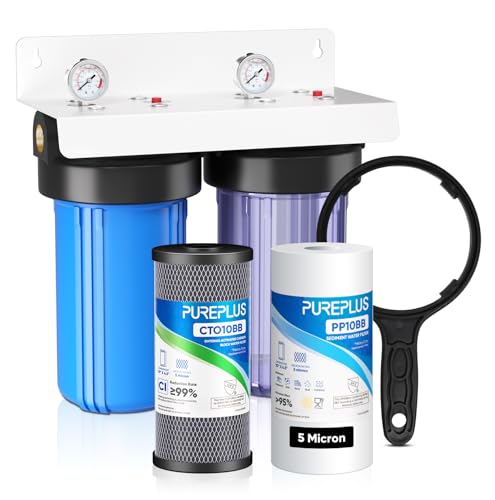
PUREPLUS 5 Micron 2-Stage Whole House Filter, Clear Housing
The Details Behind The Selections
The Essential Protection setup is the sensible starting point for most city-water households. It runs water through a sediment stage, a carbon stage, and a polishing stage, which together handle the complaints people notice first: chlorine taste, faint odor, and the cloudiness that shows up in a clear glass. For renters and first-time homeowners, the appeal is straightforward: install it where the main line enters, and every tap and appliance downstream gets treated at once.
Where the Essential really fits is mid-sized homes with municipal water that meets safety standards but tastes off. A 3-stage design means cartridge swaps land on a predictable schedule, and replacement filters are widely available. You may find the flow rate drops slightly when filters near the end of their life, so set a calendar reminder.
Strong Points
- Whole-house coverage means filtered water at the shower, washing machine, and kitchen tap, not just one drinking faucet.
- Three-stage design addresses the everyday complaints: sediment, chlorine, and taste, without specialty media overkill.
- Wide compatibility with standard housings makes finding replacement cartridges simple in most markets.
- Installation at the main line is a familiar job for most plumbers, keeping setup costs reasonable.
Things To Consider
- This setup targets general water quality and won’t address iron staining, heavy metal concerns, or hardness; that is a job for the specialty picks below.
- Filter changes must happen on schedule. Owners commonly report forgetting the swap and wondering why the water tastes off again.
Who It Suits Best
City-water households with mild taste and odor complaints who want one system to cover the whole home without specialty media.
Look Elsewhere When
You pull from a well with iron staining, in which case the Express Water Iron & Manganese 3-Stage is the more focused answer.
The Heavy Metal version swaps in KDF (kinetic degradation fluxion) media, a copper-zinc alloy that uses a redox (oxidation-reduction) reaction to neutralize dissolved metals like lead, mercury, and copper. It still uses the same 3-stage architecture as the Essential model, so the plumbing footprint stays familiar. For homes built before modern plumbing codes, that media upgrade is the whole point.
You benefit most from this system in older houses with original copper or galvanized lines, or in well-water regions where trace metal content is a known concern. Pair it with a sediment pre-filter to keep the KDF media from clogging on silt. The honest read is that the Heavy Metal is a niche tool: it does one focused job very well, and the cost jump over the Essential is justified only if that job is on your list.
Everyday Advantages
- KDF media specifically targets dissolved heavy metals that carbon alone misses.
- Whole-house design protects showers and skin contact, not just drinking glasses.
- Same 3-stage housing format as the Essential model, which keeps spare parts and replacement schedules simple.
- Redox reaction also helps reduce chlorine and some sulfide odors as a side benefit.
Worth Noting
- KDF media is sensitive to high iron levels; if your well tests above a few parts per million of iron, a dedicated iron filter is the better first stage.
- Cartridges cost more than the Essential’s, and the specialty nature means replacements are less interchangeable with off-the-shelf filters.
Made For
Homeowners in older properties or anyone with a water report showing elevated trace metal content who wants whole-house protection.
Swap It Out When
Your main complaint is hard-water scale on fixtures; the Express Water Anti-Scale 3-Stage is purpose-built for that.
If you have ever pulled a white shirt from the wash and found orange streaks, or watched the toilet bowl turn rusty around the waterline, iron is the suspect. The Iron & Manganese 3-Stage is built for that exact problem. It uses specialty oxidation media (a treated material that forces dissolved iron to convert into a filterable solid) to convert those dissolved metals into particles the sediment stage can catch and flush out.
The profile here is narrow: well owners and households on surface-fed systems with documented iron and manganese content. Compare that to the Essential model, which is built for general improvement; this one targets a specific chemistry problem with a specific chemistry answer. You should know your well’s test results before committing, because the wrong media wastes money without solving anything.
A Few Strong Suits
- Specialty oxidation media tackles both iron and manganese, which often appear together in well water.
- Whole-house coverage means fixtures, laundry, and appliances all stop collecting rust stains.
- Modular design lets you add pre-filters downstream if sediment loading becomes a concern.
Honest Caveats
- Without a proper well-water test, you are guessing. Owners commonly report overspending on this system when the actual problem is sulfur bacteria or a different mineral.
- High iron levels shorten cartridge life noticeably, and replacement media runs pricier than standard carbon stages.
Right Fit For
Well owners with confirmed iron or manganese staining on plumbing and laundry who want whole-house correction.
Where Another Pick Suits Better
If your real issue is metallic taste rather than visible staining, the Express Water Heavy Metal 3-Stage pairs better with your symptoms.
The Ultimate Protection Pro is the “do most things at once” tier. What separates it from the rest of the Express Water family is the included spin-down sediment pre-filter with a 50-micron stainless mesh screen, reusable and designed to catch sand, silt, and large debris before it reaches the specialty cartridges downstream. That single addition can double the life of the carbon and polishing stages.
For homes where the source water is unpredictable (seasonal well turbidity, construction in the neighborhood, or a dead-end main line that collects sediment) the pre-filter earns its keep. It also gives you a visual indicator of incoming water quality, since the clear bowl shows what you are catching. In most situations, that early intervention justifies the step up from the Essential model.
A Strong Showing
- Spin-down pre-filter is reusable, which cuts long-term consumable costs.
- Pre-filtration protects the specialty cartridges, stretching their service life noticeably.
- Same 3-stage architecture as siblings, so swapping configurations later is straightforward.
- Clear sediment bowl makes it easy to see when cleaning is needed, no guesswork.
Trade Offs
- The pre-filter adds physical footprint and an extra drain point, so installation space matters.
- You may find the upfront cost higher than the Essential, and the ROI shows up only if your water carries meaningful sediment.
Feature Snapshot
Best Suited To
Homeowners with sediment-prone municipal or well water who want longer cartridge life and a visible early-warning indicator.
Not Your Match When
You are renting or have very limited wall space near the main shutoff; the standalone Fortitude V2 Pleated Sediment Filter is a leaner pre-filter option.
Hard water does not pose a health risk, but it is relentless on the home. Scale builds up inside water heaters, on showerheads, and inside appliance valves until efficiency drops and parts fail early. The Anti-Scale 3-Stage uses template-assisted crystallization (TAC) media, which converts dissolved hardness minerals into microscopic crystals that stay suspended instead of sticking to surfaces. You keep the minerals; you just stop them from plating your plumbing.
Where this makes sense is regions with moderately hard water, anything above about 7 grains per gallon of hardness, where a full salt-based softener feels like overkill. It pairs well with households that want scale control without the salt-brine maintenance. Compared to the Essential, the focus is narrower: this is about protecting appliances and fixtures, not polishing drinking water.
Points In Its Favor
- TAC media reduces scale buildup without adding sodium to the water, an option for anyone avoiding salt softeners.
- Whole-house coverage protects water heaters, dishwashers, and shower glass from mineral deposits.
- No electricity or drain line required, simplifying installation compared to traditional softeners.
Practical Considerations
- TAC media reduces scaling but does not soften the feel of water the way ion-exchange softeners do.
- For very hard water, the system may need a larger media tank to keep up with household demand.
Who Will Love This
Homeowners in hard-water regions who want to extend appliance life and reduce cleaning without the maintenance of a salt-based softener.
Reach For A Different Pick When
Your water report shows hardness above 15 grains per gallon, in which case a dedicated salt-based softener or a more aggressive anti-scale system may be needed.
The Fortitude V2 is a single-stage sediment filter, not a complete water treatment system. What it does, it does well: a 30-micron pleated polyester element (a folded fabric sheet that maximizes surface area) catches sand, dirt, rust flecks, and silt while maintaining high flow rates for whole-house use. The pleats increase the surface area, which means more dirt-holding capacity before cleaning is needed.
You drop this in front of another filter system to extend the life of the more expensive cartridges downstream, or you use it on its own when sediment is the only real complaint. The reusable design is a quiet advantage: rinse it out, put it back, and skip the recurring cartridge cost. Compared to the Ultimate Protection’s built-in pre-filter, this is a dedicated standalone unit for households that want heavy sediment handling without a multi-stage system.
The Case For It
- Washable, reusable element eliminates ongoing cartridge purchases for the sediment stage.
- 30-micron rating catches visible particles while maintaining high flow for whole-house demand.
- Pleated design extends dirt-holding capacity, so cleaning intervals are longer than flat filters.
Room For Improvement
- Removes only sediment; does not address chlorine, metals, or hardness, so it usually needs a partner system.
- Larger housing requires dedicated mounting space near the main entry point.
Perfect Match For
Well owners and homes with heavy sediment who want a reusable pre-filter in front of a polishing or carbon system.
Where A Sibling Pick Shines
For an all-in-one solution with pre-filtration already built in, the Express Water Ultimate Protection 3-Stage covers more ground in one package.
This is a small part with a specific job. The Elkay strainer is an OEM (original equipment manufacturer) replacement component for Elkay and Halsey Taylor water coolers, designed to fit the 55996C model. It is the kind of piece you only know about if you have already diagnosed a slow trickle from your cooler and traced the problem to a clogged strainer.
The honest read is that this belongs on the list for a narrow reason: it is the correct part, not a generic substitute. For anyone maintaining a water cooler in a school, office, or home gym, that specificity matters. It is not a home-wide filtration system, but for the coolers it fits, it is the right answer.
Reasons It Performs
- OEM fit for Elkay and Halsey Taylor 55996C coolers, no modification needed.
- Restores flow rate when slow water is caused by strainer clogging rather than valve failure.
Some Limits To Know
- Not a standalone filtration system; addresses one specific component in one specific cooler model.
Built With In Mind
Facilities managers and homeowners maintaining an Elkay or Halsey Taylor cooler (excluding EZ and HTV models) who need a direct replacement strainer.
Skip It When
You need whole-house or point-of-use water treatment, in which case any of the other picks on this list will serve a different purpose entirely.
Reverse osmosis is the heavy lifter of drinking-water treatment, and the VIVA21 5-Stage pushes water through a sediment pre-filter, a carbon block, the RO membrane itself, and a post-carbon polish before sending it to a dedicated storage tank and lead-free faucet. The membrane is where the work happens: it strips out dissolved solids, fluoride, and a wide range of contaminants that carbon alone cannot catch.
What sets this system apart from generic RO kits is the WQA Gold Seal certification (a third-party mark verifying that the system meets specific NSF/ANSI standards for contaminant reduction and material safety), aligned to NSF/ANSI 58 for RO performance and NSF/ANSI 372 for lead-free construction. It also includes a leak detector, which addresses the single most common RO failure mode: a slow drip at a fitting that nobody notices until the cabinet floor swells. For households that want bottled-water quality from the kitchen tap, this is the focused answer.
Where It Helps
- 5-stage process delivers a level of purification that whole-house systems do not attempt.
- WQA Gold Seal certification offers independent verification of performance claims.
- Lead-free faucet and dedicated storage tank make the system self-contained under the sink.
- Leak detector adds a layer of protection against the most common installation issue.
Points To Keep In Mind
- RO systems produce wastewater (typically 3-4 gallons of reject water per gallon of purified water), which is worth knowing for conservation-minded homes.
- Under-sink installation takes up cabinet space and requires a dedicated feed line, so it is not a quick swap.
- Membrane and post-carbon filters need periodic replacement, a recurring cost beyond the initial install.
Key Specs
The Right Fit
Homeowners focused on drinking-water quality who want certified performance and the convenience of bottled-style water at the kitchen tap.
Consider Something Else When
You want every tap in the house treated, since RO only polishes water at one point; the Express Water Ultimate Protection 3-Stage covers the whole home instead.
The PUREPLUS 2-Stage is a compact whole-house setup aimed squarely at municipal water. It uses a 5-micron sediment cartridge paired with a 5-micron carbon block (coconut-shell carbon in the source spec), housed in clear housings that let you see when a filter needs changing. The pressure gauges on top are a small but practical touch, showing the differential pressure that tells you a cartridge is loading up before the water flow drops.
Where this lands is homeowners who want whole-house chlorine and sediment reduction without a multi-stage rack on the wall. The clear housings are a quiet benefit for first-time installers who want to see what their filter is catching. Compare that to the Express Water Essential, which targets the same audience with three stages; the PUREPLUS trades a stage for a smaller footprint and visible filter status, which is a fair trade in a tight utility room.
Good Reasons To Consider
- Clear housings make filter status visible at a glance, no guessing about cartridge life.
- Pressure gauges provide early warning before flow drops, simplifying maintenance timing.
- Standard 10″x4.5″ cartridges are widely available, keeping replacement costs low.
A Few Limitations
- Two-stage design does not address heavy metals, iron, or hardness, so it is a focused tool rather than a complete treatment system.
- Clear housings can yellow over time with UV exposure, a cosmetic issue that does not affect performance.
Feature Card
Whose Shelf It Belongs On
City-water households on a budget who want reliable chlorine and sediment reduction with a simple, compact installation.
Another Choice May Suit
If your water has heavy sediment or you want the longest possible cartridge life, the Fortitude V2 Pleated Sediment Filter is a stronger pre-filter stage.
What Matters Most Before Choosing Water Filtration Systems For Home
Match The System To The Water, Not The Other Way Around
The single biggest decision is whether you need whole-house coverage or point-of-use treatment. Whole-house systems treat every drop entering the home, which protects showers, laundry, and appliances. Point-of-use systems like reverse osmosis only polish water at one faucet, but they go deeper on the contaminants that matter for drinking. Most homes benefit from a layered approach: a whole-house system for general improvement plus a dedicated drinking-water filter at the kitchen tap.
Test Your Water Before You Buy
A municipal water report (usually published annually by your utility) or a private well-water test tells you what you are actually filtering. Buying a heavy-metal system to fight iron staining wastes money, and buying an anti-scale system when the real problem is sulfur bacteria accomplishes nothing. For well owners, a basic panel that checks iron, manganese, hardness, pH, and total dissolved solids covers the common scenarios.
Think About Maintenance, Not Just The Initial Install
Every cartridge-based system has a recurring cost and a recurring task. Filter life depends on water quality and household usage, so households with heavy sediment or four-person demand go through cartridges faster than a single-occupant apartment. Build a reminder system, whether that is a phone alert, a calendar entry, or a marker on the housing, so the swap happens before water quality slips. Pre-filter systems that include reusable elements cut long-term cost but still need periodic cleaning.
Size And Placement Matter
Whole-house systems mount at the main entry, before the water heater, and they need vertical clearance, a drain nearby (for some configurations), and enough wall space to accommodate housings plus a shutoff valve. Measure twice before ordering, and confirm the connection size (most residential mains are 1″ NPT, but older homes can vary). Tight utility rooms may rule out the larger 3-stage systems, in which case a compact 2-stage with clear housings is the practical fit.
Key Considerations Across These Picks
Pitfalls Shoppers Hit
The most common mistake is buying a system based on stage count rather than water chemistry. A 5-stage system that targets the wrong contaminants does no better than a 2-stage that targets the right ones. Another trap is forgetting the recurring cost: cartridges and membranes add up over years, and the initial price tells only part of the story. Always confirm replacement filter availability and price before committing to a system.
Where The Extra Money Goes
Higher-tier whole-house systems earn their step-up pricing with two things: reusable pre-filters that protect the more expensive cartridges downstream, and housing that holds larger media volumes for longer service life. On the point-of-use side, paying more typically buys third-party certification (NSF/ANSI 42, 53, 58, or 372), better fittings, and leak detection hardware. If your water report shows nothing exotic, the value tier covers the basics well; if you have specific contaminants to address, the premium tier’s media and build quality show up in longer cartridge life and fewer service interruptions.
Frequently Asked Questions
How Often Do Whole-House Filter Cartridges Need Changing?
Most standard cartridges need replacement every 3 to 6 months under typical household use, though pre-filters in heavy-sediment homes may need attention sooner. Higher-capacity specialty cartridges can last 6 to 12 months, but the schedule depends on your actual water quality and gallons per day.
Can A Whole-House Filter Remove Hardness?
Standard carbon and sediment filters do not soften water. For hardness, you need template-assisted crystallization media, ion-exchange salt-based softening, or reverse osmosis at a single tap. The Express Water Anti-Scale system uses TAC media as one option, but very hard water often calls for a dedicated softener.
Is Reverse Osmosis Necessary If I Already Have A Whole-House Filter?
Not always, but the two technologies do different jobs. Whole-house filters improve taste, odor, and sediment across every tap, while reverse osmosis strips dissolved solids and contaminants that carbon alone misses. Homes on municipal water with no specific concerns can usually skip RO, but households on well water or with known contamination issues benefit from the extra polish.
Do These Filters Reduce Water Pressure?
A well-maintained system should not noticeably affect pressure, but filters near the end of their service life restrict flow as they load up. That is the most common cause of pressure complaints, and the fix is a cartridge swap. The pressure gauges on the PUREPLUS 2-Stage make that timing easier to see.
Are These Systems Do-It-Yourself Friendly?
Basic 2-stage and 3-stage systems with push-fit or threaded NPT connections are within reach for homeowners comfortable with basic plumbing. Larger multi-stage racks, dedicated drain lines, and under-sink RO installations lean toward professional installation, especially if you are not comfortable soldering copper or working with compression fittings on a live main line.
Bottom Line
The right water filtration system depends entirely on what is in your water and where you need it treated. Most city-water households get the most value from a 2- or 3-stage whole-house system for general improvement, with an optional reverse osmosis unit at the kitchen tap for drinking-water polish. Well owners and homes with specific chemistry problems (iron, hardness, heavy metals) need specialty media matched to those problems. Match the system to your water report, build a maintenance reminder into your routine, and the right setup should run quietly for years.