

Weak shower trickle. Sputtering garden hose. A washing machine that takes forever to fill. A booster pump solves all of that without replacing your plumbing. Inline models sit quietly in the line, push water harder, and keep pressure steady across every fixture. The trick is matching the pump’s horsepower, flow rate, and pressure ceiling to your home’s actual demand. This roundup breaks down nine strong picks, from whole-house variable-speed workhorses to compact on-demand diaphragm pumps, so you can pick the one that fits your setup.
A Fast Comparison Of The Options

Red Lion RL4A 4-Gallon Well Pressure Tank

80 PSI 115V Whole House Booster Pump

MixBubole 1.35HP Variable-Speed Booster

Moonshan 1HP 80PSI Variable-Speed Pump

Truper 1/6 HP Pressurizing Pump

Moonshan 70 PSI Variable-Speed Pump
Moonshan 3/4HP 1050GPH Booster

Verbesserte 110V 4.0 GPM Diaphragm Pump

FlowFluid 110V 4 GPM Diaphragm Pump
A Deeper Look At The Lineup
The Red Lion RL4A isn’t a booster pump in the strict sense, but it’s the partner piece every well-driven booster needs. It pairs with your existing well pump to store pressurized water and smooth out demand spikes, which reduces how often the pump cycles on and off. Think of it as a buffer tank: the well pump fills it, and the booster pulls from it. That’s why well-system households tend to add one of these early in the upgrade chain.
It ships pre-charged, which cuts setup time, and the heavy-duty 20-gauge steel shell is built for years of basement or utility-room duty. The 304 stainless steel water connection uses a patented leak-safe design, and the butyl rubber diaphragm inside holds its shape across thousands of cycles. For homes pulling from a private well, this tank is the quiet workhorse that keeps pressure consistent.
Standout Benefits
- Pre-charged at the factory, so installation skips the air-charge step most tanks demand
- 20-gauge steel exterior resists dents in tight mechanical rooms
- 304 stainless connection with leak-safe design reduces fitting failures
- Butyl rubber diaphragm flexes cleanly across thousands of fill cycles
- Certified for potable water, so it slots into domestic supply lines without extra treatment
- Reduces pump cycling, which extends motor life on paired well pumps
Worth Noting
- This is a pressure tank, not a booster, so it must be paired with a pump to actually raise PSI
- Four-gallon capacity runs short for homes with high simultaneous demand
Made For
Well-system households looking to stabilize pressure and extend pump life, especially when paired with one of the boosters further down this list.
Consider Something Else When
You need actual pressure lift, not buffering; in that case the czobloik 80 PSI model does the lifting on its own.
Czobloik’s 80 PSI booster lands in the sweet spot for most municipal-supply homes. City water arrives at decent volume but often disappoints on pressure, and this unit targets that exact problem. It runs on standard 115V household current, so there’s no special wiring or sub-panel to install, and the self-priming design helps it move water efficiently even when supply-side pressure dips.
The integrated panel lets you dial in pressure settings to match what your fixtures actually want. In a two-bath home where the shower goes limp whenever someone runs the dishwasher, that adjustability matters more than raw horsepower. The robust body keeps things steady through daily use, though it’s not the quietest pick on this list.
Advantages To Know
- Self-priming structure gets water moving without manual priming steps
- Built-in control panel allows pressure tuning without opening the unit
- Standard 115V plug-in cuts the need for an electrician
- Handles whole-house flow for typical two-bath layouts
Room For Improvement
- Runs louder than water-cooled or variable-speed alternatives on this list
- Fixed-speed operation means it cycles on and off rather than ramping gently
Right Fit For
Suburban homes on city water where pressure drops noticeably during simultaneous fixture use.
Look Elsewhere When
Noise is a deal-breaker; the MixBubole variable-speed unit runs far more discreet thanks to water cooling.
The MixBubole V3-45 PRO is the over-achiever of this roundup. A 1.35HP permanent magnet motor spins up to 8000 RPM and adjusts on the fly to match demand, so pressure stays constant whether one faucet is running or three showers and the laundry are all going at once. For larger homes, multi-bath layouts, or properties where pressure swings drive you nuts, that constant-pressure behavior is the whole point.
Water-cooling technology keeps the motor’s surface temperature in check by letting the water it’s pumping flow through the housing. That approach drops noise output to roughly 30 dB, which lands closer to a quiet refrigerator than a typical booster. The 304 stainless steel internals also avoid the rust-cloud concerns that plague older cast-iron pumps, and the companion app gives you firmware updates and fault-code diagnostics remotely.
What It Does Well
- Variable-speed permanent magnet motor adjusts output to match real-time demand
- Water-cooling design drops running noise to around 30 dB
- Stainless steel internal construction keeps water clean and resists corrosion
- Wireless app support enables OTA firmware updates and fault diagnostics
- Cuts energy use notably compared to fixed-speed pumps in the same class
Trade Offs
- Higher upfront cost than simpler fixed-speed units
- Smart-app dependency adds a small learning curve for those who prefer manual controls
Quick Facts
Best Suited To
Larger households with multiple bathrooms and high simultaneous demand, especially where noise rules out traditional boosters.
Swap It Out When
You live in a smaller apartment and just need steady pressure for one or two fixtures; the Moonshan 70 PSI model is a quieter match for lighter loads.
Moonshan’s 1HP unit is the middle path between raw power and quiet operation. Precision pressure sensors monitor demand in real time, so the motor ramps up when a shower kicks on and eases back when nothing’s running. Maximum flow tops out around 1400 GPH with a head of 180 feet, and pressure can be dialed anywhere from 22 to 80 psi, which covers the realistic range most homes actually need.
That wide pressure window helps in mixed-use settings, especially homes that also feed a garden hose or run drip irrigation on the same supply. Compared to the MixBubole just above, this one trades app-based smarts for a more straightforward sensor-driven approach. For homeowners who want constant pressure without managing firmware, that’s a fair swap.
Benefits That Matter
- Real-time sensors adjust output so pressure holds steady across multiple fixtures
- Pressure range from 22 to 80 psi covers typical residential needs
- 1400 GPH maximum flow handles whole-house demand in mid-size homes
- 180-foot max head reaches upper floors and distant fixtures without strain
- Self-priming design simplifies installation
Points To Note
- Sensor calibration may need adjustment depending on incoming pressure swings
- Less insulated than water-cooled units, so it runs slightly louder than the MixBubole
Feature Snapshot
Perfect Match For
Mid-size households that want variable-speed comfort without app connectivity or premium-tier pricing.
Another Choice May Suit
Buyers who want app-driven diagnostics and the quietest operation; step up to the MixBubole unit.
Not every pressure problem needs a whole-house workhorse. The Truper 1/6 HP unit is built for targeted boosts: a single shower that loses force, a distant garden tap, a rooftop solar panel rinse-down. Its industrial plastic body keeps weight down and footprint tight, which matters in tight utility closets or workshop shelves where metal-booted pumps simply don’t fit.
With a 25 L/min flow ceiling and a 9-meter maximum height, expectations should match the spec sheet. This is a supplemental pump, not a primary supply mover, and owners who use it that way tend to be happiest. The 1/2″ NPT inlet and outlet also make it compatible with standard residential plumbing fittings.
Real Benefits
- Compact plastic body fits into small utility spaces where metal pumps won’t
- Standard 1/2″ NPT connections match common residential plumbing
- Simple 127V operation on standard household current
- Lightweight design makes wall-mounting or shelf placement realistic
Honest Caveats
- 1/6 HP output cannot support whole-house demand, only targeted boosts
- Plastic body is less durable than stainless or cast-metal alternatives under heavy use
- 9-meter max head limits how high or far it can push water
Who Should Grab It
Homeowners targeting one weak fixture or a single outdoor tap, rather than full household coverage.
Not Your Match When
You need pressure on every floor at once; the Moonshan 1HP variable-speed unit covers whole-house loads.
Moonshan’s 70 PSI variant is the gentler sibling of the 80 PSI model reviewed earlier. It uses a 500W permanent magnet motor, which sips less power and runs quieter than larger fixed-speed pumps, while still giving real-time pressure adjustment across a 22 to 73 psi window. Maximum flow sits around 1268 GPH with a 148-foot head, which is plenty for apartments, condos, and small single-family homes.
Pressure sensors track demand and ramp output accordingly, so you don’t get that harsh on-off cycling that louder boosters tend to produce. The lower pressure ceiling compared to the 80 PSI version is a deliberate trade; in most apartments, the mains pressure is already low enough that pushing beyond 70 psi would just stress older valves.
What Pays Off
- Lower power draw compared to higher-horsepower siblings in the same family
- Quieter operation thanks to permanent magnet motor design
- Pressure range of 22 to 73 psi suits apartment and condo supply lines
- 1268 GPH flow handles typical two-bath demand without strain
Potential Drawbacks
- 70 PSI ceiling may feel underpowered for taller homes with rooftop fixtures
- Smaller motor means longer ramp-up time on heavy simultaneous draws
Spec Overview
Whose Shelf It Belongs On
Apartment dwellers and small-house owners who want set-and-forget variable-speed behavior without paying for higher-tier capacity.
A Better Fit Elsewhere
Multi-story households with high ceiling fixtures; the Moonshan 80 PSI pump delivers more lift for those layouts.
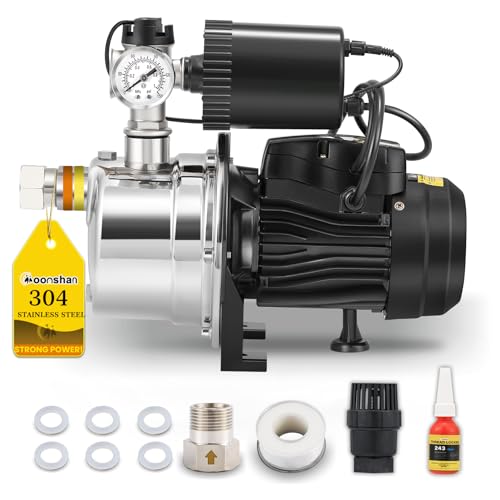
Moonshan’s 3/4HP pump wears two hats: booster and shallow well pump. A 304 stainless steel pump head replaces the cheaper cast-iron that tends to rust and cloud water, and a dual-switch design (water flow plus pressure detection) keeps the auto start-stop cycle from getting twitchy. For a small farm, large garden, or rural property with shallow well access, this hybrid role saves you from buying two separate units.
1050 GPH flow at 43 psi won’t match a 1HP dedicated booster, but it’s calibrated for outdoor and light whole-house duty. The auto on/off feature responds to actual demand rather than running continuously, which keeps wear in check during intermittent use. Owners commonly find the stainless head cleans up easily after a season of garden debris.
What Makes Sense
- Doubles as a shallow well pump, reducing equipment needs on rural properties
- 304 stainless pump head resists rust and corrosion over time
- Dual-switch auto start-stop avoids unnecessary cycling
- 1050 GPH flow supports lawn and garden irrigation
Some Limits To Know
- 43 psi ceiling is low compared to dedicated whole-house boosters
- Stainless head, while durable, adds weight over plastic alternatives
Who Will Love This
Rural homeowners and serious gardeners who want one pump to handle both indoor light use and outdoor watering.
Reach For A Different Pick When
Indoor-only pressure is the priority; the MixBubole variable-speed unit handles whole-house loads far more cleanly.
Diaphragm pumps trade raw horsepower for portability, and the Verbesserte 110V model leans into that trade hard. It delivers 4.0 GPM at up to 45 PSI with a 101-foot lift ceiling, which sounds modest until you remember it’s designed for RVs, boats, and small cabins rather than multi-bath homes. The plug-in 110V operation and onboard pressure switch mean you can move water with nothing more than a wall outlet.
Self-priming capability helps when the water source sits below the pump, and the diaphragm design runs quieter than centrifugal alternatives in this size class. For an RV shower, a boat wash-down setup, or a remote cabin sink, that balance of output and silence makes sense. Owners commonly use it for gardens too, though at 4 GPM it won’t fill a pool fast.
Points In Its Favor
- Compact diaphragm design fits in RV bays, boat lockers, and cabin utility nooks
- Self-priming for water sources below pump level
- On-demand pressure switch activates only when a fixture opens
- Quieter operation than comparable centrifugal pumps in the same size class
Where It May Fall Short
- 4.0 GPM and 45 PSI ceiling can’t drive whole-house residential demand
- Diaphragm components typically need replacement sooner than metal-impeller designs under heavy use
Perfect Match For
RVers, boaters, and cabin owners who need on-demand water pressure in a compact footprint.
Where A Sibling Pick Shines
Whole-house residential use calls for the Moonshan 1HP model, which carries far more flow and pressure.
FlowFluid rounds out the roundup with a 110V diaphragm pump that adds a built-in inline filter, which the Verbesserte above doesn’t carry. That filter screens sediment before it reaches the diaphragm, extending service intervals when your source water carries visible particulates. At 4 GPM and 45 PSI, the output profile mirrors the Verbesserte closely, but the inclusion of filtration gives it a practical edge for well or pond water use.
Self-priming up to a 100-foot lift handles below-source installations, and the plug-in 110V operation drops the barrier to entry. For an apartment kitchen that needs pressure boost on a single tap, a remote garden shed with a hose tap, or a small bathroom retrofit, this pump slots in without rewiring. Owners commonly report that the filter requires only occasional rinsing.
Notable Upsides
- Inline filter reduces sediment damage to internal diaphragm components
- Self-priming design works with below-source water supplies
- On-demand pressure switch responds to actual fixture use
- Plug-in 110V operation needs no special wiring
Possible Compromises
- 45 PSI ceiling limits use to single-fixture or low-demand scenarios
- Inline filter adds a maintenance step that pure-pump designs skip
Built With In Mind
Households drawing from well or pond water who need sediment screening along with pressure boost on a single fixture.
Skip It When
Whole-house coverage matters; the Moonshan 70 PSI unit covers small residential loads more completely.
What To Match Against Your Plumbing Before You Buy
Picking the right booster starts with reading your home’s pressure story before you read any product page. Grab a simple pressure gauge from a hardware store, attach it to an outdoor hose bib, and run the shower and a sink at the same time while you watch the needle. The number where it lands during peak demand is the real starting point. From there, the rest falls into place.
Horsepower And Flow Capacity
Horsepower (HP) on a pump describes motor strength, while flow rate (GPH or GPM) describes how much water moves per hour. These two numbers move together but aren’t identical. A 1.35HP motor can push more gallons per hour than a 1/6 HP unit, but the relationship isn’t linear because head height (vertical lift) eats into flow the higher you go. For a one-bath apartment, a 1/2HP to 3/4HP pump usually covers it. Two-bath homes generally want 1HP. Three or more baths push toward 1.35HP or higher.
Pressure Ceiling And Adjustability
Most homes are happy between 40 and 60 PSI at the fixtures, and codes often cap residential pressure around 80 PSI to protect aging pipes. Pumps with adjustable pressure windows let you match the output to your home’s needs without overshooting. Fixed-output units force the pressure tank or pressure relief valve to absorb excess, which adds wear. Variable-speed motors take this further by ramping up only when demand actually rises.
Noise And Cooling Method
Air-cooled pumps rely on fans and tend to run louder, especially as the motor works harder. Water-cooled designs route the pumped water through the motor housing to carry heat away, which drops noise output noticeably. For indoor utility rooms next to living space, that difference shows up every time someone showers at night. Permanent magnet motors tend to run quieter than traditional induction designs as well.
Build Materials And Maintenance
Stainless steel internals (particularly 304 grade) resist corrosion better than cast iron, which matters in continuous water contact. Butyl rubber diaphragms in pressure tanks hold their shape across thousands of cycles where cheaper rubber compounds can fatigue. Inline filters on diaphragm pumps cut down sediment damage but add a maintenance step. Plastic-bodied pumps cost less and weigh less but don’t tolerate heavy daily duty as well as metal builds.
Smart Considerations Across These Picks
Mistakes Worth Dodging
Choosing a pump with way more horsepower than your home needs wastes energy and may overshoot your pressure regulator’s setting. Conversely, undersizing leads to short-cycling, where the pump kicks on and off rapidly under low demand, which wears the motor and pressure switch. Check your incoming pressure first, then pick a pump that lifts you to the 50 to 65 PSI sweet spot without forcing you to crank it down. Also confirm that your electrical panel has a free 15- or 20-amp circuit, because even efficient pumps draw meaningful current on startup.
Where The Extra Money Goes
Higher-tier models in this roundup earn their keep through variable-speed motors, water-cooling, and stainless internals. Variable speed alone typically cuts energy use in half compared to fixed-speed pumps that cycle constantly. Water-cooling drops noise enough to install near living spaces. Stainless internals extend service life from a few years to a decade or more. The honest read is that spending up pays off most in homes where the pump runs frequently through the day, and less so in vacation properties or single-fixture scenarios where simple diaphragm pumps do the job.




