You probably don’t think about your furnace filter until the house feels stuffy, dust piles on the bookshelves, or allergy season kicks up. Picking the right replacement matters more than most people realize, since the filter you choose decides what actually stays trapped and what recirculates through every room. This list rounds up ten solid options across common sizes, MERV ratings, and budgets so you can match a filter to your home, your HVAC system, and the air quality issues you actually care about.
The Leading Options At A Glance

Honeywell FC100A1011 20x20x4 Pleated Air Filter MERV 11 (2-Pack)

LotFancy 20x25x1 Air Filter MERV 13 (4-Pack)

Filtrete 20x25x1 MERV 11 MPR 1000 (2-Pack)
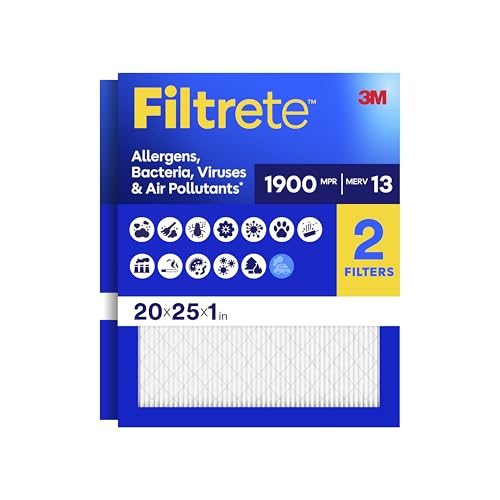
Filtrete 20x25x1 MERV 13 MPR 1900 (2-Pack)

CAL16 MERV 16 High-Performance Furnace Filter (16x25x5)

Wholesalehome FC100A1011 20x20x4 MERV 11 (2-Pack)

Filtrete 20x25x1 MERV 8 MPR 700 (4-Pack)

Trion Air Bear MERV 8 Pleated Furnace Filters (3-Pack)

Glasfloss ZL 20x25x2 MERV 10 (12-Pack)

Filtrete 20x25x1 MERV 5 MPR 300 (6-Pack)
Taking A Closer Look At The Options
This 4-inch deep pleated filter is built for homes with a Honeywell media cabinet rather than a standard 1-inch return grille. The actual footprint measures just under 20 by 20, so it slides straight into F25, F27, F35, and F100 series air cleaners without forcing.
If your HVAC already runs through a Honeywell media cabinet, this is the drop-in replacement the system was designed around. The MERV 11 rating (a scale where higher numbers capture smaller particles) hits a sweet spot for most suburban homes with light-to-moderate allergy concerns.
Everyday Perks
- Deep pleats hold more dust, so replacement stretches out to every 6 to 12 months for most households
- MERV 11 pulls in finer debris than a basic 1-inch filter, including pollen and many mold spores
- Bundle ships with a Same Day Supply reminder magnet, so you stop guessing when you last swapped it
- OEM-spec sizing (19-15/16″ x 19-3/4″ x 4-3/8″) keeps airflow steady inside the media cabinet
Things To Consider
- Only fits 20x20x4 housings, so renters with thin 1-inch slots need to look elsewhere
- Owners commonly report the cardboard frame can dent if you muscle it into a tight cabinet
Who It Suits Best
Homeowners running a Honeywell F-series media cabinet who want longer intervals between swaps.
Consider Something Else When
You have a thinner 20x25x1 grille and want allergen-grade capture, in which case the Filtrete 20x25x1 MERV 13 MPR 1900 fits better.
Where the first pick targets a thick media cabinet, this one is the 1-inch slot answer for shoppers chasing hospital-style filtration. The MERV 13 grade captures much smaller particles than the standard MERV 8 or MERV 11 filters you’ll find at most hardware stores.
Compare that to the Honeywell FC100A1011 reviewed earlier: similar particle capture, but in a slimmer housing for standard residential return grilles. The 4-pack covers a full year of replacements at the recommended 90-day cadence.
Reasons It Performs
- MERV 13 (equivalent to MPR 1500 / FPR 10, Filtrete’s home rating system) pulls in fine dust, smoke particles, and auto exhaust that lighter filters miss
- Actual dimensions of 19-3/4″ x 24-3/4″ x 3/4″ match standard 20x25x1 slots cleanly
- 4-pack stretches across an entire year for most households
Trade Offs
- Higher capture density can strain older blowers not rated for MERV 13, so check your system’s spec sheet before committing
- During peak pollen season or shedding pets, owners typically replace every 30 to 60 days instead of 90
Feature Snapshot
Made For
Allergy and asthma households running modern HVAC systems rated for higher MERV filtration.
Skip It When
Your blower or filter cabinet is older and the manual caps you at MERV 8, in which case the Filtrete 20x25x1 MERV 8 MPR 700 makes more sense.
Filtrete’s 3M-made MPR 1000 is the middle-of-the-road choice most homes default to. MPR (Microparticle Performance Rating) is Filtrete’s own scale; MPR 1000 lines up with MERV 11. This 2-pack handles pollen, pet dander, and household dust without bogging down a typical residential blower.
Where the LotFancy above pushes into MERV 13 territory, this filter threads a needle: stronger capture than the MERV 8 options later in the list, but less airflow resistance than MERV 13 pleats.
Where It Helps
- Balanced MERV 11 grade clears common allergens without choking standard 1-inch return grilles
- 3M electrostatic media captures particles across a wider range than basic fiberglass mats
- Actual 19.68″ x 24.68″ sizing fits standard slots with minimal gap
Points To Note
- 2-pack only covers roughly six months if you follow the 90-day cadence
- Pet-heavy homes tend to load the media faster than the rated interval
Right Fit For
Families with shedding pets who want a stronger daily filter than basic fiberglass without upgrading to MERV 13.
Look Elsewhere When
You need hospital-grade capture for a sensitive household, where the Filtrete 20x25x1 MERV 13 MPR 1900 is the better match.
Filtrete’s MPR 1900 sits at the top of the brand’s residential 1-inch line, hitting MERV 13 without the heavier pressure drop you usually see at that grade. MPR 1900 is Filtrete’s scale for the highest residential tier, capturing particles well below the range of MERV 11 picks.
Filtrete positions this as the highest-airflow option among MERV 13 1-inch filters. For households where one family member deals with asthma or respiratory irritation, the upgrade from MERV 11 is meaningful.
A Few Highlights
- MERV 13 capture grade for bacteria-carrier particles, fine mold spores, and pollen
- Designed to keep airflow competitive with lower-rated Filtrete models
- Actual 19.62″ x 24.62″ x 0.78″ dimensions fit standard 20x25x1 slots
Honest Caveats
- 2-pack runs out quickly during shedding season or wildfire smoke weeks
- You may find the upcharge worthwhile only if your HVAC blower can handle the added resistance
Quick Facts
Best Suited To
Sensitive respiratory households who want the strongest capture Filtrete offers in a 1-inch filter.
Reach For A Different Pick When
You want longer service life and accept slightly lower capture, in which case the Filtrete 20x25x1 MERV 11 MPR 1000 hits the middle ground.
The CAL16 jumps straight past the 1-inch options into whole-home air-purifier territory. MERV 16 falls into the H12 HEPA range (a hospital-grade standard), capturing the smallest particles most residential filters miss entirely. The 5-inch depth is built for whole-house air handler cabinets.
Compared to the Filtrete MERV 13 reviewed above, this is a different league. The annual replacement schedule and thicker cabinet point toward households that treat air quality as a primary concern.
What Pays Off
- MERV 16 capture grade approaches HEPA-class filtration for residential use
- Annual replacement schedule means fewer swaps than 1-inch filters
- Designed to balance high capture with manageable pressure drop
A Few Limitations
- Requires a 5-inch filter cabinet, so it won’t drop into a standard 1-inch return grille
- Annual cadence assumes standard residential use; heavy smoke or remodeling dust shortens the interval
Who Should Grab It
Homeowners with a 5-inch media cabinet and a real need for high-grade residential filtration.
A Better Fit Elsewhere
You only have a thin 1-inch slot and want cleaner air, in which case the LotFancy 20x25x1 MERV 13 (4-Pack) is a smarter match.
This Wholesalehome 2-pack is the aftermarket cousin to the Honeywell FC100A1011 reviewed earlier. It cross-references the Honeywell OEM part number and ships at a friendlier cost for the same 20x20x4 MERV 11 footprint.
If your home runs a Honeywell media cabinet and you don’t need a brand-stamped box, this lands as the practical swap. A microfiber cleaning cloth comes bundled, which is a small but useful touch.
Notable Gains
- Cross-compatible with Honeywell F25, F27, F35, F100, F150, and F200 media cabinets
- Actual 19.94″ x 19.75″ x 4.38″ sizing mirrors OEM spec for a snug cabinet fit
- Bundle includes a cleaning cloth for wiping down the cabinet frame on install day
Worth Bearing In Mind
- Some owners prefer OEM branding for warranty clarity, which this aftermarket pick doesn’t carry
- The bundled cloth adds little if you already keep microfiber around the house
Built With In Mind
Honeywell media cabinet owners who want OEM-spec performance at a more approachable cost.
Swap It Out When
Your cabinet is a 5-inch high-performance housing, in which case the CAL16 MERV 16 (16x25x5) is a stronger fit.
Filtrete’s MPR 700 hits MERV 8 with an electrostatic charge that pulls in pollen, lint, and dust without choking standard residential blowers. MPR 700 is one notch below the MPR 1000 reviewed earlier in this list.
If your HVAC owner’s guide caps you at MERV 8, this is the right ceiling filter for daily rotation. The 4-pack covers a full year on the recommended schedule.
What Makes Sense
- MERV 8 capture balances household dust and pollen with low airflow resistance
- Electrostatic pleats outlast basic fiberglass mats between swaps
- 4-pack covers about twelve months at the 90-day cadence
Soft Spots
- Won’t catch fine smoke, mold spores, or bacteria-carrier particles the way MERV 11 and up do
- Actual 19.88″ x 25.56″ length runs a touch longer than some other 20x25x1 picks, so check your slot depth
Whose Shelf It Belongs On
Owners of older HVAC systems rated for MERV 8 or lower who still want better-than-fiberglass capture.
Where A Sibling Pick Shines
You want stronger allergen capture in the same Filtrete 20x25x1 family, in which case the Filtrete MERV 11 MPR 1000 is the closer step up.
Trion’s Air Bear filters drop into the brand’s distinctive cube-shaped cabinet, which is a different geometry than the flat panels in most of this list. The pleated MERV 8 media captures lint, dust, and pollen for typical suburban homes.
Unlike the 1-inch picks above, this one only fits Trion Air Bear housings. If your HVAC was installed with that system, you’re locked into this filter family.
Points In Its Favor
- Made for the Trion Air Bear cabinet, which is a common setup in many newer subdivisions
- Pleated media holds more debris than flat fiberglass panels
- 3-pack covers most of the year on a quarterly cadence
Factors To Consider
- Not interchangeable with Lennox cartridges, so you need to confirm your cabinet brand before ordering
- MERV 8 capture won’t address smoke or fine allergen loads the way higher-rated picks do
Perfect Match For
Homeowners with a Trion Air Bear cabinet who need a clean drop-in replacement cartridge.
Not Your Match When
You don’t actually own a Trion system, in which case any standard 1-inch pick from this list, like the Filtrete MERV 8 MPR 700, fits a standard residential slot.
Glasfloss positions this 12-pack for property managers and homeowners who don’t want to think about filter orders for a long stretch. The 2-inch depth and galvanized metal backing make it more rigid than a typical 1-inch pleat.
Compare that to the Filtrete 4-pack reviewed earlier: same 20×25 footprint family, but thicker, more durable construction, and three times the supply in one box.
Standout Benefits
- 12-pack covers three years on the recommended 90-day cadence
- Galvanized metal frame adds rigidity for easier install and fewer crushed pleats
- MERV 10 capture bridges the gap between everyday MERV 8 and stronger MERV 11 options
Practical Considerations
- Requires a 2-inch slot, so standard 1-inch return grilles won’t accept it
- Bulk packaging takes up closet space if your filter storage is limited
Feature Card
Right Fit For
Multi-unit property owners and homeowners with 2-inch slots who want a long-lasting supply on hand.
Another Choice May Suit
You only need a single-year supply in a 1-inch slot, where the Filtrete MERV 11 MPR 1000 (2-Pack) is the more measured pick.
Filtrete’s MPR 300 lands at the entry of the brand’s residential line. MERV 5 captures the basics: lint, household dust, and the larger pollen grains that settle through the air before they get inhaled.
Compared to the MPR 700 reviewed earlier in the list, this trades meaningful allergen capture for the lowest pressure drop on the roundup. It’s the right pick when airflow matters more than fine particle defense.
Benefits That Matter
- Lowest pressure drop in this roundup keeps weak or older blowers moving freely
- 6-pack stretches across a year and a half on the standard 90-day cadence
- Standard 19.69″ x 24.69″ actual sizing fits common 20x25x1 slots
Possible Compromises
- MERV 5 won’t catch fine dust, smoke, or most allergen-carrier particles
- Pet-heavy homes will load the filter faster than the rated interval
The Right Fit
Rental properties, low-traffic homes, and HVAC systems that won’t tolerate higher MERV grades.
Look Elsewhere When
You have pets or allergy concerns at home, where the Filtrete MERV 11 MPR 1000 makes a noticeable difference.
What Matters Most Before Choosing Home Filters
Match The Filter To Your Slot
Before chasing the highest MERV rating, pull the existing filter out and check the actual printed dimensions on the frame. The nominal size on the label (like 20x25x1) is rounded up, while the actual size runs a fraction smaller so the filter slides into the slot without binding. MERV (Minimum Efficiency Reporting Value) is the rating scale that tells you how small a particle the filter can trap. A MERV 11 filter only works in a slot that physically accepts it; a tight squeeze stresses the blower and reduces airflow.
Right-Size The Capture Grade To Your Needs
MERV 5 to 8 handles everyday household dust and large pollen grains. MERV 11 to 13 picks up finer allergens, pet dander, and many mold spores, which is where most allergy households want to land. MERV 14 and up approaches HEPA-class filtration (the standard used in hospitals and clean rooms) and is overkill for most homes. Always confirm that your HVAC blower is rated for the MERV grade you’re buying, since denser media adds airflow resistance.
Factor In Replacement Cadence
Pleated MERV 11 and 13 filters typically run on a 60 to 90 day swap schedule for average households, faster during shedding season or wildfire smoke. Deeper 4-inch and 5-inch media cabinet filters stretch to 6 or 12 months. Buying in multipacks keeps you ahead of the curve and trims per-filter cost.
Key Considerations Across These Picks
Where Shoppers Go Wrong
The most common slip is grabbing the highest MERV number without checking the blower rating, which can starve the system of airflow and quietly drive up energy use. Another is buying a filter with the right nominal size but the wrong actual dimensions, leading to gaps around the frame where unfiltered air slips past. Measure twice, match the printed spec on the old filter, and your swap takes about thirty seconds.
When Paying More Pays Off
The jump from MERV 8 to MERV 11 or 13 is the meaningful one for most homes: finer allergen capture, smoke filtration, and noticeably less recirculated dust. Upgrading from MERV 13 to MERV 16 only pays off in homes with a 5-inch media cabinet and a real sensitivity story. For everyone else, the middle tier hits the right balance.
Frequently Asked Questions
How often should home filters be changed?
Standard 1-inch pleated filters typically need swapping every 60 to 90 days, while 4-inch and 5-inch media cabinet filters can run 6 to 12 months depending on household conditions.
What does MERV actually mean?
MERV stands for Minimum Efficiency Reporting Value, a scale from 1 to 16 that rates how small a particle a filter can capture; higher numbers trap finer debris but also restrict airflow more.
Can a higher MERV filter damage my HVAC system?
It can reduce airflow if your blower isn’t rated for it, which may stress the motor over time. Always check your system’s documentation before stepping up to MERV 13 or higher.
Are Filtrete MPR ratings the same as MERV?
Not exactly, but they map closely. MPR is Filtrete’s own scale tied to 3M testing, and MPR 1000 lines up with MERV 11, while MPR 1900 corresponds to MERV 13.
Do I need a media cabinet for thicker filters?
Yes, 4-inch and 5-inch filters only fit dedicated media cabinets that match their depth. Standard 1-inch return grilles won’t accept the deeper options on this list.
Wrap Up
The right home filter comes down to your slot, your blower, and the air quality issues you actually care about. Start by matching the printed dimensions on your current filter, confirm what MERV grade your HVAC can handle, then decide whether your priority is fine allergen capture or simply keeping dust down. Any of the picks above will do the job well if you swap it on schedule.